

Description
- Brand: ABB
- Full Model Number: GJR5253100R0270
- System/Series Family: ABB AC31 / Advant Controller 31
- One-Sentence Core Function: Ethernet-enabled AC31 PLC basic module combining CPU, local digital and analog I/O, CS31 bus, and network communications
- Top 3 Hardcore Specs: 24 digital inputs + 16 transistor outputs; 8 analog inputs + 4 analog outputs; 1,000 kB user program + 1,000 kB user data memory
- Stock Status: New surplus / fully tested refurbished, subject to exact inventory condition
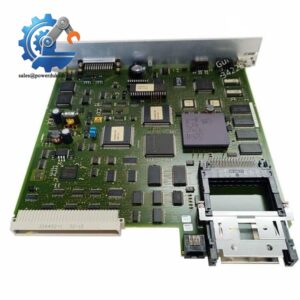
ABB identifies GJR5253100R0270 as 07KT98-ETH, with the catalog description 07KT98 Basic Module Ethernet AC31. ABB lists 0 to +55°C operating temperature, Ethernet TCP/IP, one CS31 bus, 24 digital inputs, 16 digital outputs, 8 analog inputs, 4 analog outputs, and 1,000 kB each for user program and user data.
Module 3: Commercial-Technical Deep Dive
A failed 07KT98 can affect far more than the PLC processor because this AC31 basic module carries local I/O and network functions in the same assembly. The ABB 07KT98-ETH GJR5253100R0270 combines 24 DC 24 V digital inputs, 16 DC 24 V transistor outputs, 8 configurable analog inputs, and 4 analog outputs, along with one CS31 bus and Ethernet TCP/IP. The analog inputs support voltage, current, and PT100 configurations, and ABB states that the analog channels can also be used as digital inputs. That integrated architecture makes an exact-match spare particularly valuable when maintaining an operating legacy AC31 installation.
The memory allocation is substantial for this controller generation: 1,000 kB user-program memory and 1,000 kB user-data memory, with user-program storage using Flash EPROM, non-volatile RAM, and SMC, while user-data storage uses Flash EPROM. ABB also specifies a 0.07 ms speed for 1,000 instructions under its stated 65% logic / 35% word test condition and a maximum hardware-counter input frequency of 50 kHz. Physical product data lists approximately 85 mm product depth and 1.62 kg net weight; the published packaged volume is about 5.775 dm³.
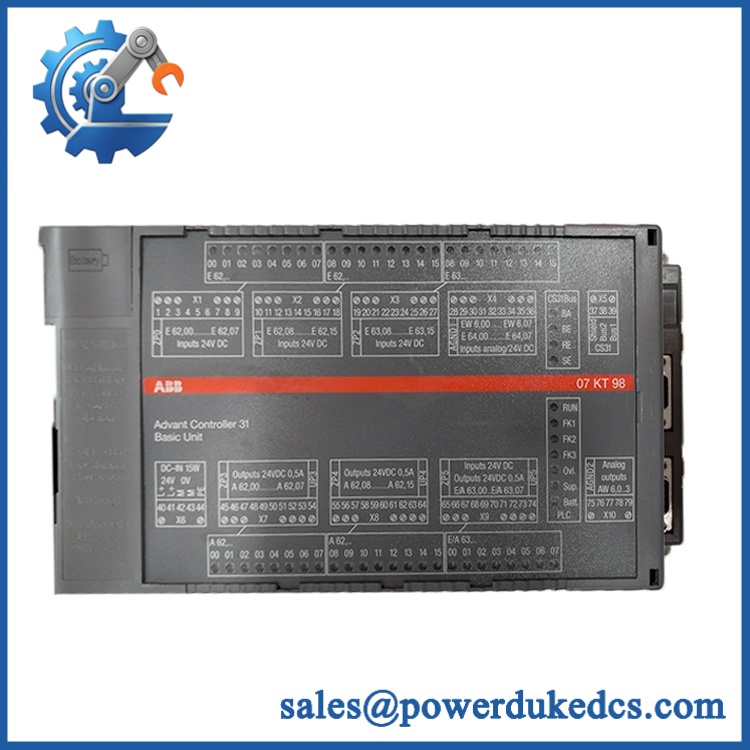
ABB 07KT98-ETH GJR5253100R0270
Module 4: Compatibility & Installation Traps
Migration/Compatibility
- Replacement type: ABB AC31 07KT98 Ethernet basic module / PLC CPU with integrated I/O.
- Firmware flash: May be required depending on the installed software revision and application state. A same-part replacement should still be checked against the existing project and controller configuration.
- Logic rewrite: Normally not required for a same-model replacement when the original application and configuration are available.
- Drop-in status: Generally suitable as a same-model replacement when the complete GJR5253100R0270 / 07KT98-ETH identification matches.
- Programming environment: ABB product data lists AC1131 as the programming software associated with the unit.
- Communications: Integrated Ethernet TCP/IP plus one CS31 bus. The unit also provides two RS232 interfaces according to ABB’s published product data.
ABB’s current replacement documentation is especially relevant to migration planning. It shows the legacy 07KT98 with 1 MB user-program memory, 1 MB user-data memory, 24 galvanically isolated digital inputs, and 16 galvanically isolated transistor outputs. ABB’s replacement architecture changes several of these details, including digital-input grouping and memory implementation, so a modern replacement should not be treated as an electrically identical substitute without checking the migration notes.
⚠️ Field Traps (Watch Out)
1. Do not confuse 07KT98 with the newer replacement adapter.
ABB’s current migration documentation explicitly compares the original 07KT98 with newer 07KT9x-AD replacement hardware and notes differences in memory and digital-input electrical isolation. A migration project therefore requires an I/O and electrical-interface review rather than a simple model-number substitution.
2. Verify the 24 VDC output loading.
The 16 digital outputs are specified at 24 VDC with 0.5 A output current. Check the actual load and common arrangement for each output group before reconnection. Do not treat 0.5 A as a universal rating across every load type or installation condition.
3. Back up the application before CPU replacement.
The 07KT98 stores both user program and user data. Capture the application, configuration, retained data, network parameters, and any site-specific setup before removing the original CPU. A replacement unit with the same catalog number does not guarantee that the customer’s existing application is already present.
4. Check analog-channel configuration carefully.
The eight analog inputs support multiple ranges and PT100 operation. A wrong channel configuration or incorrect transmitter wiring can produce plausible but incorrect process values, which is more dangerous than an obvious communication fault.
Module 5: Quality Assurance SOP
Each ABB 07KT98-ETH GJR5253100R0270 unit should pass a documented pre-shipment inspection sequence:
- OEM anti-counterfeit visual inspection: Verify ABB branding, 07KT98-ETH type designation, GJR5253100R0270 product ID, EAN/label format, connector arrangement, housing construction, and visible revision information.
- Part-number verification: Match the complete identifier against the purchase order and, where available, the installed controller BOM.
- Mechanical inspection: Check terminal blocks, pluggable screw terminals, connectors, mounting hardware, housing, ventilation openings, and signs of impact, corrosion, overheating, or unauthorized repair.
- Power inspection: Confirm the 24 VDC supply interface and inspect terminals and accessible circuitry before energization.
- Power-on self-test (POST): Power the 07KT98 in an approved test environment and verify expected startup behavior, system LEDs, diagnostic status, and absence of persistent controller errors.
- Digital I/O verification: Exercise representative or all accessible 24 VDC digital-input channels and 16 transistor outputs using an appropriate test fixture. Record channel-by-channel results.
- Analog I/O verification: Test the eight analog inputs using applicable voltage/current/PT100 simulation and verify the four analog outputs against calibrated measurement equipment.
- Communication handshake verification: Confirm Ethernet TCP/IP communication and verify CS31 bus operation with a compatible test configuration. ABB also documents two RS232 interfaces for programming, Modbus, and serial communication functions.
- High-speed input verification: Where the test fixture supports it, exercise the hardware-counter function within the documented 50 kHz maximum input frequency.
- Memory verification: Confirm normal controller initialization and verify access to the specified user-program and user-data memory areas without memory diagnostics.
- Final QC: Record serial/identification data, photograph the nameplate, retain the test report, protect terminals and connectors, and package the unit in ESD-safe material.
Module 6: CRO-Driven Buyer FAQ
1. What is ABB 07KT98-ETH ?
ABB identifies as 07KT98-ETH, a 07KT98 Basic Module Ethernet . It is an PLC basic module integrating CPU functions, local digital and analog I/O, CS31 communication, and Ethernet TCP/IP.
2. Can the 07KT98-ETH be hot-swapped?
Do not assume hot-swap capability. CPU replacement should be performed with the controller and connected field circuits isolated according to the applicable ABB maintenance procedure. Back up the application and verify the power state before removing the module.
3. Does replacing require a program download?
A same-model replacement does not inherently require application redevelopment, but the replacement CPU must contain or receive the correct project, configuration, retained data, and communication settings. Maintain a verified application backup before replacement.
4. What are the key I/O and performance specifications?
The 07KT98-ETH provides 24 digital inputs, 16 transistor outputs, 8 analog inputs, and 4 analog outputs. ABB lists 1,000 kB user-program memory, 1,000 kB user-data memory, a 50 kHz maximum hardware-counter input frequency, and 0.07 ms per 1,000 instructions under ABB’s stated benchmark conditions.
5. What warranty and technical support are provided?
Warranty duration should be stated on the quotation for the exact stock condition supplied. Technical support should cover part-number verification, controller configuration review, inspection/test records, I/O testing, and replacement guidance within documented system limits. Application redevelopment, field rewiring, and energized commissioning remain the responsibility of qualified controls personnel.


 Start Chat