

Description
- Model: AI815
- ABB Part Number: 3BSE052604R1
- Brand: ABB
- Series: S800 I/O
- Part Type: Analog Input Module with HART pass-through
- Core Function: Converts field voltage or current signals into digital process values for ABB control systems while providing current-limited transmitter power and HART communication pass-through.
- Key Specs: 8 channels, 12-bit resolution, 0–20 mA / 4–20 mA / 0–5 V / 1–5 V inputs, single-ended unipolar configuration, groupwise ground isolation, HART support, and approximately 10 ms update cycle time.
Product Introduction
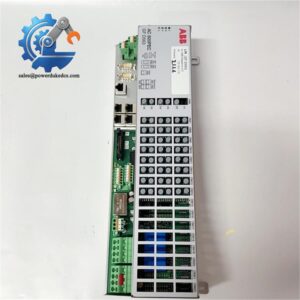
In an ABB S800 I/O installation, the AI815 3BSE052604R1 handles the analog interface between field transmitters and the control system. It accepts either current or voltage signals, digitizes the measurements, and passes the resulting process data to the host controller. ABB specifically identifies the unit as an 8-channel Analog Input HART module.
The module supports 0–20 mA, 4–20 mA, 0–5 V, and 1–5 V DC signals. Current and voltage inputs cannot be mixed on the same AI815, so the installed module configuration must be checked before connecting field wiring. (That detail is easy to overlook during a maintenance replacement.)
For transmitter-heavy process installations, the integrated current-limited transmitter supply is useful because the module can distribute HART-compatible supply power to 2-wire or 3-wire transmitters. HART communication is passed through the analog input channel rather than requiring a separate HART interface for basic pass-through applications.
Core Technical Specifications
| Parameter | Value |
|---|---|
| Manufacturer | ABB |
| Model | AI815 |
| ABB Article Number | 3BSE052604R1 |
| Product Type | Analog Input Module |
| I/O Family | S800 I/O |
| Number of Channels | 8 |
| Signal Type | Unipolar, single-ended |
| Current Inputs | 0–20 mA, 4–20 mA |
| Voltage Inputs | 0–5 V, 1–5 V DC |
| Resolution | 12 bit |
| HART | Yes, pass-through |
| SOE | No |
| Redundancy | No |
| High Integrity | No |
| Intrinsic Safety | No |
| Input Resistance — Voltage | >10 MΩ |
| Input Resistance — Current | 250 Ω |
| Channel Isolation | 1 group of 8 channels isolated from ground |
| Transmitter Supply | Current-limited, built in |
| Maximum Field Cable Length | 600 m / 656 yd |
| Update Cycle | 10 ms |
| Input Filter Rise Time | 290 ms, 0–90% |
| Maximum Error | 0.1% |
| Temperature Drift | Maximum 50 ppm/°C |
| NMRR at 50/60 Hz | >40 dB |
| Rated Insulation Voltage | 50 V |
| Compatible MTUs | TU810V1, TU812V1, TU814V1, TU818, TU830V1, TU833, TU835V1, TU838 |
| Mounting System | S800 |
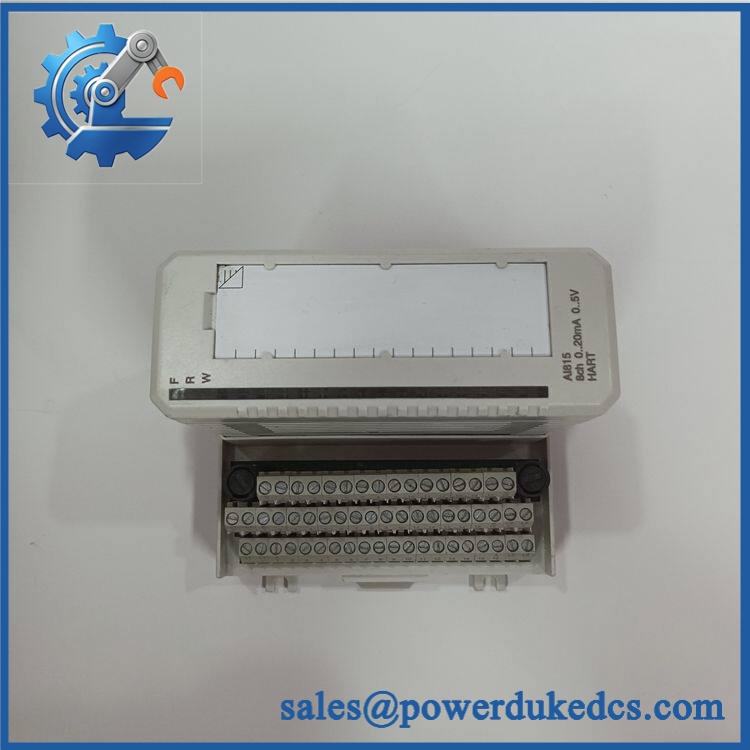
ABB AI815 3BSE052604R1
ABB’s current hardware-selector data confirms the 8-channel architecture, signal ranges, 12-bit resolution, 10 ms update cycle, 0.1% maximum error, 50 ppm/°C temperature drift, 600 m maximum field-cable length, and supported S800 MTUs.
Application Scenarios & Pain Points
A chemical process running hundreds of analog transmitters needs predictable signal acquisition at the I/O level. AI815 provides eight analog channels in one S800 module, reducing the number of individual I/O positions required for conventional process measurements.
Pressure, temperature, and flow measurement: 4–20 mA transmitters can be connected directly to the AI815. The integrated current-limited transmitter supply can support compatible 2-wire or 3-wire transmitters, while HART pass-through allows digital device communication alongside the analog measurement.
Water and wastewater systems: Level, pressure, flow, and quality transmitters commonly use 4–20 mA signals. The ‘s eight-channel format suits distributed process I/O cabinets and remote field panels.
Power-generation auxiliaries: Boiler, cooling-water, fuel, and balance-of-plant instrumentation can use standard current or voltage transmitters. The 600 m maximum specified field-cable length can also be useful for distributed installations, subject to the complete loop design.
Legacy System 800xA maintenance: When an installed I/O station uses , an exact 3BSE052604R1 replacement avoids changing the field signal architecture. ABB’s current documentation continues to identify within the I/O product family.
Common Error Codes & Diagnostic Symptoms
is an analog I/O module rather than a standalone controller, and ABB’s published product data does not provide a universal numeric fault-code list for this exact module. Diagnosis should therefore begin with signal behavior and module/channel diagnostics.
- Symptom/Code: 4–20 mA channel reads approximately zero or below expected range → Diagnosis: Check transmitter power, loop wiring, polarity, terminal connections, and the selected channel configuration. An open transmitter loop can produce an apparent low-input condition → Action: Verify the complete current loop before replacing .
- Symptom/Code: All eight channels show abnormal values simultaneously → Diagnosis: A common module supply, MTU, configuration, or module-level issue is more likely than eight independent transmitter failures → Action: Check the power path, MTU, module seating, and controller diagnostics.
- Symptom/Code: HART communication unavailable while analog signal remains valid → Diagnosis: The analog measurement path may still be operational while HART pass-through, transmitter compatibility, wiring, or external power configuration is incorrect → Action: Check the HART-compatible transmitter supply and field wiring before replacing the module. ABB specifies HART pass-through and current-limited transmitter power for .
Cross-Reference & Lifecycle Migration
The 3BSE052604R1 should be matched by signal type, channel count, MTU, and system configuration—not simply by the words “analog input.”
- Exact identification: ABB lists = 3BSE052604R1.
- Related AI modules: AI801, AI810, AI820 and other analog-input modules have different signal specifications and electrical architectures. For example, ABB lists AI810 with differential inputs and different voltage ranges, so it should not be treated as a universal substitute.
- MTU compatibility: ABB identifies TU810V1, TU812V1, TU814V1, TU818, TU830V1, TU833, TU835V1, and TU838 as compatible MTUs for .
- Signal configuration: Current and voltage signals cannot be mixed on the same module. Confirm the installed channel type before replacement.
- Firmware: is an I/O module, not a programmable PLC CPU. Firmware compatibility should still be checked against the installed I/O and controller environment, but routine replacement does not mean firmware flashing is automatically required.
- Redundancy: ABB specifies No for redundancy on the . A redundant I/O architecture therefore requires system-level design considerations rather than assuming the module itself has a redundant counterpart.
- Lifecycle: ABB’s 2026 hardware-selector documentation continues to list and part number 3BSE052604R1.
- Buffer stock: For an installed /800xA system with many channels, one or more tested spare modules can reduce downtime after a channel or module-level failure.
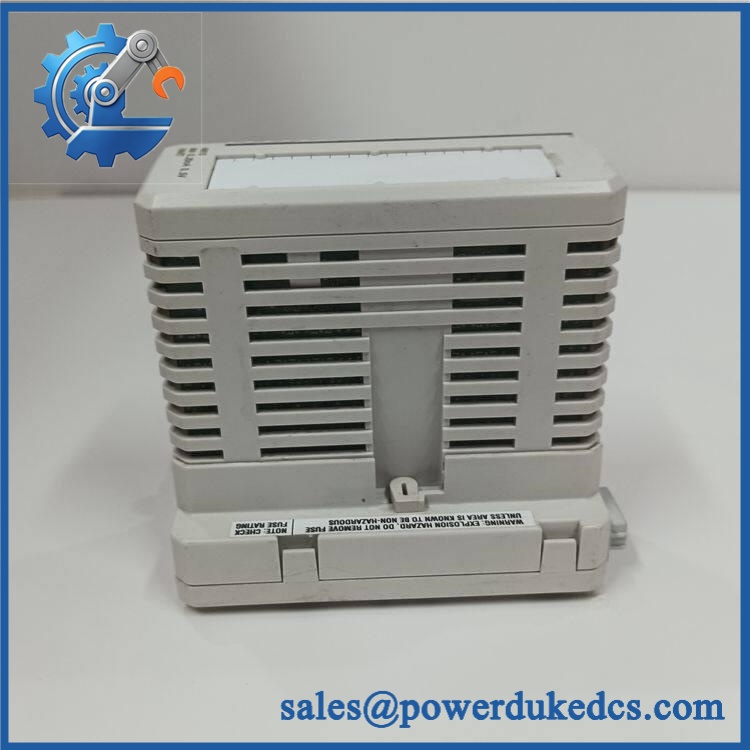
ABB AI815 3BSE052604R1
Field Engineer’s Tech Notes
Warning 1 — Do not mix voltage and current signals on one . The module supports both signal families, but ABB explicitly states that current and voltage signals cannot be mixed on the same module. Confirm the channel configuration before reconnecting field wiring.
Warning 2 — Check the MTU before blaming the I/O card. depends on the appropriate Module Termination Unit. ABB lists several compatible MTUs, including TU810V1, TU814V1, TU818, TU830V1, TU833, TU835V1, and TU838. A damaged terminal connection or mismatched MTU can create symptoms that resemble an failure.
Strict QA & Testing SOP
- Part-number verification — Confirm ABB / 3BSE052604R1 against the purchase order.
- Nameplate inspection — Record model, article number, serial number, and revision information.
- Physical inspection — Check the enclosure, terminal interface, connectors, LEDs, and PCB housing for impact or contamination.
- MTU compatibility check — Confirm that the planned installation uses an ABB-listed compatible MTU.
- Power-up inspection — Install the module on an appropriate test platform and verify normal startup.
- Channel test — Test all eight channels individually rather than validating only one input.
- Current simulation — Apply controlled 0–20 mA and 4–20 mA signals and verify corresponding digital values.
- Voltage simulation — Where the test setup permits, verify 0–5 V and 1–5 V operation.
- Accuracy check — Compare readings against a calibrated reference and verify that measurement error remains within the applicable specification.
- Update-cycle verification — Confirm appropriate process-data updating under normal controller operation.
- HART test — Connect an approved HART-compatible transmitter and verify pass-through communication.
- Transmitter-power test — Check the current-limited transmitter supply under an approved test load.
- Fault simulation — Test representative open-loop and abnormal-input conditions where permitted by the test procedure.
- Controller integration — Verify that all eight channels are correctly mapped and visible to the host control system.
- Final inspection — Record test results, serial information, photographs, and any diagnostic observations.
- ESD packaging — Protect the module with appropriate anti-static packaging and mechanical cushioning.
- Test evidence — Test videos can be provided when available, particularly for powered I/O and HART functional testing.
Buyer’s FAQ
Q: Is an 8-channel 4–20 mA module?
A: Yes, but it also supports 0–20 mA, 0–5 V, and 1–5 V DC. The module is configured for either current or voltage input; current and voltage signals cannot be mixed on the same .
Q: Does support HART?
A: Yes. ABB specifies HART pass-through communication and a current-limited transmitter supply for compatible transmitters.
Q: Which MTU should I use?
A: ABB lists several compatible MTUs, including TU810V1, TU812V1, TU814V1, TU818, TU830V1, TU833, TU835V1, and TU838. Select the MTU according to the actual cabinet and field-terminal arrangement.
Q: Can I hot-swap ?
A: I/O supports hot-swapping as a system feature, but the actual procedure must follow the installed controller, MTU, field-power, and site-maintenance configuration. Do not remove an energized module without confirming the applicable system procedure.
Q: Is redundant?
A: No. ABB’s current specification identifies Redundancy: No for .
Q: How can I verify a New Original ?
A: Request photographs of the ABB identification marking showing / 3BSE052604R1, plus serial/revision information and packaging labels where available. For a critical spare, ask for powered I/O test evidence.
Q: What warranty should I request?
A: Confirm the warranty period and product condition in writing. The supplier should clearly state whether the module is New Original, New Surplus, refurbished, or previously installed, and whether the warranty includes functional testing or replacement.



 Start Chat


