

Description
- Brand: ABB
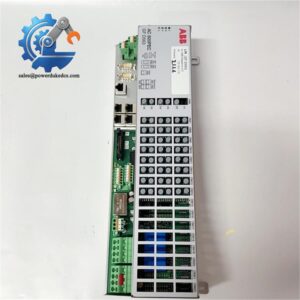
- Full Model Number: BCU-02 3AUA0000110429
- System/Series Family: ABB Industrial Drives / ACS880
- One-Sentence Core Function: Central control unit for ABB converters using fiber-optic links to coordinate converter modules and retain real-time diagnostic data
- Top 3 Hardcore Specs: 2 fiber-optic connections; 24 VDC ±10% supply; 8 GB maximum SDHC memory
- Fiber Channels: V1 and V2
- Option Slots: 3 slots for I/O extensions, encoder interfaces, or fieldbus adapters
- Additional Communication: DDCS option interface; RS-485 drive-to-drive link
- Digital I/O: 6 digital inputs plus 2 configurable digital I/O channels
- Analog I/O: 2 analog inputs and 2 analog outputs
- Relay Outputs: 3 × relay outputs, 250 VAC / 30 VDC, 2 A
- STO: Dual-channel Safe Torque Off interface
- Control Panel: RJ-45 X13
- Operating Temperature: 0°C to +70°C
- Protection: IP10
- Net Weight: 1.5 kg
- Stock Status: New Surplus / Fully Tested Refurbished subject to availability
ABB identifies 3AUA0000110429 as BCU-02; CONTROL UNIT. The BCU-02 has two fiber-optic connections and is part of ABB’s BCU-02/12/22 control-unit family. ABB’s hardware manual states that the BCU-02, BCU-12, and BCU-22 control converters through fiber-optic links and provide integrated branching functionality for collecting and storing real-time converter data.
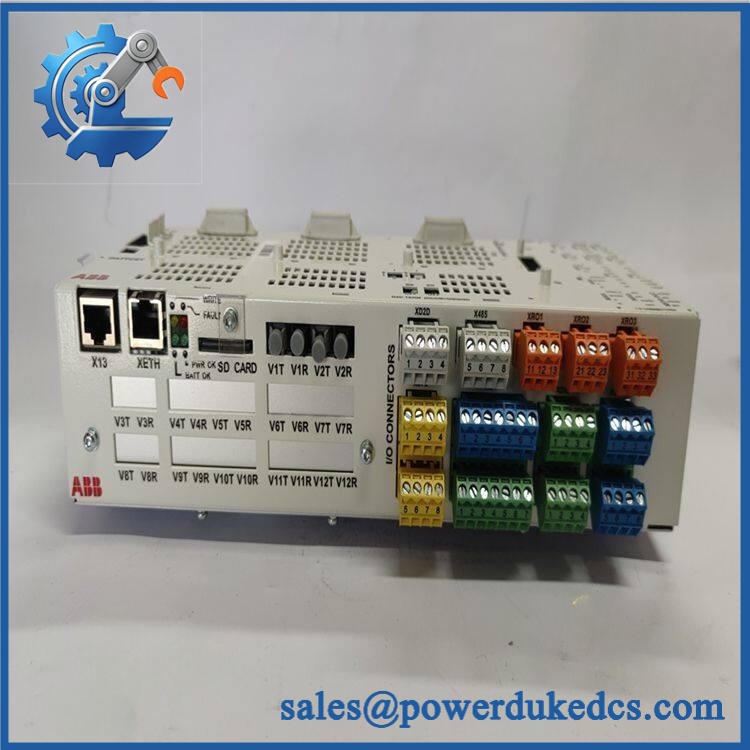
ABB BCU-02 3AUA0000110429
Module 3: Commercial-Technical Deep Dive
A failed BCU-02 can isolate an entire converter control architecture even when the power stage itself remains electrically healthy. The ABB 3AUA0000110429 is the two-channel member of ABB’s BCU control-unit family, using fiber-optic links to communicate with converter modules. ABB specifies two optical connections, V1 and V2, plus three option slots for I/O, encoder, and fieldbus extensions. The unit also provides removable parameter memory, an SDHC card slot for real-time diagnostic data, and an RS-485 drive-to-drive link for master/follower communication. That makes the a system-level control unit, not simply a communications interface.
The electrical interface set is broad enough to matter during replacement. ABB specifies a 24 VDC ±10% control supply, with two external supplies permitted for redundancy; three relay outputs are rated 250 VAC / 30 VDC at 2 A, while the analog section provides two configurable current/voltage inputs and two current outputs. The two analog inputs support -20 to +20 mA or -10 to +10 V, with a 0.25 ms sampling interval per channel, while the SDHC interface supports cards up to 8 GB. The documented operating range is 0°C to +70°C. More importantly, ABB states that a replacement control unit can retain parameter settings by moving the removable memory unit from the defective BCU to the replacement.
Module 4: Compatibility & Installation Traps
Migration/Compatibility
- Primary Role: ABB converter control unit
- Catalog Number: 3AUA0000110429
- ABB Type Designation:
- Fiber-Optic Capacity: 2 channels, V1 and V2
- Drive Family: Primarily associated with ABB ACS880 converter architectures
- Replacement Path: Exact replacement is preferred where the existing application uses the two-channel unit
- Higher-Channel Alternatives: ABB documents that can be replaced by BCU-12 or BCU-22; BCU-22 is described as the most broadly reusable spare within the BCU family. For ACS880 applications, the larger BCU can provide a plug-compatible replacement path where supported.
- Parameter Retention: Transfer the removable memory unit from the old BCU where applicable to preserve parameter settings.
- Firmware/Configuration: Verify the control program, memory unit, option modules, fiber assignments, and drive configuration before commissioning.
- Logic Rewrite: Normally not required for an exact hardware replacement; parameter restoration and functional acceptance testing remain necessary.
⚠️ Field Traps (Watch Out)
1. Do not remove the memory unit under power.
ABB explicitly warns: do not remove or install the memory unit when the control unit is powered. The memory unit can carry the parameter configuration needed by the replacement BCU, so accidental damage here can turn a hardware swap into a configuration-recovery job.
2. Match fiber cable lengths within each connected pair.
ABB specifies maximum cable lengths of 35 m for 1 mm plastic optical fiber and 100 m for 200 μm hard-clad silica fiber. More importantly, fiber pairs connected to the same control unit should have equal lengths because unequal propagation delays can affect operation.
3. Do not use the RJ-45 Ethernet connector as an active control-network assumption.
The BCU includes an XETH RJ-45 connector, but ABB’s hardware manual states that this Ethernet connection is not supported by the firmware. The X13 RJ-45 control-panel connection is the documented supported panel interface.
4. STO replacement requires an acceptance test.
When a safety circuit is connected to XSTO, ABB requires the safety-function acceptance test after replacing the control unit. A successful power-up is not sufficient evidence that the safety chain has been restored correctly.
Module 5: Quality Assurance SOP
Each ABB 3AUA0000110429 should undergo a documented control-unit inspection and functional test before shipment:
- OEM anti-counterfeit visual inspection: Verify ABB markings, , catalog number 3AUA0000110429, serial/trace information, connector layout, housing construction, and production labels.
- Part-number verification: Confirm the exact designation and document any visible hardware revision.
- Mechanical inspection: Check DIN-rail mounting features, terminal blocks, connector latches, fiber-optic interfaces, SD card mechanism, and option-slot hardware.
- PCB condition inspection: Inspect accessible electronics for corrosion, contamination, thermal discoloration, cracked components, loose hardware, and previous repair evidence.
- Power-input verification: Apply controlled 24 VDC power within ABB’s specified ±10% range and verify normal startup. Test redundant supply paths independently where the fixture supports it.
- Power-on self-test (POST): Verify normal initialization, display/LED behavior, and absence of persistent hardware faults.
- Fiber-optic handshake verification: Connect a compatible test converter or optical test fixture to V1 and V2 and verify link recognition and communication.
- Drive-to-drive communication test: Verify the XD2D RS-485 interface using an approved loopback or master/follower test arrangement.
- Digital I/O test: Exercise DI1–DI6 and the configurable DIO1/DIO2 channels at the specified 24 V logic levels.
- Analog input test: Apply controlled current and voltage signals and verify the two analog input channels across their supported ranges. ABB specifies -20 to +20 mA or -10 to +10 V operation.
- Analog output test: Verify both AO channels over the 0–20 mA range with an appropriate precision load.
- Relay output test: Verify all three relay outputs and confirm operation at the applicable low-voltage laboratory test level; ABB rates them up to 250 VAC / 30 VDC and 2 A.
- STO verification: Where the test fixture supports it, verify both STO inputs and expected diagnostic behavior. For a production safety circuit, complete the required safety acceptance test after installation.
- Memory-unit test: Verify parameter-memory recognition and confirm that the removable memory unit can be correctly recognized by the replacement BCU.
- SDHC verification: Confirm SDHC card recognition and controlled read/write operation; ABB specifies up to 8 GB. Do not remove the card while the yellow WRITE LED is active.
- Final QC record: Record catalog number, revision, memory-unit status, optical-channel results, I/O measurements, relay results, STO results, and technician sign-off.
- ESD-safe packaging: Protect the BCU in ESD-safe packaging, with additional mechanical protection for fiber ports, terminal blocks, and the front-panel interfaces.
The test record should separate power-up validation, optical communication, I/O verification, memory retention, and safety-interface testing. This is particularly important for BCU hardware because a board may start normally while a fiber channel, memory unit, or STO path remains defective.
Module 6: CRO-Driven Buyer FAQ
What is ABB 3AUA0000110429?
ABB 3AUA0000110429 is the control unit, a two-fiber-channel controller used with ABB converters. It manages converter-module communication over optical links and also provides local I/O, option slots, removable parameter memory, and diagnostic-data storage.
Can be replaced by BCU-12 or BCU-22?
Yes, with an important qualification. ABB states that can be replaced by BCU-12 or BCU-22, and describes BCU-22 as the most broadly reusable spare because it has 12 fiber channels. The actual replacement still has to be checked against the converter hardware and installed configuration.
Does replacing require re-entering all drive parameters?
Not necessarily. ABB specifically provides a removable memory unit and states that, when replacing the control unit, parameter settings can be retained by transferring the memory unit from the defective BCU to the replacement. The transfer must be performed with the control unit powered down.
Can the be replaced while energized?
The memory unit absolutely must not be removed or installed while powered. For complete control-unit replacement, follow the applicable ABB converter maintenance procedure and plant isolation requirements. If a safety circuit is connected to XSTO, perform the required safety-function acceptance test after replacement.
What should I verify before ordering 3AUA0000110429?
Confirm the exact 3AUA0000110429 / designation, the number of required fiber channels, converter model, memory-unit arrangement, option modules, fiber type and lengths, STO architecture, and I/O wiring. ABB specifies two optical channels for , 24 VDC ±10% external power, and operation from 0°C to +70°C.
What warranty and technical support should I expect?
Warranty duration should be stated for the exact unit condition and test status on the quotation. Technical support should cover part-number verification, versus BCU-12/22 compatibility review, memory-unit transfer guidance, optical-link checks, I/O verification, and documented bench-test results. Drive commissioning, firmware modification, and safety validation beyond the documented replacement procedure should be treated separately unless explicitly included.



 Start Chat