
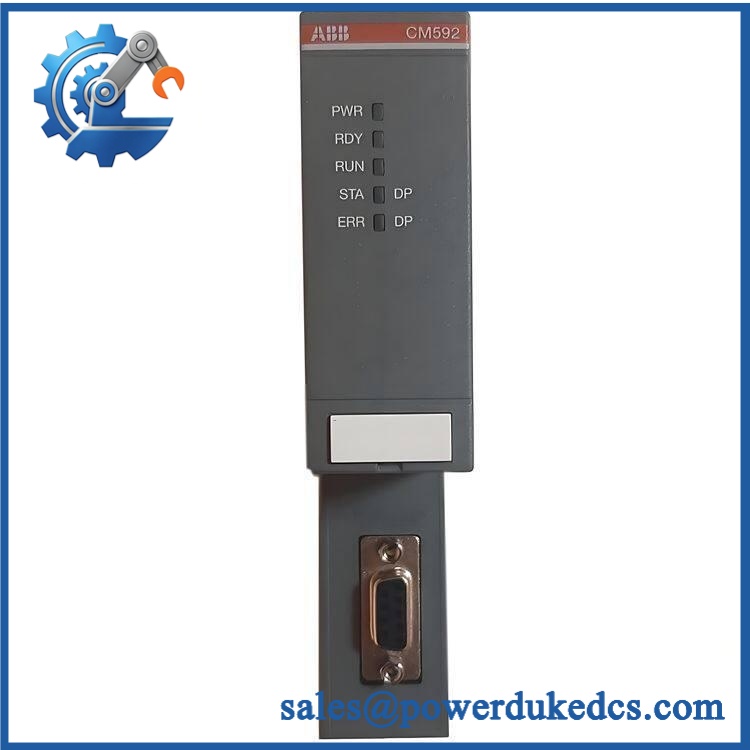

Description
- Brand: ABB
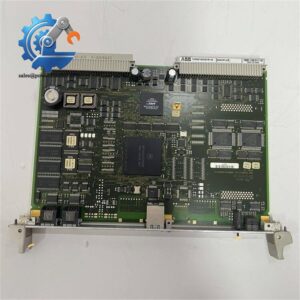
- Full Model Number: CM592-DP 1SAP173200R0001
- System/Series Family: ABB AC500 PLC / Communication Modules
- One-Sentence Core Function: PROFIBUS DP master communication module for connecting AC500 CPUs to PROFIBUS DP slave networks
- Top 3 Hardcore Specs: Up to 12 Mbit/s; up to 125 DPV0/DPV1 slaves; 244 bytes cyclic I/O data per slave
- Processor: Hilscher netX 100
- Internal RAM: 8 MB
- External Flash: 8 MB
- Interface: 9-pin D-sub PROFIBUS connector
- Transmission Standard: EIA RS-485
- Current Consumption: Approximately 65 mA from 24 VDC terminal-base supply
- Status LEDs: PWR, RDY, RUN, STA, ERR
- Compatible CPUs: PM57x, PM58x, PM59x
- Compatible Terminal Bases: TB5xx
- Mounting: 35 mm DIN rail or M4 screw mounting
- Protection: IP20
- Operating Temperature: 0°C to +60°C horizontal; 0°C to +40°C vertical
- Product Lifecycle: Active
- Stock Status: New Surplus / Factory Sealed / Fully Tested Refurbished subject to availability
Module 3: Commercial-Technical Deep Dive
A failed PROFIBUS interface can leave an otherwise healthy AC500 CPU unable to exchange cyclic process data with an entire fieldbus segment. The ABB CM592-DP 1SAP173200R0001 is the dedicated PROFIBUS DP master communication module for the AC500 platform, using a 9-pin D-sub interface and EIA RS-485 signaling. ABB specifies DPV0 and DPV1 support, communication speeds from 9.6 kbit/s through 12 Mbit/s, and support for up to 125 PROFIBUS slaves. The module is compatible with ABB PM57x, PM58x, and PM59x CPUs and TB5xx terminal bases.
The data capacity is more important than the nominal baud rate when evaluating a replacement. ABB specifies up to 244 bytes of cyclic input and 244 bytes of cyclic output data per slave, with aggregate cyclic limits of 5712 input bytes and 5760 output bytes. The CM592-DP uses a Hilscher netX 100 communications processor with 8 MB internal RAM and 8 MB external flash. Typical current consumption is approximately 65 mA from the 24 VDC terminal-base supply. Mounting orientation also affects the published thermal limit: ABB specifies 0°C to +60°C for horizontal installation and 0°C to +40°C for vertical installation.
Module 4: Compatibility & Installation Traps
Migration/Compatibility
- PLC Platform: ABB AC500
- ABB Order Number: 1SAP173200R0001
- Type: CM592-DP
- Role: PROFIBUS DP master
- Protocol: PROFIBUS DP, DPV0 / DPV1
- Maximum Speed: 12 Mbit/s
- Maximum Slaves: 125
- Supported CPUs: PM57x, PM58x, PM59x
- Terminal Bases: TB5xx
- Physical Interface: 9-pin D-sub, EIA RS-485
- Replacement Type: Exact CM592-DP replacement preferred
- Configuration: PROFIBUS master parameters, slave addressing, GSD/device configuration, and cyclic data mapping must match the existing AC500 project
- Logic Rewrite: Normally not required for a like-for-like hardware replacement; hardware configuration should still be validated before commissioning
- Lifecycle: Active according to ABB product documentation
⚠️ Field Traps (Watch Out)
1. Do not confuse CM592-DP with -XC.
ABB assigns 1SAP173200R0001 to the standard and 1SAP373200R0001 to the XC version. The product suffix is therefore part of the technical procurement specification.
2. Preserve the existing PROFIBUS configuration.
Replacing the hardware does not automatically restore slave addresses, GSD assignments, cyclic data mapping, or DPV1 parameters. A module can pass its startup test and still leave the fieldbus offline because the project configuration does not match.
3. Check installation orientation against cabinet temperature.
For the standard module, ABB specifies 0°C to +60°C horizontal installation but only 0°C to +40°C vertical installation. In a cabinet operating at 45°C, mounting orientation can become a specification issue.
4. Verify the RS-485 network before condemning the module.
Check cable shielding, connector termination, segment topology, and station addressing. PROFIBUS physical-layer faults are often mistaken for a failed communication module.
Module 5: Quality Assurance SOP
Each available ABB 1SAP173200R0001 should undergo a documented communication-module inspection and functional test before shipment:
- OEM anti-counterfeit visual inspection: Verify ABB markings, complete 1SAP173200R0001 order number, designation, LED labels, connector geometry, housing markings, and production identifiers.
- Variant verification: Confirm the unit is the standard and not the XC variant.
- Mechanical inspection: Check the DIN-rail clip, M4 mounting provisions, terminal-base interface, enclosure, and 9-pin D-sub connector.
- PCB condition inspection: Check for corrosion, contamination, cracked components, thermal discoloration, loose hardware, and previous repair evidence.
- Power precheck: Perform controlled resistance and continuity checks before applying supply voltage.
- Power-on self-test (POST): Install on a compatible test assembly and verify PWR, RDY, RUN, STA, and ERR indications.
- PROFIBUS master handshake verification: Connect a controlled DP test network and verify master initialization.
- Baud-rate testing: Verify representative communication rates within the specified 9.6 kbit/s to 12 Mbit/s range where supported by the test fixture.
- Slave communication test: Connect representative DPV0 and DPV1 test slaves and verify cyclic data exchange.
- Addressing verification: Confirm correct recognition of programmed test-node addresses.
- Cyclic data test: Exercise representative input and output data and confirm correct master data exchange.
- DPV1 test: Where suitable test hardware is available, perform controlled acyclic reads and writes.
- Fault-diagnostic test: Disconnect a controlled slave or interrupt the bus and verify the expected diagnostic indication.
- RS-485 interface inspection: Verify signal integrity and connector continuity using approved instrumentation.
- Thermal observation: Monitor temperature under active fieldbus traffic and record test orientation.
- Final QC record: Document order number, hardware markings, LED results, tested baud rate, slave addresses, cyclic/acyclic results, and technician sign-off.
- ESD-safe packaging: Package the module in ESD-protective material with connector protection and mechanical support.
The outgoing test report should identify the exact PROFIBUS configuration used during testing. For a fieldbus module, “power tested” provides very little evidence compared with a documented master-to-slave communication test.
Module 6: CRO-Driven Buyer FAQ
What is ABB 1SAP173200R0001?
ABB 1SAP173200R0001 is the PROFIBUS communication module for the PLC platform. It operates as a PROFIBUS DP master and supports DPV0 and communication at rates from 9.6 kbit/s to 12 Mbit/s.
Which ABB CPUs work with the ?
ABB specifies compatibility with PM57x, PM58x, and PM59x CPUs, together with TB5xx terminal bases. Verify the CPU and terminal-base combination before ordering.
What is the maximum PROFIBUS network size?
The supports up to 125 PROFIBUS DP slaves. Cyclic data limits are up to 244 input bytes and 244 output bytes per slave, subject to the overall master limits and actual network configuration.
Can I replace the without rewriting the PLC application?
Usually, an exact hardware replacement does not require rewriting the PLC application. The hardware configuration and PROFIBUS project still need to be checked for slave addresses, GSD/device assignments, data mapping, and settings.
Can the be replaced while the is powered?
Do not assume powered replacement is permitted. Follow the applicable maintenance procedure and isolate the module before removal unless the specific installation procedure explicitly authorizes live work.
What warranty and technical support should I expect?
Warranty duration should be stated for the exact unit condition and test status on the quotation. Technical support should cover part-number verification, CPU compatibility, PROFIBUS configuration review, installation guidance, and documented communication testing. PLC application modification, network engineering, and commissioning should be handled separately unless specifically included.


 Start Chat