
Description
- Model: DI840
- Part Number: 3BSE020836R1
- Brand: ABB
- Series: S800 I/O
- Part Type: Digital Input Module
- Core Function: Acquires 24 V DC field signals and transfers discrete process states into the S800 I/O control architecture.
- Key Specs: 16 channels, 24 V DC, current-sinking inputs, 18–30 V DC input range, 7 mA input current at 24 V DC, SOE capability, redundant or single operation, and advanced onboard diagnostics.
- SOE Performance: Event recording resolution of 1 ms, with an event queue supporting up to 257 events.
- Mechanics: ABB S800; compatible MTUs include TU810V1, TU812V1, TU814V1, TU830V1, TU833, TU838, TU842, TU843, and TU852.
Product Introduction
When a process cabinet begins showing missing or inconsistent discrete signals, the fault is not always in the field switch itself. A failed input module can affect multiple channels at once, making the correct identification of the S800 hardware essential before replacement.
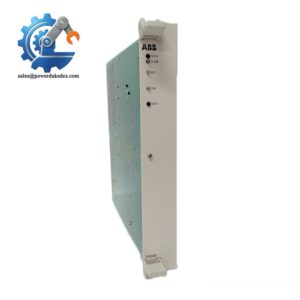
ABB DI840 3BSE020836R1 is a 16-channel, 24 V DC digital input module in the ABB S800 I/O family. ABB specifies it for single or redundant applications, with current-sinking inputs and one group of 16 channels isolated from ground.
Each input incorporates current limiting, EMC protection, an input-status LED, and an optical isolation barrier. The module also provides supervised, current-limited transducer power distribution. Its SOE function can capture process events with 1 ms resolution, which is useful where sequence timing matters (for example, trip and interlock analysis).
Core Technical Specifications
| Parameter | Value |
|---|---|
| Manufacturer | ABB |
| Model | DI840 |
| Article Number | 3BSE020836R1 |
| Product Type | Digital Input |
| Product Family | S800 I/O |
| Signal Specification | 24 V DC |
| Number of Channels | 16 |
| Signal Type | Current sinking |
| Input Voltage Range | 18–30 V DC |
| Logic “0” Input Range | -30 to +5 V |
| Logic “1” Input Range | 11–30 V |
| Input Current | 7 mA at 24 V DC |
| Input Impedance | 3.3 kΩ |
| Channel Isolation | 1 group of 16, isolated from ground |
| HART | No |
| SOE | Yes |
| SOE Resolution | 1 ms |
| Event Queue | Up to 257 events |
| Digital Filter | 0–127 ms, selectable |
| Maximum Field Cable Length | 600 m |
| Redundancy | Yes |
| High Integrity | No |
| Intrinsic Safety | No |
| Modulebus +5 V Consumption | 100 mA |
| External +24 V Consumption | 15 mA + transducer power, max. 335 mA |
| Typical Power Dissipation | 2.7 W |
| Rated Insulation Voltage | 50 V |
| Dielectric Test Voltage | 500 V AC |
| Mechanics |
ABB’s current DI840 hardware data sheet provides the electrical, diagnostic, SOE, and mechanical specifications above.
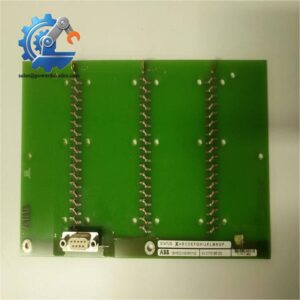
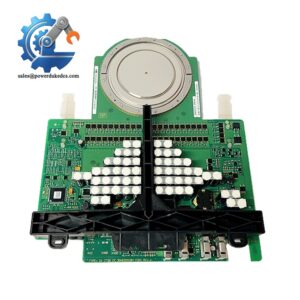
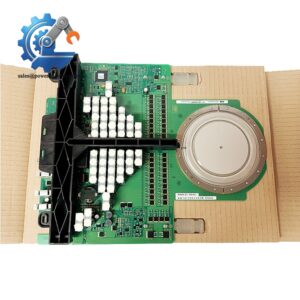
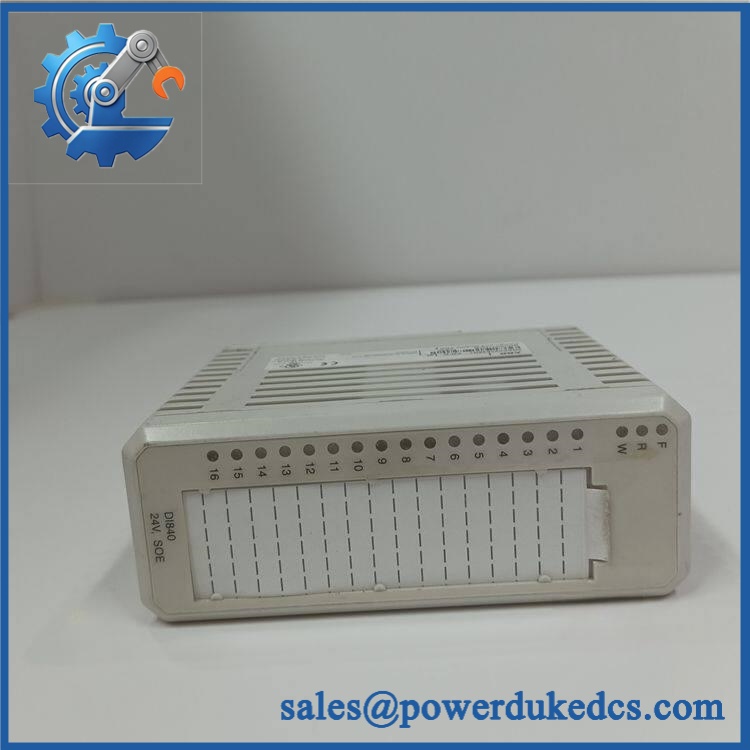 ABB DI840 3BSE020836R1
Application Scenarios & Pain Points
The main engineering advantage of DI840 is its combination of dense 24 V DC discrete acquisition and event recording. That makes it useful where the control system needs both ordinary status signals and accurate event timing.
1. Process Interlocks
In a chemical or process plant, can collect discrete states from switches, contacts, and other 24 V DC field devices. Sixteen channels on one module reduce the number of individual I/O positions required.
2. Power Generation
For generator and auxiliary systems, digital inputs can monitor breaker positions, permissive signals, trip contacts, alarms, and equipment status. The 1 ms SOE resolution is particularly useful when reconstructing the order of closely spaced events.
3. Motor and Pump Control
Pump running status, motor auxiliary contacts, local/remote selectors, and protection contacts can be brought into the system through the . When several channels disappear simultaneously, technicians should investigate the common I/O module or field supply rather than replacing each field device individually.
4. Sequence-of-Events Monitoring
For applications where the exact order of trips matters, the SOE capability records input changes at 1 ms resolution. The module’s event queue can contain up to 257 events, providing useful information during post-event analysis.
5. Remote Distributed I/O
ABB describes I/O as a distributed, modular process-I/O system that can be installed close to field sensors and actuators. fits this architecture where 24 V DC discrete signals need to be collected at a remote I/O station.
Common Error Codes & Diagnostic Symptoms
ABB’s public documentation identifies front-panel F (Fault), R (Run), W (Warning), and channel-status LEDs, but does not provide a universal numerical error-code list for every field fault.
- Symptom/Code: F (Fault) LED active → Diagnosis: The module is reporting a hardware or internal diagnostic condition; investigate module status and diagnostics before assuming a field-device failure → Action: Check module power, diagnostics, wiring, and configuration; replace the if the fault remains isolated to the module.
- Symptom/Code: Multiple channel LEDs remain incorrect → Diagnosis: Simultaneous abnormal states across several channels can indicate field-power loss, common wiring problems, configuration issues, or module failure → Action: Verify the 24 V DC supply and common field wiring before replacing the module.
- Symptom/Code: SOE timestamps missing or inconsistent → Diagnosis: The input signal, filtering configuration, synchronization, or module/event-recording function may be affecting event capture → Action: Check SOE configuration, digital filter settings, controller time synchronization, and module diagnostics.
Cross-Reference & Lifecycle Migration
Compatible Module Termination Units
ABB specifies the following compatible MTUs for :
- TU810V1
- TU812V1
- TU814V1
- TU818
- TU830
- TU833
- TU838
- TU842
- TU843
- TU852
The MTU must match the actual cabinet wiring and installation. Do not substitute an MTU merely because it physically fits.
Related Digital Inputs
is part of a broader digital-input family. For example, ABB lists DI810 as a 16-channel 24 V DC current-sinking module, while DI831 is a 16-channel 48 V DC input module.
These are not automatically direct replacements for . specifically provides SOE, redundancy support, extended diagnostics, and transducer-power distribution.
Configuration / Firmware
is an I/O module rather than a standalone PLC CPU. Replacement normally requires the I/O station and controller configuration to recognize the module correctly.
Before removing the original unit, document:
- I/O station address
- Module position
- Channel assignments
- Digital filter settings
- SOE configuration
- Redundancy arrangement
- Connected MTU
- Controller-side I/O configuration
After replacement, verify every affected channel and the SOE function before returning the process to normal operation.
Lifecycle Status
Lifecycle: Active / Supported
ABB’s current hardware selector continues to list , article number 3BSE020836R1, with a current 2026 data sheet.
For existing installations, this is materially different from sourcing an obsolete legacy module: standard inventory planning can focus on maintaining compatible spare stock rather than relying solely on refurbished-market availability.
Field Engineer’s Tech Notes
Tech Note 1 — Verify current sinking versus current sourcing.
is a current-sinking input module. Do not wire it as though it were a current-sourcing input. Check the field device output type and the actual wiring diagram before energizing the channel.
Tech Note 2 — Do not ignore the digital filter when troubleshooting SOE.
permits selectable digital filtering from 0 to 127 ms. If an engineer is investigating millisecond-level event sequences, an inappropriate filter setting can affect what is recorded. Check the configured filter before declaring the SOE hardware defective.
Strict QA & Testing SOP
For an ABB 3BSE020836R1, a suitable inspection and testing sequence is:
- Part Number Verification
Confirm / 3BSE020836R1 on the module label. - Physical Inspection
Check the housing, front-panel LEDs, connector interface, labels, and mounting features for damage. - MTU Compatibility Check
Verify that the intended TU810V1/TU812V1/TU814V1/TU818/TU830/TU833/TU838/TU842/TU843/TU852 installation is compatible with the actual cabinet arrangement. - Power Verification
Confirm the correct module and field power conditions before applying signals. - Channel Simulation
Apply controlled 24 V DC input signals to each channel using an appropriate test fixture. - Threshold Test
Verify recognition of logic states against the published input ranges: 0 = -30 to +5 V and 1 = 11 to 30 V. - LED Verification
Confirm the corresponding channel-status indicators respond correctly. - Diagnostic Test
Check F/R/W status and diagnostic information for abnormal conditions. - SOE Test
Generate controlled input transitions and verify event capture at the specified 1 ms resolution. - Filter Verification
Test the configured digital filter behavior where the application depends on short-duration pulses. - Redundancy Test
For redundant installations, verify the module behaves correctly within the configured redundant architecture. - Final QC Record
Record part number, serial information, test conditions, channel results, diagnostic status, photographs, and packaging condition. - ESD Protection
Place the module in anti-static packaging with sufficient mechanical protection for shipment.
Test videos can be provided with the inspection record when required.
Buyer’s FAQ
Q: Can the be hot-swapped?
A: ABB states that I/O supports module exchange and reconfiguration during operation in appropriate system configurations. However, whether a particular installation can be exchanged live depends on the controller, I/O station, redundancy arrangement, and configured procedure.
Q: Is 3BSE020836R1 the correct part number for ?
A: Yes. ABB identifies with article number 3BSE020836R1.
Q: What makes different from a standard 16-channel digital input?
A: combines 16-channel 24 V DC current-sinking input capability with SOE, 1 ms event resolution, redundancy support, onboard diagnostics, and transducer power distribution.
Q: Can a New Original be tested before shipment?
A: Yes. A proper acceptance process can include part-number inspection, visual QC, channel-by-channel 24 V DC simulation, diagnostic verification, and SOE testing. Test records and inspection videos can be supplied when requested.


 Start Chat