

Description
- Model: ABB NGC8206
- Brand: ABB
- Series: Totalflow NGC8206 Natural Gas Chromatograph
- Part Type: Field-mounted natural gas chromatograph / gas composition analyzer
- Core Function: Performs on-site chromatographic analysis of pipeline-quality natural gas and calculates heating value, relative density, Wobbe index, GPM, and related gas-quality parameters.
- Key Specs: Approximately 5-minute analysis cycle; up to 4 sample streams; up to 2.052 GB internal memory; 0°F to 130°F (-18°C to 55°C) normal operating range; approximately 28 lb (12.7 kg).
Product Introduction
Installed directly beside the pipeline sampling point, the ABB NGC8206 operates as a field-mounted natural gas chromatograph rather than as a conventional PLC or DCS I/O module. Its purpose is direct measurement: the analyzer separates gas components, determines mole percentages, and calculates key commercial and process values on site.
The analyzer can handle up to four independent natural gas streams, with configurable calibration/validation arrangements. A typical analysis cycle takes approximately five minutes, making the NGC8206 suitable for continuous gas-quality monitoring where laboratory sampling would introduce unacceptable delays.
For legacy gas metering installations, the unit remains relevant as a legacy migration and maintenance spare when an existing NGC8206 installation must remain operational. The architecture includes a replaceable analytical module, controller, termination panel, and other serviceable assemblies (useful when maintaining an installed analyzer rather than replacing the complete measurement package).
Core Technical Specifications
| Parameter | Value |
|---|---|
| Manufacturer | ABB |
| Model | NGC8206 |
| Product Type | Natural Gas Chromatograph |
| Product Family | Totalflow NGC |
| Primary Application | Pipeline-quality natural gas analysis |
| Analysis Method | Process gas chromatography |
| Analysis Time | Approximately 5 minutes |
| Sample Streams | Up to 4 |
| Gas Components | Air, C1, CO2, C2, C3, iC4, nC4, NeoC5, iC5, nC5, C6+ |
| Calculated Values | AGA 8 gas compressibility, relative density, Btu/CV, GPM, Wobbe Index, methane number |
| Optional Calculations | AGA 10 speed of sound, hydrocarbon dew point |
| Memory | Up to 2.052 GB |
| Carrier Gas | Helium; hydrogen optional |
| Carrier Gas Purity | 99.995% chromatographic-grade helium |
| Normal Operating Temperature | 0°F to 130°F (-18°C to 55°C) |
| Low-Temperature Option | Reliable operation down to -20°F (-29°C) |
| Storage Temperature | -22°F to +140°F (-30°C to 60°C) |
| Dimensions | 6.75 in diameter × 16 in long × 9.00 in high |
| Weight | Approximately 28 lb / 12.7 kg |
| Shipping Weight | Approximately 47 lb / 21.3 kg |
| Communications | RS-232, USB, Ethernet; remote telemetry options |
| Operator Software | PCCU 32 |
| Enclosure | Aluminum alloy, white polyester powder coating |
| Environmental Construction | CSA Type 4X; IECEx IP56; ATEX Type 4X / IP66 equivalent |
| Pipeline Mounting | Designed for 2 in to 12 in pipelines; pole mounting also available |
| Historical Data | Default configuration retains 480 analysis cycles, 840 hours, 35 days, and the most recent month of stream averages |
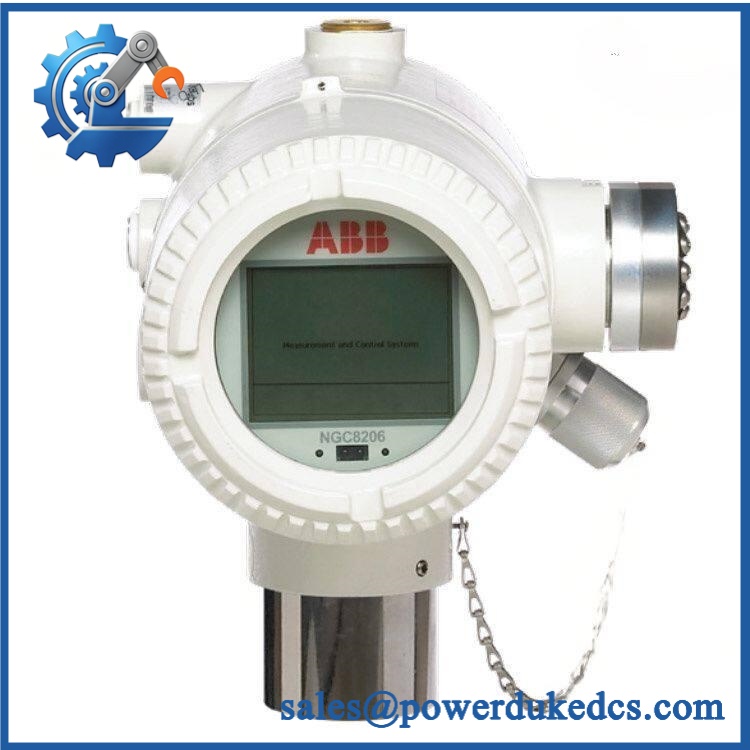
ABB NGC8206
ABB’s published data sheet confirms the analyzer’s five-minute cycle, four-stream capability, memory capacity, environmental range, enclosure ratings, and physical dimensions.
Application Scenarios & Pain Points
Pipeline custody-transfer stations: When gas composition must be established close to the measurement point, the provides local chromatographic analysis rather than relying entirely on off-site laboratory results. Its calculated Btu/CV, relative density, Wobbe index, and gas-compressibility values support commercial gas measurement workflows.
Natural gas transmission pipelines: A five-minute analysis cycle allows operators to observe changes in gas quality at relatively short intervals. The four-stream selector can also support multiple sample points within one analyzer configuration.
Gas processing facilities: C1 through C6+ component information helps operators evaluate gas composition and energy characteristics. For installations exposed to 50°C+ ambient temperatures, the specified 55°C upper operating limit should be checked carefully against the actual enclosure and site conditions.
Metering and allocation systems: Historical storage can retain normalized and un-normalized components, Btu/CV, density, Wobbe index, alarms, and diagnostic parameters. That record can help engineers investigate communication interruptions or abnormal analyzer behavior after the event.
Remote gas-quality monitoring: PCCU 32 supports local operation through RS-232, USB, or Ethernet, while remote telemetry can be used for installations where technicians cannot remain at the analyzer continuously.
Common Error Codes & Diagnostic Symptoms
Because ABB documentation for the relies heavily on diagnostic reports, alarms, chromatograms, and operational parameters rather than presenting a universal short list of PLC-style numeric fault codes, the following are physical diagnostic symptoms, not claimed universal error-code numbers.
- Symptom/Code: Abnormal or missing chromatographic peaks → Diagnosis: Possible analytical-module, valve, detector, carrier-gas, or sample-flow problem. Check chromatogram output, carrier pressure, detector values, and sample conditioning before condemning the analytical module → Action: Troubleshoot the gas path and replace the affected analytical assembly if hardware failure is confirmed.
- Symptom/Code: Carrier pressure outside expected operating condition → Diagnosis: Inspect the carrier-gas supply, regulator assembly, tubing, and pressure-control hardware. The records carrier regulator pressure as part of its diagnostic information → Action: Correct the gas supply or replace the failed pressure-control component.
- Symptom/Code: Oven temperature instability / analysis cycle fails to stabilize → Diagnosis: An oven-temperature or feed-through/heater problem can prevent the chromatographic section from reaching its required operating condition → Action: Check temperature diagnostics, heater circuitry, and associated hardware; replace the defective assembly when confirmed.
Cross-Reference & Lifecycle Migration
The should not be treated as a conventional ABB PLC module with a simple CPU/I/O replacement number. It is a complete Totalflow natural gas chromatograph containing its own controller, analytical processor, chromatographic section, pressure regulation, valves, and field interface hardware.
- Previous revisions: ABB documentation exists across multiple manual revisions, including older 2101510-series documentation. A revision-specific replacement should therefore be checked against the analyzer’s complete nameplate, hardware revision, analytical module configuration, and installed software before procurement.
- Direct replacement claim: No verified ABB source located here establishes a universal direct-drop-in replacement for every revision. Do not assume another revision is interchangeable solely because the base model number matches.
- Firmware/software: PCCU 32 is the operating and diagnostic interface. Firmware/software compatibility should be verified against the existing analyzer configuration before commissioning; do not flash firmware simply to make two units appear equivalent.
- Lifecycle: A current ABB lifecycle status specifically identifying was not located in the available ABB sources. ABB’s general lifecycle framework uses Active, Classic, Limited, and Obsolete phases, with progressively reduced availability and support as a product moves toward Obsolete.
- Buffer-stock strategy: For an installed population, procurement should prioritize exact configuration matching and verified spare availability. Keeping a tested complete analyzer or critical replaceable assemblies in stock can reduce exposure to long lead times.
Field Engineer’s Tech Notes
Warning 1 — Do not treat this like a normal transmitter swap. The includes chromatographic hardware, carrier-gas regulation, valves, an oven, analytical electronics, and sample handling. Before removing the unit, document tubing connections, stream assignments, calibration configuration, communication settings, and installed options. A mechanically correct installation can still produce bad gas data if the sample path is configured incorrectly.
Warning 2 — Protect the analytical section from contamination. Sample conditioning matters. ABB specifically provides conditioning options for filtration and sample transport lag, while the analyzer is intended for dry pipeline-quality gas. Liquid carryover, contaminated tubing, or unsuitable sample conditioning can create analytical problems that look like electronic failures (do not replace the controller before checking the gas path).
Strict QA & Testing SOP
A suitable inspection process for an replacement should include:
- Inbound identification — Record the ABB model, nameplate data, serial number, hardware revision, configuration information, and visible option codes.
- Physical inspection — Check the enclosure, conduit entries, display if fitted, connectors, tubing interfaces, mounting points, and seals for shipping damage.
- Internal assembly inspection — Verify the controller, analytical module, termination panel, feed-through assembly, and related modules are correctly installed. The uses a modular architecture with replaceable analytical and controller assemblies.
- Electrical inspection — Verify power-input characteristics and inspect communication interfaces before energization.
- PCCU 32 connection test — Establish local communication and confirm that the analyzer can be accessed through the supported operator interface.
- Diagnostic verification — Review alarms, events, carrier regulator pressure, oven temperature, sample pressure, detector noise, and detector balance values where applicable.
- Live-rig functional test — Where the test setup permits, run an appropriate natural-gas or approved calibration/validation gas and confirm chromatographic response.
- Calibration verification — Confirm calibration behavior against the applicable gas standard and site procedure.
- Data-retention check — Verify historical records and time-stamped alarm/event logging.
- Final packaging — Use anti-static protection for electronic assemblies, mechanical protection around the enclosure and analytical hardware, moisture protection where appropriate, and impact-resistant outer packaging.
- Test documentation — Record the inspection results and available test evidence. Test videos can be provided when available, particularly for functional or live-rig verification.
Buyer’s FAQ
Q: Can I hot-swap an while the pipeline is running?
A: Do not assume hot-swapping is permissible. The is a complete field chromatograph with electrical, sample-gas, carrier-gas, and potentially hazardous-area considerations. Follow the site’s isolation, depressurization, electrical, and hazardous-area procedures before replacement.
Q: How do I know an is genuinely New Original?
A: Ask for clear photographs of the original ABB nameplate, serial number, packaging labels, hardware revision, and configuration details. For a new-original claim, the commercial condition should be documented separately from the technical compatibility check.
Q: Is still suitable as a replacement for an installed unit?
A: It can be appropriate when the existing installation is based on hardware, but the exact revision and configuration should be matched. Check analytical-module configuration, stream arrangement, communications, options, and software compatibility rather than relying on the base model number alone.
Q: What happens if the replacement unit works electrically but produces incorrect gas results?
A: Start with the sample path, carrier-gas pressure, calibration gas, oven temperature, detector diagnostics, and chromatogram rather than immediately blaming the controller. Gas chromatography failures can originate outside the main electronics.
Q: What warranty should I expect?
A: Warranty terms depend on the seller and product condition. Before purchasing, confirm the stated warranty period, whether it covers repair or replacement, whether functional testing is included, and what evidence is required for a claim. For used or New Surplus equipment, the warranty should be documented explicitly rather than assumed.


 Start Chat