

Description
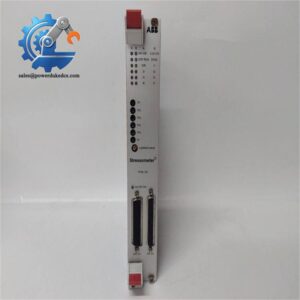
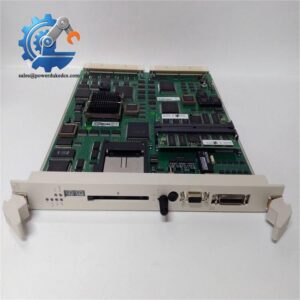
- ABB PDP800 | Original Symphony Plus SD Series PROFIBUS DP Interface
2. At-A-Glance Executive Brief
- Model: PDP800
- Brand: ABB
- Series: Symphony Plus SD Series
- Part Type: PROFIBUS DP Master Interface Module
- Core Function: Connects ABB Symphony Plus controllers with PROFIBUS DP field devices, allowing intelligent transmitters, actuators, and IEDs to exchange process data with the DCS.
- Key Specs: PROFIBUS DP V0/V1/V2; communication speeds from 9.6 kbps to 12 Mbps; up to 125 PROFIBUS slave devices; module and line redundancy; hot-swappable design; front-panel Mini USB diagnostic port.
3. Product Introduction
Inside an ABB Symphony Plus control architecture, the PDP800 sits between the DCS controller environment and the PROFIBUS DP field network. It functions as a PROFIBUS DP master interface, allowing the controller to communicate with intelligent field equipment such as transmitters, actuators, and intelligent electronic devices.
The module supports PROFIBUS DP V0, V1, and V2 and communication rates from 9.6 kbps through 12 Mbps. With capacity for up to 125 slave devices, it can serve as a substantial field-network interface rather than a simple point-to-point communications adapter. (That distinction matters when replacing an installed DCS communication module.)
For legacy Symphony Plus installations, PDP800 remains relevant as a maintenance and legacy migration component. ABB’s current hardware-selector documentation continues to identify PDP800 as the PROFIBUS DP master interface for SPCxxx controllers.
4. Core Technical Specifications
| Parameter | Value |
|---|---|
| Manufacturer | ABB |
| Model | PDP800 |
| Product Family | Symphony Plus |
| Series | SD Series |
| Product Type | PROFIBUS DP Master Interface |
| Communication Role | Master |
| Protocol | PROFIBUS DP V0, V1, V2 |
| PROFIBUS PA Support | Native support; third-party DP/PA linking devices can also be used |
| Maximum Slave Capacity | Up to 125 PROFIBUS slave devices |
| Transmission Speed | 9.6 kbps to 12 Mbps |
| Module Redundancy | Yes |
| Line Redundancy | Yes |
| Hot Swap | Yes |
| Diagnostics Interface | Mini USB on module front plate |
| Form Factor | xA Style |
| Module Width | 186 mm |
| Mounting | Horizontal row |
| HN800 Bus Length | 175 mm |
| PROFIBUS Link Distance | Up to 15 km using fiber-optic lines and repeaters |
| Host System | ABB Symphony Plus / SPCxxx controllers |
| Typical Applications | Power generation, water treatment, process automation |
| Communication Function | Intelligent field-device integration |
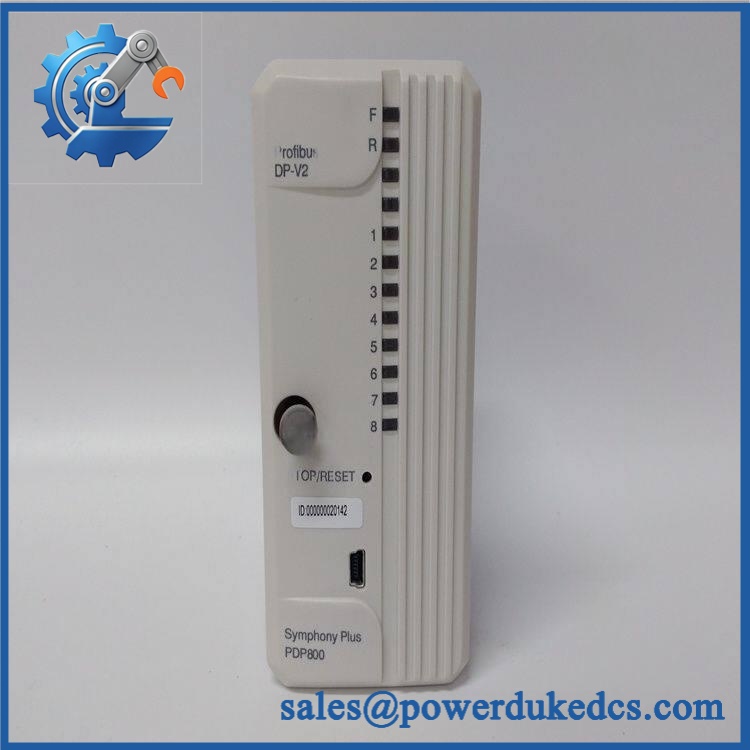
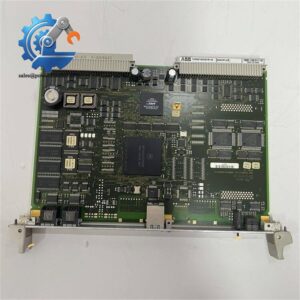
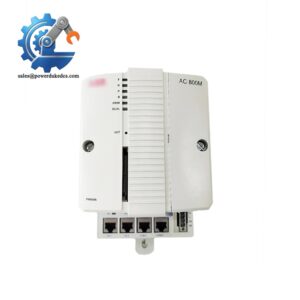
ABB PDP800
ABB’s current hardware selector specifies the PDP800’s V0/V1/V2 support, 12 Mbps maximum line speed, 125-slave capacity, redundancy features, hot-swap capability, xA form factor, and Mini USB diagnostic interface.
5. Application Scenarios & Pain Points
A power plant with dozens of intelligent field devices cannot efficiently treat every PROFIBUS device as an isolated control point. PDP800 provides the network-level master interface needed to bring those devices into the Symphony Plus control environment. ABB specifically describes the module as the connection between Symphony Plus controllers and PROFIBUS DP communication channels.
Power generation: Turbine auxiliaries, intelligent transmitters, actuators, and other PROFIBUS devices can be integrated into the Symphony Plus DCS through PDP800. The current ABB architecture supports up to 125 PROFIBUS slaves per PDP800 interface.
Water and wastewater plants: ABB identifies Symphony Plus as a platform used extensively in water applications. PDP800 provides the PROFIBUS interface required for distributed intelligent field equipment.
Large process networks: At a communication speed of 12 Mbps, the interface can handle substantially faster PROFIBUS communication than low-speed legacy configurations. Fiber-optic infrastructure with repeaters can extend PROFIBUS links up to 15 km, which is useful for geographically distributed equipment.
Redundant DCS architectures: Both module redundancy and line redundancy are supported. This matters when a single communication-card failure or network-path failure cannot be allowed to interrupt field-device communications.
6. Common Error Codes & Diagnostic Symptoms
ABB’s public PDP800 documentation does not establish a universal numeric fault-code list that can safely be attributed to every PDP800 configuration. The following are practical diagnostic symptoms engineers should investigate.
- Symptom/Code: PROFIBUS communication lost / slave devices unavailable → Diagnosis: Check the PROFIBUS network, termination, cabling, slave power, node configuration, and PDP800 master status before replacing the module → Action: Correct the network fault or replace the PDP800 if module-level diagnostics confirm hardware failure.
- Symptom/Code: Multiple PROFIBUS slaves simultaneously report communication failure → Diagnosis: A common master, bus, or communication-path problem is more likely than simultaneous failure of multiple field devices → Action: Check PDP800 status, redundant module/line path, bus termination, and network diagnostics.
- Symptom/Code: PDP800 diagnostic interface unavailable → Diagnosis: Check module power, HN800 host connection, module seating, and the front-panel Mini USB diagnostic connection → Action: Reseat or replace the module after the host-side infrastructure has been verified. The PDP800 includes a Mini USB diagnostic port specifically for local diagnostics.
7. Cross-Reference & Lifecycle Migration
The PDP800 is a Symphony Plus SD Series PROFIBUS DP master, so compatibility should be evaluated at the system and host-controller level rather than by treating it as a generic PROFIBUS card.
- Host compatibility: ABB identifies PDP800 as the PROFIBUS DP master interface for SPCxxx controllers.
- Related architecture: ABB’s documentation places PDP800 within Symphony Plus alongside controllers such as HPC800/SPCxxx and other communications interfaces.
- Capacity consideration: Current ABB documentation specifies up to 125 PROFIBUS slave devices for one PDP800. System-level controller capacity can differ, so do not confuse the module’s 125-slave capability with the total PROFIBUS capacity of an entire DCS.
- Redundancy: Both module and line redundancy are supported. A replacement must therefore match the existing redundancy architecture rather than simply providing PROFIBUS master functionality.
- Firmware: Firmware compatibility should be checked against the installed Symphony Plus controller and engineering environment. Do not flash firmware simply because two modules carry the same base PDP800 designation.
- Lifecycle: ABB’s current hardware selector continues to list PDP800, while the available ABB literature identifies it as part of the Symphony Plus platform. A specific lifecycle phase for an individual PDP800 serial/revision was not established from the available documentation.
- Buffer-stock strategy: For plants with redundant PDP800 installations, maintaining at least one tested spare can reduce recovery time after a communication-module failure, particularly where the PROFIBUS network carries a large number of field devices.
8. Field Engineer’s Tech Notes
Warning 1 — Don’t blame the PDP800 before checking the PROFIBUS physical layer. When several slaves disappear simultaneously, inspect termination, cable shielding, connectors, slave power, and network topology first. A bus-level fault can look exactly like a failed master module from the operator’s perspective.
Warning 2 — Verify the redundancy arrangement before pulling the card. PDP800 supports both module and line redundancy, and the installed architecture may depend on both. A replacement procedure that ignores the redundant partner or network path can turn a single-module maintenance job into a communication outage.
9. Strict QA & Testing SOP
- Part identification — Confirm the module marking as ABB PDP800 and record all available serial/revision information.
- Visual inspection — Check the housing, front connector area, LEDs, Mini USB port, mounting hardware, and PCB enclosure for damage.
- Connector inspection — Verify that the module interface and HN800 connection points are clean and mechanically intact.
- Host compatibility check — Confirm that the intended installation uses a compatible Symphony Plus SPCxxx controller architecture.
- Power-up test — Install the module on an appropriate test system and verify normal startup behavior.
- PROFIBUS master test — Confirm that the module initializes as a PROFIBUS DP master.
- Network simulation — Connect approved PROFIBUS test devices and verify master-to-slave communication.
- Speed verification — Test the intended PROFIBUS communication rate, including the required configuration up to the applicable system limit of 12 Mbps.
- Slave-device test — Verify communication with representative PROFIBUS devices and check diagnostic information.
- Redundancy test — Where the test platform supports it, verify module and line redundancy behavior.
- Hot-swap verification — Confirm that the replacement procedure complies with the installed Symphony Plus architecture and the applicable maintenance procedure; do not assume every system condition permits unrestricted live removal.
- Diagnostic test — Verify the front-panel Mini USB diagnostic interface and relevant module status information.
- Final inspection — Record test results, module condition, serial information, and photographs.
- ESD packaging — Place the module in appropriate anti-static packaging and use shock-resistant outer protection.
- Test evidence — Test videos can be provided when available, especially for powered functional testing and PROFIBUS communication verification.
10. Buyer’s FAQ
Q: Is PDP800 a PLC CPU?
A: No. PDP800 is a PROFIBUS DP master interface for the ABB Symphony Plus environment. It provides the communication interface between compatible DCS controllers and PROFIBUS field devices.
Q: Can PDP800 communicate with PROFIBUS PA devices?
A: Yes. ABB states that PDP800 supports PROFIBUS PA natively and can also support PROFIBUS PA through third-party DP/PA linking devices.
Q: How many PROFIBUS devices can one PDP800 handle?
A: ABB’s current specification states up to 125 PROFIBUS slave devices. Actual system capacity can be constrained by the controller architecture, network design, device configuration, and engineering strategy.
Q: Can I hot-swap PDP800?
A: The current ABB specification explicitly lists Hot Swap: Yes. However, the maintenance procedure should still follow the installed Symphony Plus redundancy architecture and site operating procedure.
Q: Does PDP800 support redundant operation?
A: Yes. ABB specifies both module redundancy and line redundancy. The exact implementation depends on the host system and network configuration.
Q: Is PDP800 still available as an original ABB part?
A: ABB’s current Symphony Plus hardware-selector documentation still lists PDP800 functionality, but the exact commercial availability of a particular physical unit depends on its ordering configuration and supply status. For procurement, request the complete nameplate and revision information rather than relying only on a generic PDP800 listing.
Q: What warranty should I request?
A: Confirm the warranty period and coverage in writing. For a critical DCS communication module, specify whether the unit is New Original, New Surplus, refurbished, or previously installed, and ask whether functional PROFIBUS testing is included.


 Start Chat