

Description
- Model: PFRL101C-1.0
- Brand: ABB
- Series: Pressductor PFRL101
- Part Type: Radial load cell / force transducer
- Core Function: Measures radial force for web-tension control in shaft-mounted measurement applications.
- Key Specs: 1.0 kN nominal load, ±0.5% accuracy class, 0.01 mm deflection, and 500% overload capacity in the measurement direction. ABB identifies the PFRL101 as a Pressductor radial load-cell system for web-tension measurement.
- ABB Article Number: 3BSE023316R1002 for the PFRL101C 1.0 kN variant.
Product Introduction
When web tension drifts on a converting, printing, textile, or film line, the problem may originate at the force-measurement point rather than the drive controller. The ABB PFRL101C-1.0 is a shaft-mounted Pressductor radial load cell designed to measure web tension through radial force measurement. ABB lists the PFRL101 family for converting, plastic-film, printing, textile, and other web-processing machinery.
The PFRL101C version is available in a 1.0 kN rated-load configuration, with ABB documentation identifying the corresponding article number as 3BSE023316R1002.
Pressductor technology uses the magneto-elastic effect to generate a measurement signal from applied mechanical force. ABB notes that the transducer produces a high-power, low-impedance AC signal with strong resistance to electrical interference and earth faults.
Core Technical Specifications
| Parameter | Value |
|---|---|
| Manufacturer | ABB |
| Model | PFRL101C-1.0 |
| Series | PFRL101 |
| Technology | Pressductor |
| Product Type | Radial load cell |
| Measurement Direction | Radial |
| Nominal Load | 1.0 kN / 225 lbf |
| Extended Load | 1.5 kN / 337 lbf |
| Overload Capacity, Measurement Direction | 5.0 kN / 1125 lbf |
| Accuracy Class | ±0.5% |
| Repeatability Error | <±0.1% |
| Deflection | 0.01 mm / 0.4 mil |
| Spring Constant | 100 kN/mm |
| Mounting Style | Shaft-mounted |
| Typical Application | Web tension measurement |
| ABB Article Number | 3BSE023316R1002 |
| PFRL101C Shaft Dimension | Ø100 mm |
| Operating Temperature | -10 to 80°C |
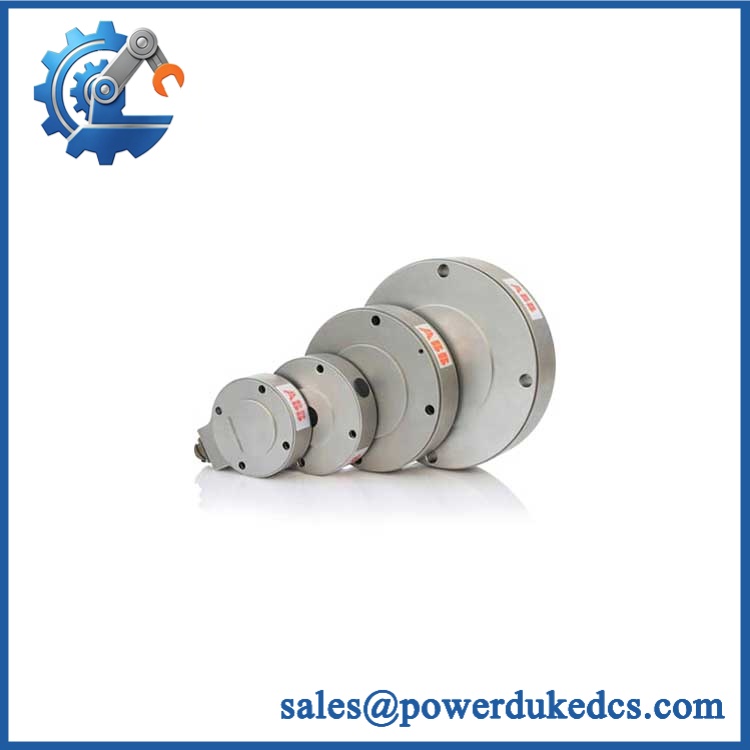
ABB PFRL101C-1.0
ABB’s product documentation specifies the PFRL101 family with nominal capacities from 0.5 to 2.0 kN for the relevant PFRL101 variants, while the PFRL101C 1.0 kN configuration is identified as 3BSE023316R1002. The mechanical drawing specifies a 100 mm shaft-related dimension.
Application Scenarios & Pain Points
On a film-converting line, unstable web tension can quickly become a product-quality problem. The -1.0 measures radial force at the shaft-mounted load-cell position, supplying the measurement basis required by the web-tension control system. ABB specifically identifies plastic-film and converting machinery among the target applications.
Printing machinery presents another demanding use case. Uneven tension can contribute to registration and material-handling problems, making accurate force measurement important throughout the production process. The family is designed for web-tension applications in printing machinery.
Textile processing also benefits from continuous tension measurement. The family is intended for textile machinery, where maintaining controlled web tension helps prevent excessive material stress and process variation.
In high-temperature production areas, installation conditions still matter. ABB documentation gives an operating temperature range of -10 to 80°C for the family, so cabinet, shaft, and surrounding machinery temperatures should remain within the specified range.
Common Error Codes & Diagnostic Symptoms
Symptom: Web tension reading becomes unstable
→ Diagnosis: A damaged load cell, mechanical mounting problem, shaft misalignment, or degraded connection can cause unstable force signals.
→ Action: Inspect mechanical installation and signal wiring; replace the -1.0 if the transducer is confirmed defective.
Symptom: Tension measurement remains consistently incorrect
→ Diagnosis: Incorrect load-cell configuration, mechanical loading, zero-point deviation, or sensor damage may cause a persistent measurement error.
→ Action: Verify the mechanical installation and calibration parameters, then test the load cell against a known reference.
Symptom: No usable tension signal from the measurement channel
→ Diagnosis: An open circuit, damaged sensor, poor connector connection, or internal load-cell failure may interrupt the measurement signal.
→ Action: Check the signal path and associated PFEA electronics before replacing the load cell.
Important: The -1.0 is a load cell, not a PLC CPU or standalone controller. Numerical fault codes are normally generated by the associated tension electronics or host control system rather than by the load cell itself.
Cross-Reference & Lifecycle Migration
- Primary model:
- ABB article number: 3BSE023316R1002.
- Product family: Pressductor radial load cells.
- Related variants: ABB documents PFRL101A, PFRL101B, , and PFRL101D with different mechanical dimensions and load capacities.
- Direct substitution: Do not a .0 with another variant solely because the connector or housing appears similar. Rated load and mechanical dimensions must match the application.
- Mechanical distinction: The uses a 100 mm shaft-related dimension, while the A/B and D variants use different dimensions.
- Firmware: No firmware is required in the load cell itself. Configuration and signal processing are handled by the associated tension electronics.
- Lifecycle: ABB currently maintains a dedicated product page and service offering, including commissioning, maintenance, repair, and spare-part services.
- Buffer-stock strategy: For a critical web-processing line, stocking the exact variant is preferable to holding a different-capacity as an assumed substitute.
Field Engineer’s Tech Notes
Warning 1 — Check the mechanical load path before blaming the sensor.
A load cell can produce an apparently bad tension signal when the shaft, mounting bracket, bearings, or mechanical alignment is incorrect. The dimension drawing identifies a 100 mm shaft-related dimension, so verify the mechanical interface before installing a replacement.
Warning 2 — Do not treat the load cell like a conventional strain-gauge sensor.
ABB’s Pressductor technology uses a magneto-elastic measurement principle and produces a high-power, low-impedance AC signal. Use the specified ABB tension electronics and wiring arrangement rather than applying generic strain-gauge excitation methods.
Strict QA & Testing SOP
- Part identification — Confirm and, where applicable, ABB article number 3BSE023316R1002.
- Label inspection — Record product markings, serial information, and manufacturing data.
- Mechanical inspection — Check the load-cell body, shaft interface, mounting surfaces, and mechanical dimensions.
- Connector inspection — Examine the electrical connection for bent contacts, contamination, corrosion, or mechanical damage.
- Environmental inspection — Check for excessive heat, moisture, oil, dust, or other contamination.
- Mechanical installation check — Verify shaft alignment, mounting position, and mechanical loading before electrical testing.
- Signal testing — Connect the load cell to the appropriate ABB tension electronics and verify the measurement signal.
- Zero-point verification — Confirm stable unloaded output and investigate excessive drift.
- Load testing — Apply controlled mechanical loads within the specified operating range and verify the response.
- Functional verification — Confirm stable tension measurement through the complete measurement chain.
- Final inspection — Record test data and photographs before packaging.
- ESD and mechanical protection — Protect the electrical connection and cushion the load-cell body against impact during shipment.
Test videos are available upon request for units that undergo functional testing.
Buyer’s FAQ
e .0 a 1.0 kN load cell?
A: Yes. ABB lists the configuration with a 1.0 kN nominal load, equivalent to approximately 225 lbf. Its extended load is 1.5 kN.
Q: What is the ABB article nr .0?
A: ABB documentation identifies the 1.0 kN configuration as 3BSE023316R1002.
Q: Can I use a PFRL101A, B, or D instead?
A: Not as an automatic substitute. The variants have different rated capacities and mechanical dimensions. The uses a 100 mm shaft-related dimension, so both mechanical fit and rated load must be checked.
Q: What should I check if the tension signal is unstable after replacement?
A: Start with mechanical alignment and mounting, then inspect the signal wiring and associated PFEA tension electronics. Do not immediately assume the new load cell is defective; mechanical loading errors can produce the same symptom.


 Start Chat