

Description
- Brand: ABB
- Full Model Number: PM862K01
- ABB Article Number: 3BSE076940R1
- Product Family: AC 800M
- Lifecycle Status: Current product-series listing; software compatibility specifically restricted by ABB
- Core Function in System: AC 800M processor unit for System 800xA control applications
- Top 3 Hardcore Specs: 67 MHz MPC866 processor; 32 MB memory; 23.521 MB RAM available for application
- Application Cycle Time: Down to 1 ms
- Boolean Performance: 0.18 ms per 1,000 Boolean operations
- Ethernet: 2 × RJ45, 10 Mbit/s
- Serial Interfaces: 2 × RJ45 serial ports; COM3 RS-232C with modem control, COM4 isolated configuration port
- Power Supply: 24 V DC, 19.2–30 V DC
- Power Consumption: 210 mA typical / 360 mA maximum
- Power Dissipation: 5.1 W typical / 8.6 W maximum
- ModuleBus Capacity: Up to 96 I/O modules with a single PM862
- Dimensions: 119 × 186 × 135 mm
- Weight: 1.2 kg including base
- Condition & Lead Time: New replacement inventory subject to hardware/software verification; emergency dispatch based on confirmed stock
ABB’s current hardware selector identifies 3BSE076940R1 as the article number for PM862K01. The unit contains a 67 MHz MPC866 processor, 32 MB memory, and 23.521 MB RAM available for application. ABB also identifies built-in redundant Ethernet communication ports and AC 800M CPU redundancy capability at the platform level.
Module 3: Technical Intro & Downtime Impact
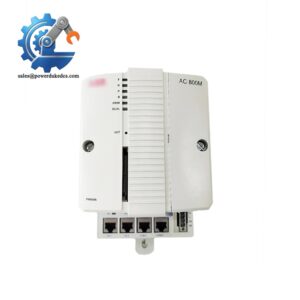
A failed AC 800M CPU can stop application execution, I/O processing, control sequences, and plant communication at the same time. ABB PM862K01, 3BSE076940R1 is an AC 800M processor unit intended for System 800xA control applications. Its 67 MHz MPC866 processor, 32 MB memory, Ethernet interfaces, CEX-Bus capability, and ModuleBus support make it the central execution point for a wide range of distributed control installations.
For MTTR reduction, the documented figures are clear: 67 MHz, 32 MB memory, 23.521 MB application RAM, 0.18 ms per 1,000 Boolean operations, and application cycle times down to 1 ms. The controller operates from 19.2–30 V DC, consumes approximately 210 mA typically and 360 mA maximum, and dissipates 5.1 W typical / 8.6 W maximum. The package includes the PM862 CPU, TP830 baseplate, TB850 and TB807 terminators, TB852 RCU-Link terminator, and memory-backup battery. —Software compatibility is the major commissioning checkpoint: ABB states that PM862K01 is compatible only with 800xA 6.0.2 and Compact Control Builder 6.0.0-1 and later.
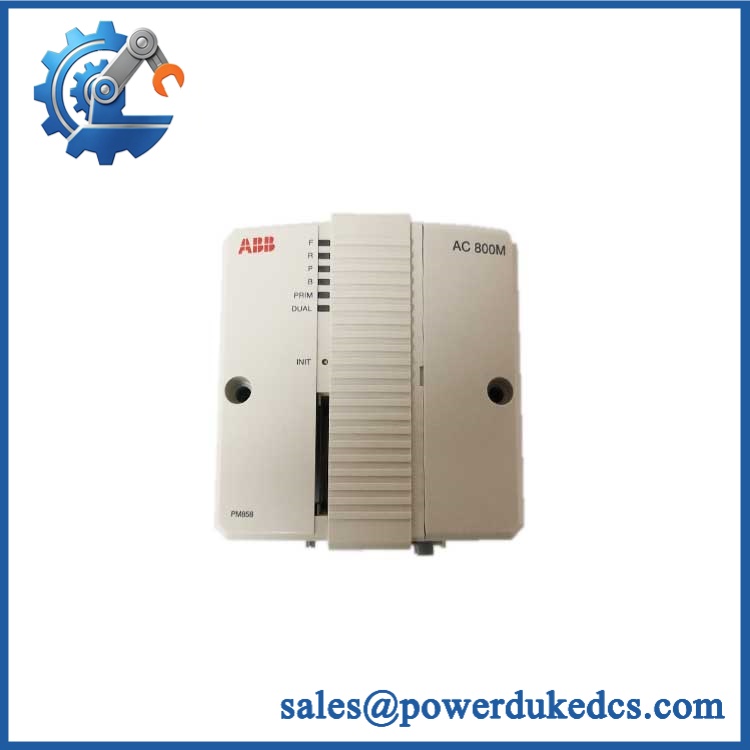
ABB PM862K01 3BSE076940R1
Module 4: Dynamic Emergency Swap & Configuration Guide
1. Pre-Swap Prep — Capture the complete AC 800M state
- Place the affected controller/process in the approved maintenance condition.
- Determine whether the system uses a single PM862 or a redundant PM862K02 arrangement.
- Isolate the controller’s 24 V DC supply where required.
- Record PM862K01 / 3BSE076940R1 and hardware revision.
- Record the installed firmware version and 800xA/Compact Control Builder revision.
- Back up the controller application and project configuration.
- Record the Ethernet hardware address from the TP830 baseplate.
- Photograph Ethernet, serial, CEX-Bus, ModuleBus, RCU-Link, terminator, and neighboring-module connections.
- Verify the memory-backup battery condition.
- Use ESD protection before touching the CPU or baseplate.
ABB states that every TP830 baseplate has a unique Ethernet address that provides the CPU hardware identity. The PM862K01 package also includes the TB852 RCU-Link terminator, which should be accounted for during replacement.
2. Removal — Use the AC 800M slide-and-lock mechanism
- Confirm the controller has entered the approved safe state.
- Isolate and verify the 24 V DC supply.
- Disconnect Ethernet and serial connections as documented.
- Preserve CEX-Bus, ModuleBus, and RCU-Link connections unless the approved procedure requires removal.
- Release the TP830 slide-and-lock mounting mechanism.
- Withdraw the PM862 CPU/baseplate assembly carefully.
- Keep the CPU aligned with the baseplate connector.
- Inspect the TP830 baseplate, contacts, terminators, and adjacent modules for contamination, corrosion, bent contacts, or thermal damage.
ABB explicitly specifies a simple DIN-rail attachment and detachment procedure using the slide-and-lock mechanism for the PM862 controller baseplate.
3. Installation & Configuration — Preserve the software and hardware identity
- Verify ABB / 3BSE076940R1 before installation.
- Confirm compatibility with the installed 800xA 6.0.2 / Compact Control Builder 6.0.0-1 or later environment.
- Install the CPU and TP830 baseplate in the original position.
- Engage the slide-and-lock mechanism fully.
- Reconnect both Ethernet ports and required serial connections.
- Verify the Ethernet address against the recorded value.
- Confirm TB850 CEX-Bus, TB807 ModuleBus, and TB852 RCU-Link termination.
- Restore the backed-up controller application and configuration.
- Verify CEX-Bus modules, ModuleBus I/O configuration, IP settings, and communication parameters.
- Confirm redundant power-supply status inputs where used.
- Do not treat a replacement CPU with factory defaults as production-ready.
ABB’s package documentation lists the CPU, baseplate, TB850, TB807, TB852, and backup battery as included items. The same ABB catalog explicitly restricts compatibility to the specified newer 800xA and Compact Control Builder releases.
4. Power-On Self-Test (POST) — Validate CPU, buses, and application
- Apply 24 V DC using the approved AC 800M startup procedure.
- Observe CPU status LEDs and the INIT indication.
- Confirm the controller reaches its normal operating state.
- Verify Ethernet link and control-network communication.
- Confirm the engineering environment recognizes the CPU.
- Verify application loading or retained application state.
- Check CEX-Bus communication.
- Check ModuleBus communication.
- Confirm configured I/O modules appear online.
- Verify RCU-Link status where applicable.
- Check alarms, interlocks, and critical sequence logic.
- Perform a controlled application restart where required.
- Release the controller back to process control only after the complete diagnostic chain passes.
The PM862 CPU board contains the microprocessor, RAM, real-time clock, LED indicators, INIT push button, and CompactFlash interface. The baseplate provides the two RJ45 Ethernet ports plus COM3 and COM4 serial interfaces.
Module 5: Quality Assurance & Testing SOP
QA should verify the controller as a complete AC 800M processor package. Hardware identification, software compatibility, communication, and I/O behavior all need to agree before release.
1. OEM identity verification
- Verify ABB
- Verify
- Verify 3BSE076940R1
- Confirm CPU and baseplate
- Check hardware revision
- Verify TB850, TB807, and TB852 termination hardware
- Perform OEM anti-counterfeit visual inspection
- Photograph all identification and revision markings
2. Physical inspection
- Inspect CPU housing for cracks, deformation, contamination, and impact damage
- Check baseplate and DIN-rail locking mechanism
- Inspect Ethernet and serial connectors
- Check CEX-Bus, ModuleBus, and RCU-Link interfaces
- Verify memory-backup battery installation
- Inspect LED indicators and INIT push button
- Check for thermal discoloration or unauthorized PCB rework
3. Electrical screening
- Verify 24 V DC input within 19.2–30 V DC
- Measure controller current consumption under approved conditions
- Verify expected power dissipation behavior
- Check protective-earth continuity where applicable
- Inspect terminal and connector integrity
- Verify redundant power-supply status inputs where configured
- Do not apply arbitrary hipot voltages to populated controller electronics
4. Functional testing
- Power up in an approved AC 800M test environment
- Perform power-on self-test
- Check CPU status indications
- Verify firmware revision
- Verify engineering-tool recognition
- Test both Ethernet interfaces
- Test COM3 RS-232C functionality where required
- Verify COM4 configuration interface
- Verify CEX-Bus communication
- Verify ModuleBus communication
- Confirm representative I/O modules are recognized
- Perform I/O full-range simulation on applicable test channels
- Load a controlled test application
- Verify task execution
- Verify controller restart and application recovery
- Check alarm and event handling
- Record firmware, application revision, network parameters, supply voltage, current consumption, and test results
ABB specifies 32 applications per controller, 64 programs per application, 32 tasks per controller, and up to 96 I/O modules on ModuleBus for a single . ModuleBus scan time is specified from 0–100 ms, depending on the number of connected I/O modules.
5. Final QC release
- Independent QC sign-off
- Configuration backup retained
- Firmware compatibility recorded
- Battery condition recorded
- ESD-safe packaging
- Connector protection
- Final cross-check of / 3BSE076940R1
- Retain communication and I/O test reports
- Release only after controller and bus tests pass
Module 6: Maintenance & Reliability FAQ
Q1. Is ABB 3BSE076940R1 a direct drop-in replacement, or does it require a firmware flash?
The mechanical installation follows the AC 800M architecture, but it is not a blind replacement. ABB specifically states that is compatible only with System 800xA 6.0.2, Compact Control Builder 6.0.0-1, and later. Before installation, verify the controller firmware, engineering-software revision, application compatibility, CEX-Bus configuration, and ModuleBus configuration.
Q2. Is it safe to hot-swap the while the system is running?
Do not assume live replacement is permitted. is the execution controller for the AC 800M system, so withdrawal can interrupt application execution and I/O communications. Unless the specific system architecture provides an approved live-maintenance procedure, isolate the controller before removal.
Q3. Will replacing the cause my current program or configuration to be lost?
Back up the complete controller application and configuration before removal. Record the firmware revision, Ethernet configuration, hardware address, CEX-Bus setup, ModuleBus topology, I/O assignments, task settings, and controller parameters. The backup battery also needs to be checked as part of the replacement procedure.
Q4. How much processing and memory capacity does the provide?
ABB specifies a 67 MHz MPC866 processor, 32 MB memory, and 23.521 MB RAM available for application. The controller is specified at 0.18 ms per 1,000 Boolean operations, with application cycle times down to 1 ms. Actual execution performance depends on the application structure and connected I/O workload.
Q5. What should I verify before ordering a replacement?
Verify , 3BSE076940R1, hardware revision, firmware compatibility, baseplate compatibility, Ethernet hardware address, CEX-Bus configuration, ModuleBus topology, RCU-Link termination, memory-backup battery, and the installed 800xA/Compact Control Builder version. Also confirm whether the plant requires a single or a redundant PM862K02 pair. ABB lists PM862K02 separately as the redundant processor-unit package.



 Start Chat