

Description
- Brand: ABB
- Full Model Number: PP D113 B01-26-111000
- ABB Product ID: 3BHE023784R2630
- Lifecycle Status: Active catalog item; ABB record indicates Made To Order: No
- Core Function in System: AC 800PEC high-performance control unit for power-electronics and excitation applications
- Top 3 Hardcore Specs: Control cycle down to 100 μs; ANYIO-1 CEX2-Bus RS422; ANYIO-2 Anybus/Modbus RTU
- Optical Communication: Fiber-optic communication supported within the AC 800PEC architecture
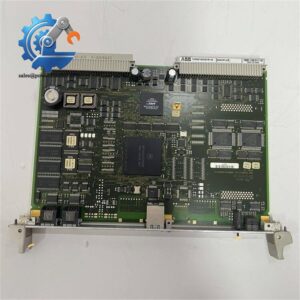
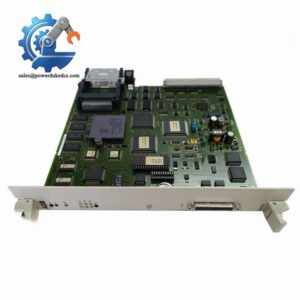
- Expansion Configuration: U7-U9 populated with UF D128; U10-U12 empty
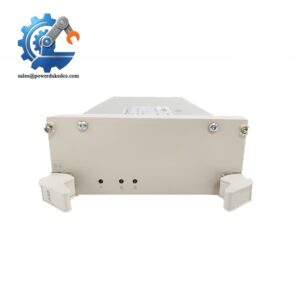
- Physical Dimensions: 145 × 450 × 100 mm
- Net Weight: 2.59 kg
- Condition & Lead Time: New replacement inventory subject to physical verification; emergency dispatch based on confirmed stock
ABB-associated product data identifies 3BHE023784R2630 as PP D113 B01-26-111000: AC 800PEC. The recorded configuration includes CEX2-Bus RS422, Anybus/Modbus RTU, three UF D128 populated option slots, three empty option slots, and a net weight of 2.59 kg.
Module 3: Technical Intro & Downtime Impact
At 3 AM, losing the AC 800PEC controller can halt time-critical excitation or power-electronics control even when the associated power stage remains electrically intact. The ABB PPD113B01-26-111000, Product ID 3BHE023784R2630, is an AC 800PEC control unit built for high-speed control applications. Its documented configuration includes dedicated communication interfaces and multiple UF D128 positions, making exact hardware identification critical before a breakdown replacement.
MTTR improves when the replacement is identified by its complete ordering code rather than by enclosure appearance alone. This version has a documented 100 μs minimum control-cycle capability, RS422 CEX2-Bus on ANYIO-1, Anybus/Modbus RTU on ANYIO-2, and a physical size of 145 × 450 × 100 mm at 2.59 kg. The published product information does not establish a universal RAM figure, nominal controller supply voltage, or single operating-temperature specification for every installed AC 800PEC configuration, so those values should be taken from the applicable system documentation.
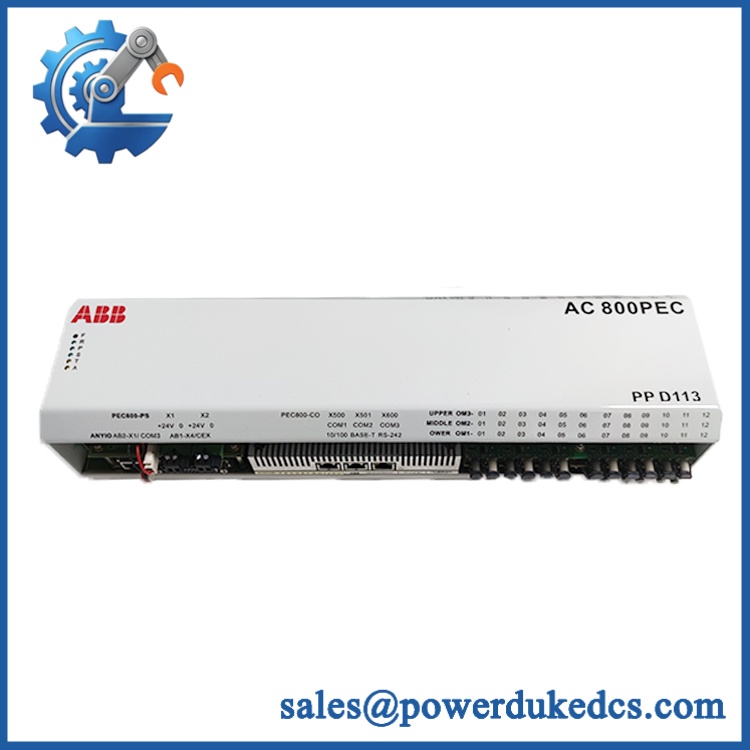
ABB PPD113B01-26-111000
Module 4: Dynamic Emergency Swap & Configuration Guide
1. Pre-Swap Prep — Isolate the AC 800PEC rack
- Place the excitation or power-electronics system in its approved maintenance state.
- Complete electrical isolation according to the host system procedure.
- Verify hazardous stored energy has been removed before accessing the controller enclosure.
- Photograph the existing controller, connector arrangement, and all installed option positions.
- Record PPD113B01-26-111000 / 3BHE023784R2630 and the hardware revision.
- Use ESD protection before touching the controller or its internal interfaces.
2. Removal — Preserve the slot and connector arrangement
- Disconnect external interfaces only after the system is confirmed safe.
- Label ANYIO-1 and ANYIO-2 connections before removal.
- Document the three populated UF D128 positions at U7, U8, and U9.
- Release the controller’s retaining hardware using the approved cabinet procedure.
- Withdraw the controller evenly from its mechanical mounting arrangement.
- Inspect mating connectors and adjacent wiring for bent contacts, oxidation, contamination, or heat damage.
3. Installation & Configuration — Match the exact AC 800PEC build
- Verify the replacement identification: PP D113 B01-26-111000 / 3BHE023784R2630.
- Confirm that the replacement has the same documented option-slot population.
- Install the controller in the original orientation and secure all retaining hardware.
- Reconnect CEX2-Bus RS422 and Anybus/Modbus RTU interfaces according to the recorded configuration.
- Confirm the three UF D128 units are assigned to the correct positions.
- Restore documented communication parameters, addresses, jumpers, and application configuration.
- Do not assume default settings will match the failed controller.
- Do not flash firmware unless the applicable ABB engineering documentation calls for a specific revision.
4. Power-On Self-Test (POST) — Confirm controller and communications
- Re-energize using the approved AC 800PEC startup sequence.
- Observe controller diagnostic indicators during initialization.
- Confirm there is no persistent controller or communication fault.
- Verify CEX2 and Anybus/Modbus communication with the connected control system.
- Confirm the expected optical communication path to the power stage where applicable.
- Run a controlled functional test before reconnecting the process to full operating conditions.
The AC 800PEC documentation describes a 100 μs control-cycle capability, IEC 61131-3 programming support, MATLAB/Simulink integration, and FPGA-based implementation of protocol and application functions. Exact indicator behavior and startup sequencing remain installation-dependent, so the host-system manual should be treated as the controlling document.
Module 5: Quality Assurance & Testing SOP
The pre-shipment inspection should treat this AC 800PEC as a configured controller assembly, not simply as a generic PCB. Every populated interface and option position must agree with the required ordering code.
1. OEM identity verification
- Verify ABB
- Verify PP D113 B01-26-111000
- Verify 3BHE023784R2630
- Compare product labels, identification markings, connector layout, and hardware revision
- Perform OEM anti-counterfeit visual inspection
- Photograph all identification markings
2. Configuration inspection
- Confirm ANYIO-1: CEX2-Bus RS422
- Confirm ANYIO-2: Anybus/Modbus RTU
- Confirm U7: UF D128
- Confirm
- Confirm
- Confirm U10-U12: empty, unless the supplied configuration is specifically required otherwise
- Compare the physical assembly against the documented product configuration
3. Physical inspection
- Inspect enclosure, PCB areas, connectors, and mounting hardware
- Check for corrosion, contamination, cracked housings, bent contacts, and thermal damage
- Inspect fiber-optic interfaces for contamination or mechanical damage where fitted
- Record dimensions and physical condition against the expected 145 × 450 × 100 mm assembly size
- Verify the measured shipping unit against the documented 2.59 kg net weight where practical
4. Functional testing
- Perform power-on self-test in an approved compatible AC 800PEC test environment
- Check applicable RUN/ERR or equivalent diagnostic indicators
- Confirm controller initialization
- Verify -Bus communication
- Verify Anybus/Modbus RTU communication
- Exercise available I/O through a controlled simulation fixture
- Perform I/O full-range simulation only on interfaces actually present in the tested configuration
- Verify communication behavior before release
- Record test conditions, hardware revision, diagnostic observations, and results
5. Final QC release
- Independent QC sign-off
- ESD-safe packaging
- Connector and optical-port protection
- Final cross-check of PPD113B01-26-111000 / 3BHE023784R2630
- Retain inspection photographs and test records with the shipment documentation
ABB-related product data lists the assembly as an AC 800PEC unit and specifies the installed interface/option configuration, dimensions, and weight. Those details should be checked during receiving inspection because a superficially similar AC 800PEC assembly may not have the same internal configuration.
Module 6: Maintenance & Reliability FAQ
Q1. Is ABB PPD113B01-26-111000 a direct drop-in replacement, or does it require a firmware flash?
Treat it as a configuration-controlled replacement. Match the complete PP D113 B01-26-111000 / 3BHE023784R2630 identification and installed hardware configuration first. Firmware should be changed only when the applicable ABB engineering documentation specifies the required version. The published specification confirms the AC 800PEC platform and its configured interfaces, but it does not define one universal firmware requirement for every installation.
Q2. Is it safe to hot-swap this controller while the system is running?
Do not assume that live removal is permitted. This is a system controller used in excitation and power-electronics applications, so the site’s electrical isolation procedure and the specific AC 800PEC installation manual should govern replacement. Shut down and isolate the equipment unless the exact configuration has documented hot-swap support.
Q3. Will replacing the AC 800PEC controller cause my current program or configuration to be lost?
The replacement should be preceded by a verified backup of the application and hardware configuration. Record communication parameters, addresses, controller settings, option-slot assignments, and software revision before removal. After installation, restore only the documented configuration and verify it against the pre-failure record before enabling the process.
Q4. Does the 100 μs figure apply to every application running on this controller?
No. ABB documentation describes AC 800PEC as capable of control cycle times down to 100 μs, but actual execution time depends on the application, task structure, configured functions, I/O workload, and system architecture. It should therefore be treated as a documented platform capability rather than a guaranteed cycle time for every user program.
Q5. What are the warranty terms if the replacement fails after installation?
Warranty coverage should be defined in the supplier’s written terms before purchase. Keep the serial or identification photographs, inspection report, test results, installation record, alarm history, and failure evidence. Those records are important when determining whether the failure originated in the controller or from the surrounding excitation system, power supply, communication network, or configuration.



 Start Chat