

Description
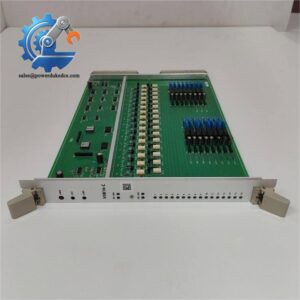
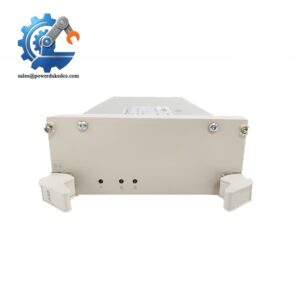
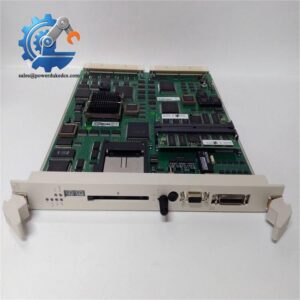
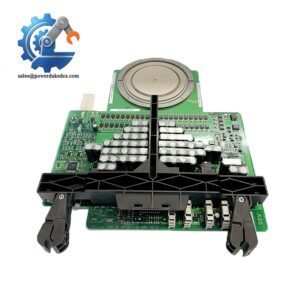
- Model & Brand: ABB PPD513A0E-110110, part number 3BHE039724R0E41.
- Product Identity: Available supplier records identify this reference as a redundant power supply / industrial power module. Public listings are inconsistent about the exact ABB system association, so the nameplate and OEM documentation should control final asset classification.
- Input: Published technical data lists 110–120 VAC nominal, within a reported 90–264 VAC input range.
- Output: Reported as 24 VDC, 10 A continuous, approximately 240 W.
- Physical Dimensions: Approximately 180 × 40 × 125 mm (W × H × D) according to one technical listing. Treat this as preliminary until the exact mechanical revision is measured or confirmed by ABB.
- Estimated Shipping Weight: Allow approximately 1–2 kg packaged for preliminary freight planning. A verified packed weight should be used for the commercial invoice.
- What’s in the Box: Power-supply module and manufacturer packaging. Do not assume mounting hardware, mating connectors, or external accessories are included.
Product Introduction
Power continuity is the defining consideration for this component. The PPD513A0E-110110 / 3BHE039724R0E41 is publicly documented as a redundant power-supply unit with dual AC inputs and a 24 VDC output rated at 10 A continuous. The reported architecture provides a rapid transfer between redundant inputs (the published figure is below 200 μs).
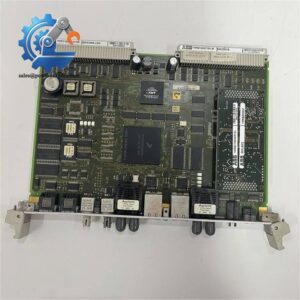
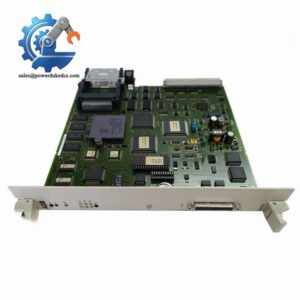
There is an important asset-control issue here. Several third-party databases incorrectly classify the same part number as a controller, protection relay, or AC 800M processor, while another listing calls it an industrial power-distribution device. Do not use those descriptions interchangeably. For procurement and customs records, verify the physical nameplate, ABB ordering code, hardware revision, and applicable ABB manual before assigning the final functional classification.
Core Technical Specifications
| Parameter | Value |
|---|---|
| Manufacturer | ABB |
| Model | PPD513A0E-110110 |
| ABB Part Number | 3BHE039724R0E41 |
| Product Type | Redundant Power Supply |
| Nominal Input | 110–120 VAC |
| Reported Input Range | 90–264 VAC |
| Input Frequency | Not independently verified |
| Input Configuration | Dual redundant AC inputs |
| Output Voltage | 24 VDC |
| Output Tolerance | ±0.5% reported |
| Continuous Output Current | 10 A |
| Approx. Output Power | 240 W at 24 VDC |
| Transfer Time | <200 μs reported |
| Efficiency | Approximately 94% at full load, per supplier data |
| Power Factor | >0.98 reported |
| Protection | Overvoltage, overcurrent, short circuit, overtemperature |
| Operating Temperature | -25°C to +70°C reported; derating above 55°C |
| Dimensions | Approx. 180 × 40 × 125 mm |
| Mounting | Verify exact cabinet/mechanical arrangement from ABB documentation |
| Firmware | Not applicable as a conventional programmable controller firmware asset |
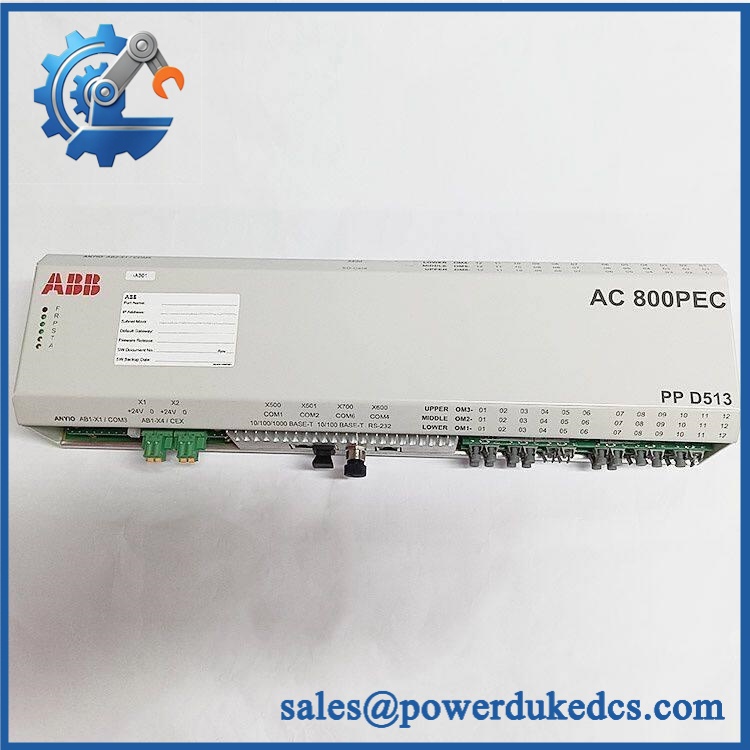
- ABB PPD513A0E-110110
The 240 W figure is a calculated nominal output capacity from 24 V × 10 A. Do not confuse this with actual cabinet heat dissipation; thermal loss depends on input voltage, load, efficiency, and ambient temperature.
The available technical record reports approximately 94% full-load efficiency, which would imply roughly 15 W of heat loss at 240 W output under that operating condition. This is an engineering estimate, not a certified thermal-dissipation specification.
? Global Compliance & Industry Certifications
Potential compliance documentation for this class of ABB industrial power equipment should be checked for:
- CE Mark — relevant for applicable European-market configurations.
- UL/cUL — verify the exact certification file and product revision rather than relying on a generic ABB family listing.
- IEC 61508 / SIL documentation — one supplier claims SIL 3 certification, but this claim requires verification against an actual ABB certificate before being used in a safety case.
- ATEX/IECEx — do not assume hazardous-area approval unless the exact 3BHE039724R0E41 configuration has the required certificate.
- Marine approvals — DNV, ABS, or similar approval should only be recorded when supported by the applicable certificate.
For a redundant control-system power supply, certification affects more than procurement paperwork. The approved input configuration, isolation characteristics, environmental limits, and installation conditions can determine whether the module is acceptable for a particular plant cabinet or hazardous-area boundary.
Verify specific lot certifications with OEM.
? Long-Term Storage & Asset Preservation Guide
- Keep the module sealed and dry. Store it in its original packaging or suitable ESD-protective packaging. Maintain a stable warehouse environment and avoid condensation, especially after movement between hot and cold storage areas.
- Protect the terminal and connector surfaces. Do not allow the exposed electrical interfaces to contact metal shelving or other loose hardware. Oxidation or mechanical damage at the connection points can create a seemingly intermittent power fault after installation.
- Record the date code and inspection history. For long-held DCS spares, record the incoming condition, packaging status, and any visible capacitor or enclosure abnormalities. Before energization, inspect for swelling, leakage, corrosion, contamination, and damaged insulation.
A power supply that has sat untouched for years should not be treated as automatically installation-ready. Test it under a controlled maintenance procedure before committing it to a live redundant power bus.
Physical Installation Prerequisites
- Confirm the exact ABB mounting arrangement before cabinet installation. Public listings disagree on whether this reference should be treated as a DIN-rail-mounted module, a dedicated power assembly, or another ABB system component; the physical nameplate and ABB documentation should take precedence.
- Provide sufficient clearance around ventilation openings for convection cooling. Do not obstruct the enclosure with adjacent wiring ducts or cable bundles.
- Maintain protective-earth bonding according to the applicable ABB cabinet design.
- Verify both redundant AC input paths independently before energization.
- Confirm the 24 VDC output polarity and load rating before connecting downstream control equipment.
- Use the specified terminal hardware and torque values from the applicable ABB installation documentation.
- Do not hot-swap the module unless the exact ABB system documentation explicitly permits live replacement.
Buyer’s FAQ
Q: Which HS tariff code should be used for 3BHE039724R0E41?
Do not assign an HS code solely from the part number. The available records describe the item inconsistently, so the customs classification should be based on its verified function as an industrial power supply and validated against the importing country’s tariff schedule.
Q: What Country of Origin should be declared?
Do not copy the COO from an online supplier page. One current listing states USA, but that is a supplier assertion rather than sufficient OEM-origin evidence. Use the physical product marking, ABB documentation, or a supplier-issued COO supported by the actual unit.
Q: Should shipping insurance be purchased?
Yes, particularly for international shipment. The module should be protected against impact, moisture, and connector damage, with insurance based on the actual replacement value rather than its relatively modest shipping weight.
Q: Does this module contain the latest firmware?
No conventional user firmware should be expected if the unit is confirmed as the redundant power supply described in the technical records. Firmware claims found in third-party listings that classify this same part as a processor should not be applied to the power-supply identity without ABB verification.


 Start Chat