

Description
- Full Model Number: SD833
- ABB Article Number: 3BSC610066R1
- Lifecycle Status: Current ABB Compact Product Suite item
- Core Function in System: Regulated 24 V DC power supply for ABB control and I/O systems
- Top 3 Hardcore Specs: 24 V DC output; 10 A rated output; 240 W rated output power
- Input Voltage: 100–120 V AC / 200–240 V AC auto-select
- Frequency: 50–60 Hz ±6%
- Mounting: DIN rail
- Maximum Ambient Temperature: 55 °C
- Output Protection: Current limiting and over-voltage protection
- Dimensions: 60 × 124 × 117 mm
- Weight: 0.7 kg
- Condition & Lead Time: New replacement stock subject to physical verification; emergency dispatch based on confirmed inventory
ABB identifies SD833 as a switch-mode power supply with article number 3BSC610066R1. Its rated output is 24 V DC at 10 A, providing 240 W, with an auto-select AC input of 100–120 V or 200–240 V. ABB specifies DIN-rail mounting and protection against overcurrent and overvoltage.
Module 3: Technical Intro & Downtime Impact
A failed 24 V control supply can shut down an entire automation cabinet even when the controller, I/O stations, and field devices are otherwise healthy. ABB SD833 is a regulated switch-mode power supply designed to provide the 24 V DC control power required by ABB control and I/O equipment. With a 10 A rated output and 240 W capacity, it is sized for substantial cabinet loads rather than a small auxiliary circuit.
For MTTR reduction, the electrical checks are unusually clear: 24 V DC output, 10 A nominal current, 240 W power, 100–120/200–240 V AC auto-select input, and 50–60 Hz operation. ABB also specifies approximately 46/47 ms holdup time during an AC mains interruption, 91/91.6% efficiency, and a maximum ambient temperature of 55 °C. The unit measures approximately 60 × 124 × 117 mm and weighs 0.7 kg. —The cabinet load should still be calculated from the actual 24 V consumers rather than assuming the full 10 A is continuously available under every thermal condition.
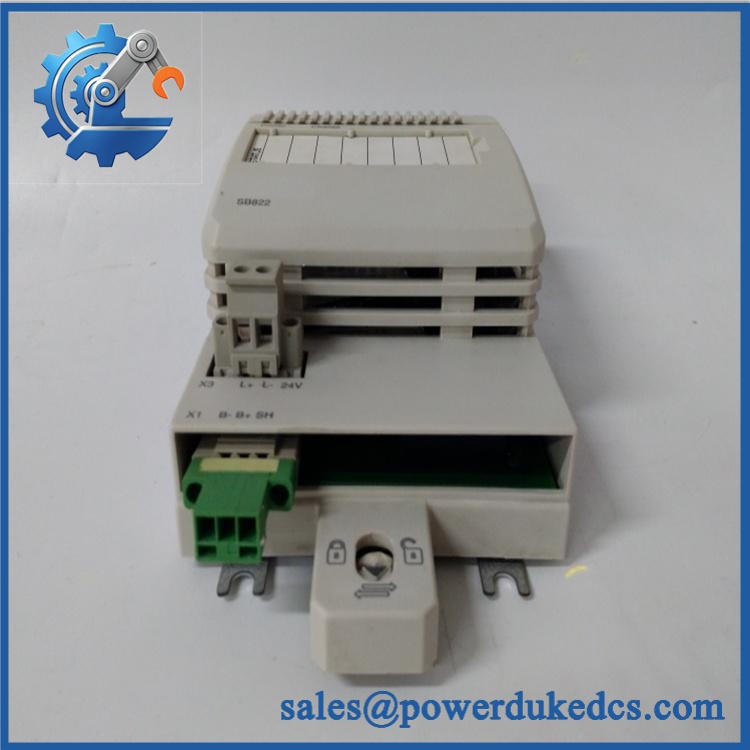
ABB SD833 3BSC610066R1
Module 4: Dynamic Emergency Swap & Configuration Guide
1. Pre-Swap Prep — Confirm the cabinet power architecture
- Place the control cabinet in the approved maintenance state.
- Isolate the AC source feeding the SD833.
- Apply site lockout/tagout.
- Verify absence of hazardous voltage at the AC input terminals.
- Record SD833 / 3BSC610066R1 and photograph the complete wiring arrangement.
- Identify all 24 V DC loads connected to the positive and negative output terminals.
- Check whether the supply is used alone or as part of a redundant arrangement with an ABB diode-voting unit.
- Use an appropriately rated meter and ESD controls during handling.
ABB states that SD83x power supplies can be used in both non-redundant and redundant applications; redundant configurations require an appropriate diode-voting unit such as SS823 or SS832.
2. Removal — DIN-rail mounted power supply
- Confirm AC input and DC output are electrically safe.
- Label the AC input and each DC output conductor before disconnecting.
- Disconnect the N, L, PE input conductors.
- Disconnect the L+ and L− DC output wiring.
- Release the SD833 from its DIN-rail retention mechanism.
- Remove the unit without pulling on connected wiring.
- Inspect the DIN rail, terminals, and adjacent components for heat discoloration, looseness, or corrosion.
ABB’s hardware documentation shows the as a DIN-rail-mounted unit with N/L/PE at the lower input connection and L+/L− at the upper output connection.
3. Installation & Configuration — Match voltage and wiring
- Verify ABB / 3BSC610066R1 before installation.
- Confirm the required AC input range is within the ‘s 100–120 V or 200–240 V AC specification.
- Mount the replacement securely on the DIN rail.
- Reconnect PE first according to the approved cabinet procedure.
- Reconnect AC input conductors to the correct terminals.
- Reconnect 24 V DC L+ and L− output conductors with correct polarity.
- Verify conductor size and terminal torque against the applicable ABB installation documentation.
- Check that downstream loads do not exceed the supply’s rated capacity.
- For redundant systems, verify the voting-unit arrangement before energization.
- Do not change the cabinet’s 24 V distribution architecture merely because the replacement physically fits.
4. Power-On Self-Test (POST) — Verify the 24 V rail
- Energize the AC input under the approved commissioning procedure.
- Confirm the front-panel OK indication illuminates.
- Measure the DC output before reconnecting sensitive downstream loads when practical.
- Verify the output remains within the specified operating range.
- Reconnect or enable downstream control loads in a controlled sequence.
- Monitor for output sag, overload behavior, abnormal heating, or repeated shutdown.
- Verify all connected controllers and I/O stations return to normal status.
- In a redundant configuration, verify the expected load-sharing/voting behavior.
ABB’s technical documentation shows an OK indicator on the front panel and states that the regulated output is 24 V DC. The documented output over-voltage protection operates below 39 V.
Module 5: Quality Assurance & Testing SOP
The is a cabinet power source, so incoming inspection should focus on accurate identity, insulation integrity, output stability, protection behavior, and thermal condition.
1. OEM identity verification
- Verify ABB
- Verify
- Verify 3BSC610066R1
- Compare front-panel markings, terminal arrangement, and physical configuration
- Perform OEM anti-counterfeit visual inspection
- Photograph the identification label and terminal markings
2. Mechanical inspection
- Inspect the enclosure for cracks, deformation, contamination, and impact damage
- Check DIN-rail retention hardware
- Inspect AC and DC terminal blocks for damage
- Check ventilation openings for obstruction
- Inspect for discoloration associated with overheating
- Verify approximate dimensions of 60 × 124 × 117 mm
- Confirm approximate net weight of 0.7 kg where required for inventory control
3. Electrical screening
- Verify PE continuity where applicable
- Check input terminals for mechanical integrity
- Verify DC output polarity
- Measure no-load output voltage using the approved test setup
- Verify output voltage under controlled load
- Check current-limiting behavior using an appropriate test fixture
- Verify over-voltage protection only with a manufacturer-approved procedure
- Do not apply arbitrary hipot voltages to an energized electronic supply
4. Functional testing
- Apply 100–120 V AC or 200–240 V AC within the permitted input range
- Confirm controlled startup without abnormal breaker or fuse operation
- Verify 24 V DC nominal output
- Apply controlled load up to the approved test level
- Check output regulation and ripple
- Verify the OK status indication
- Check response to controlled overload
- Verify shutdown/recovery behavior according to the approved procedure
- Where practical, verify short-circuit protection behavior
- Record input voltage, output voltage, load current, temperature, and test duration
ABB specifies output ripple below 50 mV peak-to-peak, output regulation at maximum current below approximately 70/100 mV, and a maximum output current of 12 A at ambient temperatures below 45 °C, despite the 10 A rated output.
5. Final QC release
- Independent QC sign-off
- ESD-appropriate packaging
- Terminal protection against impact
- Moisture and contamination protection
- Final cross-check of / 3BSC610066R1
- Retain electrical test results and inspection photographs
- Release only after output stability and protective-function checks pass
Module 6: Maintenance & Reliability FAQ
Q1. Is ABB 3BSC610066R1 a direct drop-in replacement, or does it require a firmware flash?
There is no firmware to flash. is a power supply. Compatibility depends on the AC input range, 24 V DC output requirement, 10 A load requirement, terminal arrangement, DIN-rail mounting, and cabinet architecture. ABB identifies 3BSC610066R1 as the article number for .
Q2. Is it safe to hot-swap the while the system is running?
Do not assume live replacement is permitted. The unit has an AC mains input and a 24 V DC output feeding control equipment, so normal replacement requires isolation of the supply and verification of the electrical state. Redundant systems may have different service procedures, but those must be explicitly documented for the installed architecture.
Q3. Will replacing the cause my current program or configuration to be lost?
The does not store the PLC or controller application. The operational risk is different: interruption of the 24 V rail can cause controllers and I/O devices to restart or drop offline. Before replacement, determine which equipment depends on the output and confirm that critical devices have an independent redundant supply or controlled shutdown procedure where required.
Q4. What is the actual output capacity of the ?
The rated output is 24 V DC at 10 A, equivalent to 240 W. ABB also specifies a maximum output current of 12 A at ambient temperatures below 45 °C. That 12 A figure should not be interpreted as the normal continuous design load; cabinet power budgeting should use the rated 10 A / 240 W value.
Q5. What should I verify before ordering an replacement?
Verify , 3BSC610066R1, input voltage, output voltage, required current, DIN-rail arrangement, terminal configuration, ambient temperature, and whether the cabinet uses redundant power supplies with a diode-voting unit. Also check the total 24 V DC load. At full rated output, ABB specifies approximately 24/22 W heat dissipation, which should be considered when evaluating cabinet thermal conditions.


 Start Chat