

Description
- Brand: ABB
- Full Model Number: YKU167G
- Identification Status: Public-source identification requires verification
- Likely Related ABB Type: YXU167G
- Related Part Number Found: YT204001-JE
- Product Type: Pulse Transform Unit
- Lifecycle Status: Legacy ABB industrial automation spare
- Core Function in System: Pulse-transform interface associated with ABB industrial control electronics
- Top 3 Hardcore Specs: YXU167G reference | YT204001-JE reference | Approx. 28 × 17 × 16.13 cm reported by secondary source
- Reported Weight: Approximately 0.287 kg
- Reported Origin: Sweden
- Condition & Lead Time: New inventory reported by secondary supplier; exact stock, revision, and identity require verification
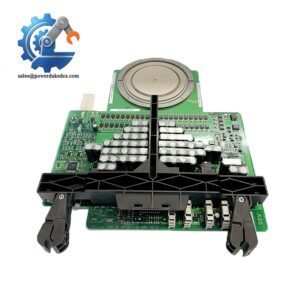
A secondary ABB parts listing identifies YXU167G / YT204001-JE as a Pulse Transform Unit, with an approximate size of 28 × 17 × 16.13 cm and weight of 0.287 kg. Another listing identifies YXU167F/YXU167G within ABB’s engineering-station control-board product family.
Module 3: Technical Intro & Downtime Impact
At a failed legacy control cabinet, a pulse-transform interface fault can be difficult to isolate because the symptoms may appear downstream as missing switching commands, abnormal control feedback, or converter-control faults rather than as an obvious transformer-unit failure. The available ABB-related documentation points to YXU167G / YT204001-JE as a Pulse Transform Unit, but I could not establish from reliable primary documentation that YKU167G is the exact same catalog designation.
For maintenance planning, that identification issue is itself a critical reliability consideration. Public secondary data reports approximately 28 × 17 × 16.13 cm and 0.287 kg for YXU167G / YT204001-JE, but no reliable primary-source record located here establishes a universal input voltage, pulse ratio, insulation rating, frequency range, MTBF, or operating-temperature specification for the exact YKU167G marking.Those values should therefore not be inserted into a purchasing specification until the nameplate, cabinet drawing, or original ABB documentation has confirmed the exact part. For an emergency spare, correct identification can prevent a much longer fault-finding cycle caused by installing a visually similar but electrically different pulse-transform assembly.
Module 4: Dynamic Emergency Swap & Configuration Guide
1. Pre-Swap Prep — Confirm the Exact Part Before Isolation
Apply the plant’s approved LOTO procedure and isolate the cabinet circuit associated with the suspected pulse-transform unit. Photograph the original nameplate, connector positions, terminal markings, PCB reference designators, and wire routing.
Most importantly, verify whether the installed part is actually marked YKU167G or . The available ABB-related sources support / YT204001-JE, not a definitive YKU167G catalog identity.Do not proceed on model-name similarity alone.
2. Removal — Disconnect the Pulse-Transformer Assembly Without Pulling the Wiring
Once the circuit is electrically safe, label every connected conductor and connector. Release retaining hardware and remove the unit while supporting the assembly. Avoid pulling directly on small-gauge control wiring or stressing any PCB-mounted transformer terminals.
Inspect the removed unit for overheated windings, cracked solder joints, damaged connectors, discoloration, or evidence of mechanical impact. Those observations can help determine whether the primary failure originated in the pulse-transform unit or in an upstream switching circuit.
3. Installation & Configuration — Reproduce the Original Wiring Exactly
Install the replacement only after matching the exact identification and terminal arrangement. Restore each conductor according to the original electrical drawing, including polarity or winding orientation where specified.
There is no reliable evidence supporting a universal jumper, DIP-switch, or firmware procedure for the exact YKU167G marking. The ABB-related documentation found here identifies it as a pulse-transform unit, so configuration should be driven by the host equipment drawing rather than by generic online specifications.
4. Power-On Self-Test (POST) — Verify Pulse Transfer Under Controlled Conditions
Restore power through the approved commissioning procedure and check for abnormal current draw, overheating, audible noise, or protection trips. Verify the associated controller or converter diagnostic state.
Where the test equipment permits, use an oscilloscope or suitable pulse measurement instrument to compare the replacement’s waveform against the known-good reference. Check pulse amplitude, timing, polarity, and repetition rate against the original equipment specification. A unit that merely passes a continuity check is not necessarily functional as a pulse transformer.
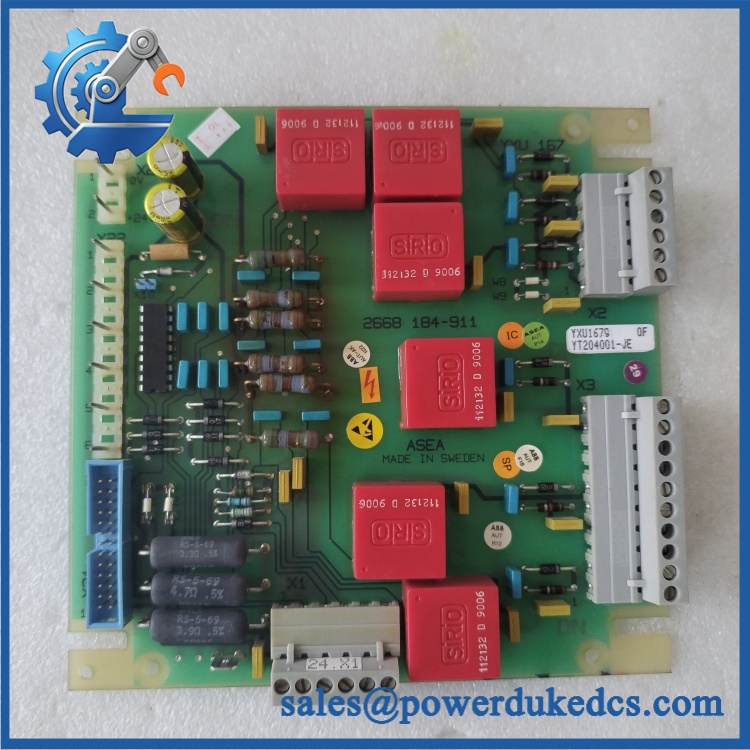
YKU167G
Module 5: Quality Assurance & Testing SOP
Each available unit marked should undergo a strict identification and functional QA process:
- OEM anti-counterfeit visual inspection — verify ABB markings, complete nameplate, type designation, serial number, PCB construction, connector quality, and manufacturing marks.
- Part-number reconciliation — compare the physical marking against and the customer’s BOM, schematic, and cabinet photographs.
- YXU/YKU cross-check — specifically determine whether the nameplate reads or . Public sources currently support / as the documented ABB-related item.
- Dimensional inspection — where the unit matches the reference, compare the approximate reported dimensions of 28 × 17 × 16.13 cm against the physical unit.
- Weight verification — compare the physical unit against the approximately 0.287 kg secondary-source reference where applicable.
- Connector and winding inspection — inspect terminals, transformer body, solder joints, insulation materials, and mechanical mounting points.
- Insulation test — perform the applicable winding-to-winding and winding-to-ground insulation test using the voltage specified by the original ABB equipment documentation.
- Continuity test — verify winding continuity and compare resistance against a known-good reference where available.
- Pulse waveform test — apply the specified driving waveform and verify transferred pulse amplitude, polarity, timing, and shape on the secondary side.
- Load simulation — connect the intended downstream test load and confirm stable pulse transmission without excessive heating or waveform distortion.
- Power-on self-test (POST) checking for ERR/RUN diagnostics — where the host cabinet provides diagnostic LEDs, record the complete startup state and any resulting fault codes.
- Extended operation test — run the assembly under representative pulse activity and monitor temperature, waveform stability, and insulation behavior.
- Final QA record — retain nameplate photographs, dimensional data, winding measurements, pulse-test screenshots, insulation results, and final packing photographs.
The strongest available evidence currently supports / as a pulse-transform unit; therefore, the supplier QA record should explicitly document the identification discrepancy rather than silently normalizing the part number.
Module 6: Maintenance & Reliability FAQ
Is the ABB a direct drop-in replacement, or does it require a firmware flash?
The exact designation could not be independently verified from the reliable sources located. The closest documented ABB reference is / , described as a Pulse Transform Unit.A pulse-transform unit is hardware, so firmware flashing would not normally be the primary replacement operation. Exact compatibility must be confirmed from the host equipment drawing and nameplate.
Is it safe to hot-swap the while the system is running?
Do not assume that it is. The available information does not establish a hot-swap procedure for this part, and pulse-transform assemblies can be connected to energized control circuitry. Use the applicable plant isolation and LOTO procedure before disconnecting the unit.
Will replacing the cause my current program to be lost?
There is no evidence that the pulse-transform unit itself stores the main control application. Replacing a passive transformer/interface assembly would therefore not normally erase the controller program. The host control system should still be backed up before maintenance, particularly where loss of power or accidental wiring changes could affect the controller.
What should I verify before ordering an emergency spare?
Verify the exact marking on the existing part, because the public ABB-related evidence found here points to / , not conclusively to .Provide the supplier with the nameplate photograph, cabinet drawing, connector photographs, and host-system model. This is much safer than matching only the “167G” suffix.
What are the warranty terms if the unit fails after installation?
Warranty depends on the supplying party and the purchase agreement. Confirm the warranty period, DOA coverage, test scope, and return procedure before shipment. Retain the pre-shipment pulse waveform test, insulation result, and nameplate photographs so a post-installation failure can be distinguished from an incorrect part match or an upstream drive/control fault.



 Start Chat