

Description
- Brand: Bently Nevada
- Full Model Number: 1900/27
- Lifecycle Status: Obsolete / Retired
- Core Function: Single-channel standalone machinery vibration monitoring and protection
- Top 3 Technical Specs: 100 mV/g accelerometer input; 20 g peak maximum acceleration; built-in 4–20 mA output
- Stock & Condition: New surplus / tested refurbished — verify exact configuration and transducer compatibility before PO
The Bently Nevada 1900/27 is a single-channel, locally mounted vibration monitor that accepts compatible accelerometer signals, converts the signal to peak velocity, provides an LCD display, and provides Alert/Danger relay outputs. Its built-in 4–20 mA interface supports plant control and trending.
Module 3: Obsolescence & Supply Chain Deep Dive
A failed 1900/27 can leave a critical vibration point without local indication or its configured alarm outputs, creating an avoidable machinery-protection gap. The unit accepts a single compatible transducer input, processes the vibration into peak velocity, displays the result locally, and provides Alert and Danger relay outputs. Its 4–20 mA interface can also transmit the monitored value to a plant control or automation system.
For TCO, an exact legacy replacement can preserve the installed sensor wiring, alarm philosophy, enclosure arrangement, and operator procedures instead of forcing an immediate monitoring-system redesign. That can reduce engineering and outage costs substantially. The lifecycle risk is real, however: Bently Nevada’s plantwide condition-monitoring guide places the 1900/27 in lifecycle phase 5 and identifies the 2300 series as the recommended replacement path. A direct 2300 migration is not equivalent to a simple parts swap, since it can require wiring and configuration changes; retaining a verified 1900/27 spare can therefore be valuable where immediate continuity matters.
Module 4: Compatibility & Replacement Matrix
| Procurement Check | 1900/27 Assessment | Engineering Action |
|---|---|---|
| Replacement Type | Drop-in Replacement for an equivalent installed 1900/27 configuration | Match the complete monitor and transducer setup |
| Software Compatibility | Configuration-dependent | Verify internal jumpers, switch settings, setpoints, and 4–20 mA behavior |
| Hardware Modification | Normally none for an exact replacement | Confirm enclosure, terminals, sensor type, and wiring |
| Typical Switch Time | Approx. 1–3 hours | Allow additional time for alarm and analog-output testing |
| Estimated Engineering / Testing Cost | Approx. 300–1,500 | Include channel calibration and relay verification |
| Modernization Alternative | Bently Nevada 2300 series | Requires engineering review rather than assuming direct wiring compatibility |
Field Traps — Watch Out
Transducer compatibility: The 1900/27 is designed for compatible Trendmaster 2000 accelerometers, and the manual identifies the 200150 or 190520 accelerometer family. Do not connect a standard proximity probe directly to the monitor merely because the sensor is branded Bently Nevada.
4–20 mA behavior during BYPASS: The monitor’s internal jumper configuration determines whether BYPASS causes the 4–20 mA output to continue carrying vibration data or instead indicate the bypass condition with a low-current NOT OK signal. Record the existing jumper configuration before replacement.
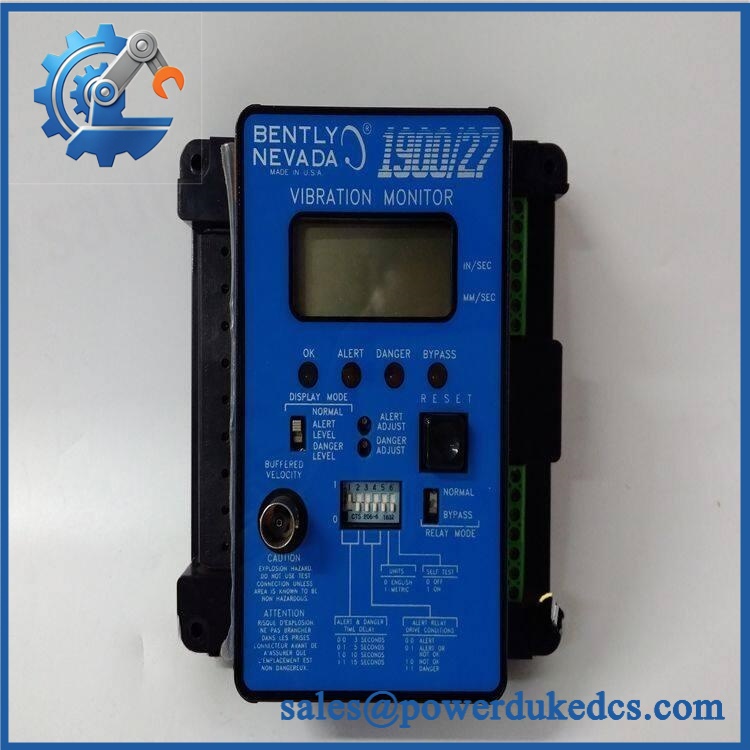
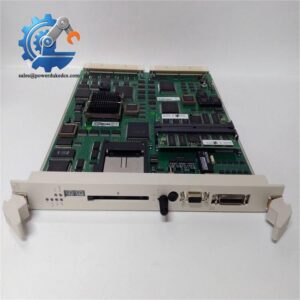
Bently Nevada 1900/27
Module 5: Quality Assurance & Testing SOP
The 1900/27 should be evaluated as a machinery-protection instrument, with signal, alarm, display, and analog-output testing completed before shipment.
1. Incoming inspection
- Record manufacturer, model, serial number, and revision/date-code information.
- Perform OEM anti-counterfeit visual inspection.
- Inspect the housing, LCD, keypad/switches, terminals, connectors, and PCB assemblies.
- Check for corrosion, contamination, cracked components, damaged terminals, or unauthorized repair.
2. Configuration verification
- Confirm 1900/27 identification.
- Record internal jumper settings.
- Record front-panel configuration-switch positions.
- Document Alert and Danger setpoints.
- Record selected engineering units and relay time-delay settings.
- Photograph the internal configuration before any test adjustment.
3. Power-on testing
- Connect the monitor to a controlled test supply.
- Perform power-on self-test (POST).
- Verify the LCD initializes correctly.
- Confirm the OK LED indicates a valid monitor/transducer/field-wiring state.
- Check for diagnostic or NOT OK conditions.
4. Signal and protection testing
- Connect an appropriate calibrated accelerometer simulator or compatible test source.
- Verify input response and conversion to peak velocity.
- Check the LCD indication against the applied reference.
- Exercise Alert and Danger thresholds.
- Verify relay operation, reset behavior, and configured time delay.
- Verify the 4–20 mA output across the operating range.
- Test BYPASS behavior against the recorded jumper configuration.
- Perform I/O load testing on applicable relay outputs under controlled conditions.
- Run an extended stability test to identify intermittent signal or alarm faults.
5. Final QC
- Record measured values, setpoints, jumper configuration, serial number, and test date.
- Verify the monitor’s maximum specified measurement range and signal-conditioning response against the applicable documentation.
- Generate a unit-specific Test Report.
- Package using ESD protection and mechanical cushioning.
- Apply final QC identification before shipment.
Module 6: Procurement & Lifecycle FAQ
Is Bently Nevada 1900/27 genuinely in stock, and what is the emergency-shipping cutoff?
The 1900/27 is a retired product, so physical availability should be confirmed against the actual serial-numbered unit rather than a catalog description. Emergency dispatch depends on completed QC, order/payment clearance, warehouse processing, and the courier cutoff.
How do you guarantee the condition and authenticity of an obsolete 1900/27?
Require model and serial-number verification, PCB and connector inspection, configuration recording, controlled power-up, sensor-input simulation, LCD verification, Alert/Danger relay testing, 4–20 mA verification, and a unit-specific Test Report. The original jumper and switch configuration should also be documented.
Are there firmware compatibility issues I should warn my engineers about before issuing the PO?
The larger concern is configuration rather than firmware. The 1900/27 uses internal jumpers and front-panel switches to configure relay behavior, alarm conditions, time delay, units, and other functions. Those settings should be copied from the existing monitor before replacement.
Is the Bently Nevada 2300/20 a direct replacement for the 1900/27?
It is a documented replacement path, but procurement should not treat it as a simple one-for-one hardware swap. Bently Nevada documentation identifies the 2300/20 as a replacement for legacy 1900/27 monitors, while the 2300 architecture adds different channel, interface, and configuration capabilities. Engineering review of sensor wiring, outputs, configuration, and installation is required.
What warranty and return terms should procurement require?
Specify 1900/27, serial number, tested condition, configuration record, warranty period, DOA criteria, acceptance window, and return procedure in the PO. Functional acceptance should include successful power-up, valid sensor simulation, LCD response, both alarm relays, and the 4–20 mA output.



 Start Chat