

Description
- Brand: Bently Nevada
- Full Model Number: 330100-90-01
- Lifecycle Status: Active / Legacy 3300 Series Spare
- Core Function: Proximitor Sensor for non-contact vibration, position, and speed measurement
- Top 3 Technical Specs: 9.0 m total system length; 0.25–2.3 mm linear range; −17.5 to −26 VDC supply
- Stock & Condition: Physical stock verification required; New Surplus / Tested Refurbished; Emergency dispatch subject to QA release
Module 3: Obsolescence & Supply Chain Deep Dive
A failed Bently Nevada 330100-90-01 can interrupt the complete proximity-transducer signal chain, leaving a machinery-monitoring channel without a valid shaft-position or vibration signal. The 330100-90-01 is identified as a 3300 Proximitor Sensor with a 9.0 m total system length, supporting static and dynamic measurements for vibration, position, and speed applications. Published specifications identify a 0.25–2.3 mm (10–90 mil) linear range, a nominal incremental scale factor of 7.87 mV/µm (200 mV/mil), and a −17.5 to −26 VDC power requirement.
For an operating 3300 installation, replacing the failed sensor system is usually far less expensive than redesigning the complete machinery-monitoring channel. Existing probes, monitoring electronics, field wiring, and alarm logic can remain in service when the replacement configuration matches the installed system. That avoids unnecessary engineering, outage labor, calibration work, and new cabinet hardware. —The important procurement issue is system matching: the Proximitor must be paired with the appropriate probe and extension cable, and the complete electrical and mechanical chain should be verified before installation.
Module 4: Compatibility & Replacement Matrix
| Replacement Scenario | Classification | Engineering / Procurement Guidance |
|---|---|---|
Exact 330100-90-01 replacing the same installed Proximitor |
Drop-in Replacement | Match total system length, probe family, electrical configuration, and application |
| Same 3300 Proximitor configuration with approved equivalent components | Software Compatible / Hardware Verification Required | No firmware flash is normally required; verify complete transducer-chain compatibility |
| Different 3300 Proximitor length or electrical configuration | Hardware Modification / Engineering Review | Confirm calibration, probe, extension cable, and monitoring input requirements |
| Different-generation Proximitor system | Not Automatically Compatible | Verify probe type, supply, scale factor, connectors, and monitoring electronics |
Estimated switch cost/time: With a verified spare already available on-site, plan approximately 1–3 hours for removal, installation, electrical verification, calibration, and signal checkout. A newly sourced unit may require 1–5 business days for inspection and expedited transportation. Actual outage time depends on machine accessibility and site testing procedures.
Field Traps — Watch Out
- Total system length: The
90configuration is associated with a 9.0 m (29.5 ft) total system length. Do not substitute a different length without checking the physical installation. - Probe and extension matching: The Proximitor is one component in a probe-extension-Proximitor system. Mixing incompatible components can alter calibration and measurement accuracy.
- Supply-voltage mismatch: Verify the installed power source supports the specified −17.5 to −26 VDC operating range before energization.
- Calibration condition: A physically compatible Proximitor still requires correct gap setting and system calibration after installation.
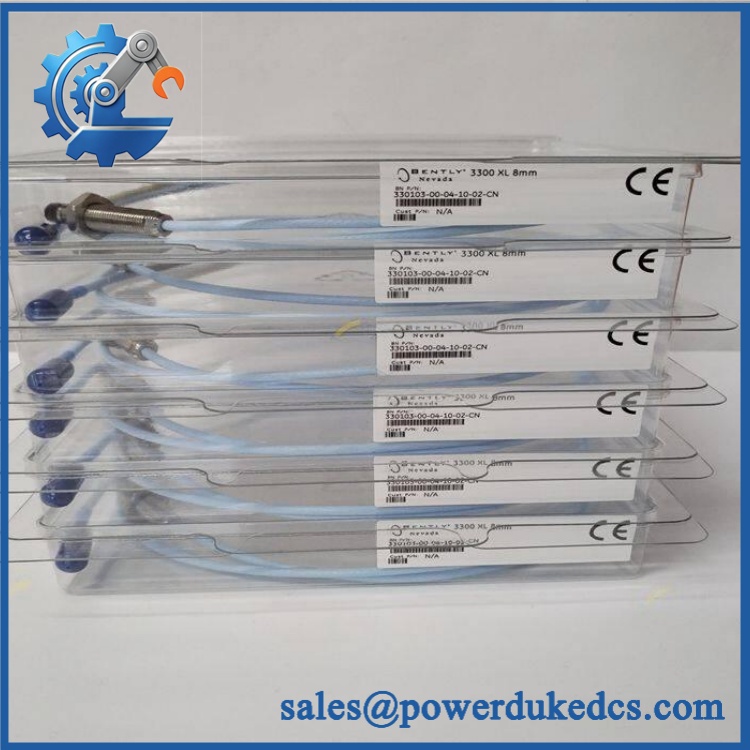
Bently Nevada 330100-90-01
Module 5: Quality Assurance & Testing SOP
A machinery-protection Proximitor should be accepted through measurement-chain testing, not merely a visual inspection.
- Part-number verification: Confirm
330100-90-01, manufacturer markings, revision data, and serial/traceability information. - OEM anti-counterfeit visual inspection: Examine Bently Nevada markings, housing construction, connector assemblies, terminal interfaces, cable identification, and evidence of unauthorized repair.
- Physical condition inspection: Check the sensor housing, connectors, mounting hardware, cable interface, and probe-system connections for impact, corrosion, contamination, or mechanical damage.
- System-length verification: Confirm the specified 9.0 m total system length where applicable.
- Power-input verification: Energize the Proximitor using a controlled source within the specified −17.5 to −26 VDC range.
- Power-on self-test (POST): Verify expected electrical startup behavior and stable output before connecting to the final monitoring channel.
- Probe compatibility check: Connect the appropriate 3300 probe and extension cable and verify correct electrical interaction.
- Gap calibration test: Use a calibrated target and controlled mechanical adjustment to verify the intended operating range.
- Output testing: Check representative static gap and dynamic signal outputs across the working range.
- Scale-factor verification: Verify the expected approximately 7.87 mV/µm (200 mV/mil) incremental scale factor within the applicable tolerance.
- Frequency-response test: Exercise representative dynamic inputs and verify response across the applicable frequency range, with published data extending to approximately 6.5 kHz at −3 dB.
- Signal-load testing: Apply representative measurement conditions while monitoring output stability, noise, and thermal behavior.
- Monitoring-interface test: Connect the sensor system to a compatible monitoring channel and confirm stable measurement transmission.
- Extended observation: Maintain representative operating conditions to identify intermittent signal loss, connector instability, or drift.
- Final QC release: Record part number, serial number, test voltage, calibration results, scale-factor measurements, photographs, condition grade, test date, and QC authorization.
Published technical data also identifies the sensor’s 50 Ω output resistance, 100°C maximum sensor operating temperature, and 15.2 mm minimum target diameter for the relevant configuration. These values can be incorporated into incoming inspection where the application requires them.
Module 6: Procurement & Lifecycle FAQ
Q1. Is the Bently Nevada 330100-90-01 genuinely in stock, and what is the cutoff for emergency shipping?
Physical inventory should be verified against the exact 330100-90-01 identification before the PO is accepted. Emergency dispatch depends on QA completion, warehouse location, carrier pickup time, and destination. Same-day shipment should only be confirmed after the actual unit has been identified and released.
Q2. How do you guarantee the condition and authenticity of a 330100-90-01?
Require exact part-number verification, OEM visual inspection, controlled power testing, probe-system compatibility checks, gap calibration, scale-factor verification, dynamic signal testing, and documented QC results. Photographs of the actual sensor and identification markings should remain with the procurement record.
Q3. Does the 330100-90-01 require firmware compatibility checks?
No firmware is normally flashed into the Proximitor Sensor itself. Compatibility instead depends on the probe type, extension cable, Proximitor electrical configuration, calibration, and receiving 3300 monitoring equipment.
Q4. Can any 3300 Proximitor replace the 330100-90-01?
No. Total system length, probe family, electrical configuration, scale factor, environmental requirements, and application must be matched. The 330100-90-01 configuration is associated with a 9.0 m total system length, so another length should not be treated as a direct equivalent without engineering review.
Q5. What warranty and return terms should be written into the PO?
Specify warranty duration, DOA coverage, calibration and signal-performance coverage, return authorization, inspection period, and serial-number traceability. For refurbished inventory, require the actual calibration and functional-test record and define whether commissioning-stage failures are covered.



 Start Chat