

Description
- Model & Brand: GE General Electric IS220PRTDH1BC
- Associated Part Number: 336A5026ADP13
- Product Type: PRTD Resistance Temperature Device Input Pack
- Series: Mark VIe / Mark VIeS
- Primary Function: RTD signal acquisition and transmission to the Mark VIe control network.
- Physical Dimensions: Published commercial packing records commonly use approximately 160 × 160 × 120 mm (W × H × D) for shipment planning; the actual module envelope is smaller, so verify the installed assembly before cabinet or freight calculations.
- Estimated Shipping Weight: Approximately 1.0 kg packed planning allowance; use the actual packed weight for freight and customs documentation.
- What’s in the Box: IS220PRTDH1BC module, ESD shielding bag, connector protection, cushioning, outer carton, and available inspection/test documentation.
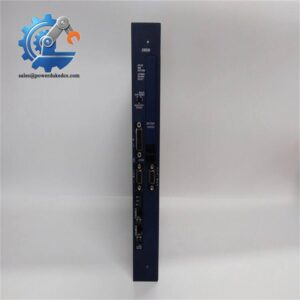
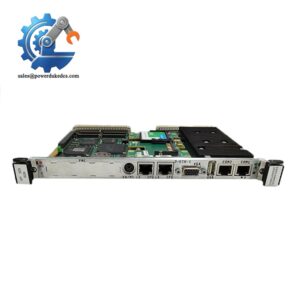
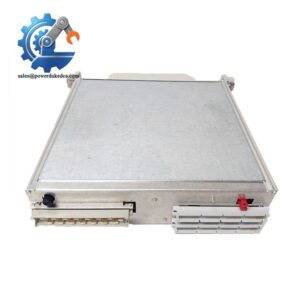
- Visible Hardware: Black electronic housing with metal retaining hardware, dual network connectors, and a lower field-interface connection (protect the connectors carefully during long-term storage).
Product Introduction
Temperature channels are often the first signals examined when a turbine bearing, winding, compressor, or process vessel moves outside its expected operating envelope. The GE IS220PRTDH1BC is a Mark VIe PRTD RTD Input Pack, providing the electrical interface between an RTD terminal board and one or more I/O Ethernet networks so measured resistance-temperature signals can enter the control system. GE documentation identifies the PRTD family as a dedicated RTD input function rather than a general-purpose analog I/O module.
The electrical margins are worth recording exactly. The published PRTD ratings specify a 28.0 VDC nominal supply, 27.4–28.6 VDC operating range, and 0.24 A maximum current, while the RTD interface is specified for 0–4.2 V with 10 mA nominal excitation. The standard PRTD pack handles up to eight RTD inputs directly, while compatible terminal-board arrangements can extend the measurement architecture to 16 RTDs (which makes the terminal-board part number just as important as the I/O-pack label during replacement).
Core Technical Specifications
| Parameter | Value |
|---|---|
| Manufacturer | GE General Electric |
| Model | IS220PRTDH1BC |
| Associated Part Number | 336A5026ADP13 |
| Product Type | PRTD RTD Input Pack |
| Platform | Mark VIe / Mark VIeS |
| Input Function | Resistance Temperature Device |
| Direct RTD Capacity | Up to 8 RTD inputs per pack |
| Extended RTD Architecture | Up to 16 RTDs with applicable terminal-board arrangement |
| RTD Wiring | Compatible terminal-board configurations support appropriate RTD field wiring |
| Power Supply | 28.0 VDC nominal |
| Minimum Supply | 27.4 VDC |
| Maximum Supply | 28.6 VDC |
| Maximum Current | 0.24 A |
| Approx. Maximum Control Power | 6.7 W at rated maximum current |
| RTD Input Voltage | 0–4.2 V |
| RTD Excitation | 10.0 mA nominal |
| Communication | I/O Ethernet |
| Network Ports | ENET1 and ENET2 |
| Control Modes | Simplex architecture is documented for the PRTD family |
| Compatible Terminal Boards | IS200TRTDH2D, IS200SRTDH1A, IS200SRTDH2A for the documented HazLoc configuration |
| Operating Temperature | -30°C to +65°C for the documented PRTD HazLoc configuration |
| Storage Temperature | Use controlled dry storage; exact storage limits should follow the applicable GE documentation |
| Hazardous-Area Use | Documented Class I, Division 2 / Class I Zone 2 / ATEX Zone 2 combinations |
| Conversion | PRTD acquisition electronics perform RTD signal conditioning and digital conversion |
| Memory | Processor-board RAM/flash is revision-dependent; do not infer a universal capacity from the catalog number |
The 27.4–28.6 VDC supply window is narrow enough that it should be measured at the module connector under load rather than assumed from the cabinet power-supply nameplate. The maximum electrical load of about 6.7 W is calculated from the published 28 V nominal supply and 0.24 A maximum current; actual dissipation during service will depend on operating state and field configuration.
One critical compatibility point: GE’s documentation specifically identifies IS220PRTDH1A/H1B with IS200TRTDH2D, IS200SRTDH1A, or IS200SRTDH2A for the documented hazardous-location configuration. Do not substitute an apparently similar terminal board without checking the approved combination.
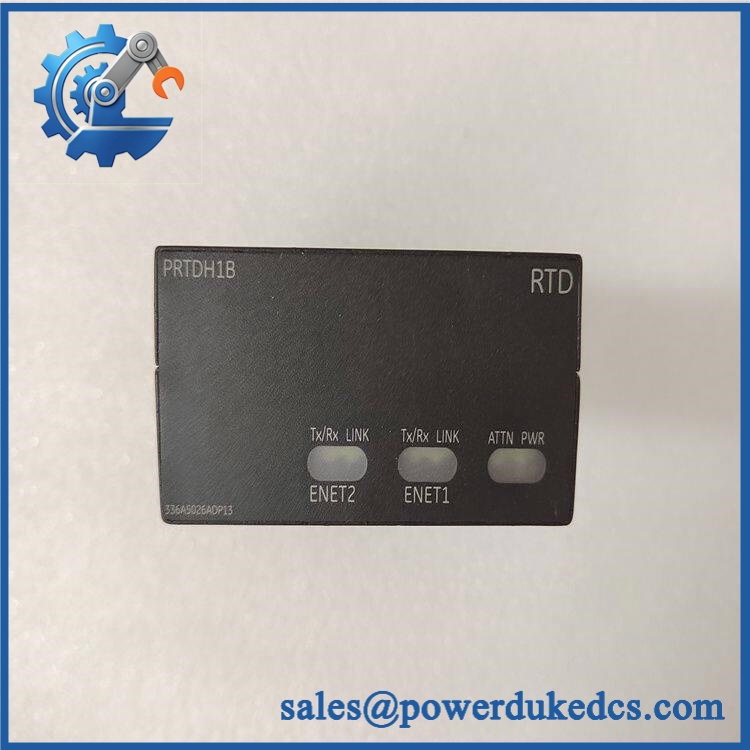
GE IS220PRTDH1BC
🚨 Global Compliance & Industry Certifications
The PRTD family has documented hazardous-location configurations. GE’s HazLoc documentation identifies the IS220PRTDH1A/H1B with the applicable terminal-board combinations for Class I, Division 2, Groups A, B, C, and D; Class I, Zone 2, Group IIC; and ATEX Zone 2, Group IIC applications. The same documentation specifies the electrical and intrinsic-safety conditions that govern the RTD field circuit.
For project documentation, review the following certification categories as applicable:
- CE Mark: Relevant to European-market conformity of the applicable equipment/system.
- UL/cUL: Important for North American control-system acceptance and project certification requirements.
- ATEX/IECEx: Critical when the completed installation is located in a classified hazardous area; the certification controls how the field wiring and associated apparatus may be used.
- Marine approvals such as DNV: Project-specific; do not infer marine approval from ordinary industrial certification.
A Class I Division 2 or Zone 2 rating matters because the electrical equipment must be evaluated so that normal operation and defined fault conditions do not create an unacceptable ignition source in the specified hazardous environment. Field wiring, terminal-board pairing, enclosure, and installation conditions remain part of that assessment.
Verify specific lot certifications with OEM.
🚨 Long-Term Storage & Asset Preservation Guide
Keep the IS220PRTDH1BC in its original ESD shielding bag whenever possible. Protect the dual Ethernet connectors and field connector from dust, mechanical impact, and moisture; bent or contaminated contacts are particularly undesirable on a temperature-measurement channel where intermittent resistance can masquerade as a sensor problem.
Maintain a dry warehouse environment, preferably below 60% RH, with stable temperature and no condensation. The aluminum or plated connector surfaces are more vulnerable to oxidation after years of uncontrolled humidity than the sealed electronic housing itself.
Record the full IS220PRTDH1BC / 336A5026ADP13 identity, serial number, hardware revision, firmware revision, and compatible terminal-board type in the asset register. Photograph the connector condition before shelving (that physical baseline is valuable when a spare has been stored for several years).
For long-term critical inventory, periodically inspect packaging integrity and connector surfaces. Do not apply contact cleaner or other chemicals as a routine preservation measure unless the approved maintenance procedure specifically calls for it.
Physical Installation Prerequisites
Install the PRTD pack only with the approved Mark VIe terminal-board architecture. For hazardous-location service, the documented combinations include IS200TRTDH2D, IS200SRTDH1A, and IS200SRTDH2A with the corresponding PRTD input pack family.
Allow adequate cabinet airflow around the module and adjacent electronics. A practical design allowance is at least 50 mm around major ventilation paths, unless the GE cabinet drawing or equipment installation manual specifies a different clearance.
Verify the 28.0 VDC nominal supply at the point of connection and check grounding, shield termination, connector seating, and network wiring before energization. The RTD circuit is sensitive to wiring resistance and noise, so route sensor conductors away from VFD output cables, high-current contactors, and other strong interference sources.
For a PRTD installation, wiring topology must also match the terminal-board design. GE documentation notes differences between terminal-board variants and their filtering arrangements; using an incompatible or incorrect board revision can produce a system incompatibility indication even when no physical damage occurs.
Buyer’s FAQ
Q: What HS Tariff Code should be used for ?
A: The final HS classification depends on the importing country’s tariff schedule and the declared function of the RTD input pack. Do not treat a supplier’s suggested code as universally valid; obtain the classification approved by your customs broker or internal trade-compliance process.
Q: Does Country of Origin affect the shipment?
A: Yes. COO can affect duty treatment, origin marking, customs records, and preferential-trade eligibility. Keep the actual lot’s origin documentation with the commercial invoice and packing list rather than relying on a catalog assumption.
Q: Should this module be shipped with insurance?
A: For a critical turbine temperature-input spare, insurance is prudent. Use ESD shielding, rigid cushioning, connector protection, and pre-shipment photographs, particularly where the replacement value materially exceeds ordinary industrial I/O hardware.
Q: Does the include the latest firmware pre-loaded?
A: Do not assume it does. The PRTD uses a common processor architecture with application-specific acquisition electronics, and firmware/configuration must correspond to the target Mark VIe installation; record the installed revision and verify compatibility before commissioning.



 Start Chat