

Description
- Brand: HIMA
- Full Model Number: Z7136
- System/Series Family: HIQuad H41q / H51q I/O system
- Core Function: Dedicated system cable plug connecting the HIMA F3322 16-channel digital output module to field wiring
- Top 3 Hardcore Specs: F3322-specific interface; 16 output channels; LiYY 16 × 0.5 mm² cable, 750 mm reference length
- Stock Status: Verify current New Surplus, Factory Sealed, or Fully Tested Refurbished configuration before order
Module 3: Technical Product Introduction
A replacement F3322 output module is only useful when the field-side connection hardware matches the I/O architecture. HIMA Z7136 is the dedicated cable-plug assembly associated with the F3322 16-channel output module. HIMA’s H41q documentation identifies the cable plug as Z 7136 / 3322 / C.., with the connection scheme defined specifically for F3322. The published wiring data shows a LiYY 16 × 0.5 mm² cable arrangement and a 2.8 × 0.8 mm flat-pin plug interface.
The engineering advantage is correct channel-to-field termination without redesigning the I/O interface. This is not a generic multi-core cable: Z7136 is mapped to F3322, while other HIMA output and input modules use different cable-plug designations. HIMA’s technical documentation lists separate assemblies for , F3325, F3330, F3331, F3333, F3334, and F3349, which makes the module-specific cable code an important replacement criterion. Exact cable length and suffix should be confirmed from the installed assembly because the documentation uses the C.. variant notation rather than treating every Z7136 assembly as one identical finished cable.
Module 4: Application Scenarios & Field Realities
- When replacing an in an H41q/H51q cabinet, Z7136 provides the intended field-side connection path for the module’s 16 output channels. The HIMA wiring documentation specifically pairs Z7136/3322 with , so the cable identification should be checked alongside the module nameplate before installation.
- During cabinet rewiring or terminal-side maintenance, the dedicated plug can reduce the risk of moving individual conductors onto the wrong module interface. That benefit only holds when the cable’s channel assignment, suffix, and lead marking match the original cabinet drawings.
- For legacy spare-parts stocking, deserves its own inventory record rather than being treated as an interchangeable accessory. HIMA uses distinct Z-series system cables for different I/O modules; for example, Z7116 is associated with F3236, while is associated with .
- Where field wiring includes inductive loads, inspect the downstream terminal and actuator circuit before reconnecting the cable. is an interconnection component; it does not change the electrical limits or protection characteristics of the output module itself.
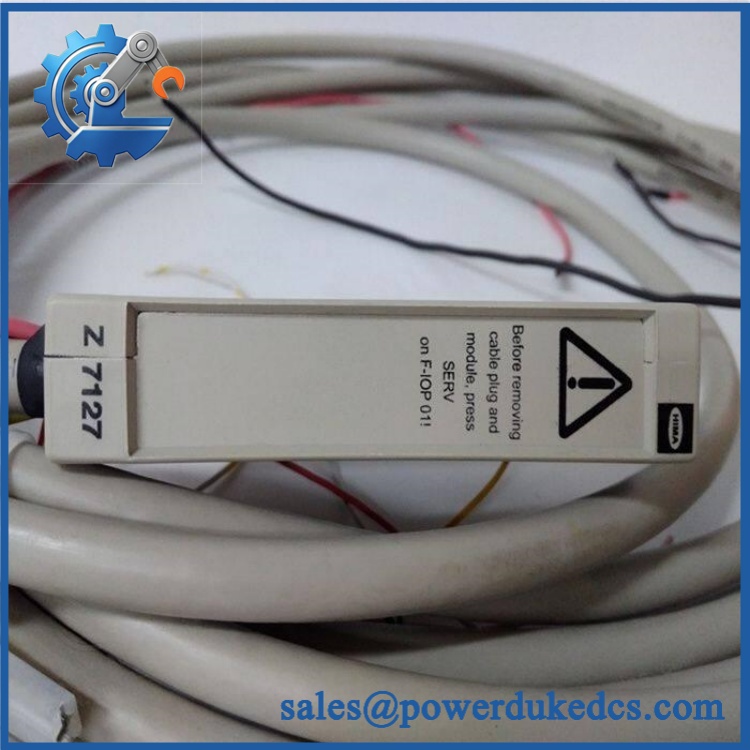
HIMA Z7136
Module 5: Migration, Compatibility & Installation Traps
Replacement Matrix
Exact / 3322 cable configuration: Drop-in Replacement
When the connector arrangement, cable suffix, lead assignment, and installed interface match, the cable plug can normally be exchanged without application-software changes.
with a different suffix: Software Compatible / Hardware Verification Required
The base designation alone is not enough. HIMA documentation uses / 3322 / C.., meaning the final suffix identifies a particular cable configuration. Verify the actual suffix, cable length, conductor arrangement, and connector termination before ordering.
Cable for another HIMA I/O module: Hardware Modification Required
Do not substitute another Z-series cable simply because the connector appears similar. HIMA specifies different cable families for different I/O modules.
⚠️ Field Traps (Watch Out)
Wrong suffix or lead assignment: is the family designation, but the technical drawing references /3322/C... A visually identical cable with a different suffix may have a different conductor arrangement or length. Compare every lead marking against the original wiring documentation before termination.
Connector damage during insertion: The connection uses a flat-pin plug arrangement. Do not force an offset or partially seated connector into the module. Bent contacts can create intermittent channels that are difficult to distinguish from an output-module fault.
Module 6: Quality Assurance SOP
Pre-Shipment QA Protocol for HIMA
- Step 1 — Identity Verification: Confirm HIMA marking, designation, complete suffix such as /3322/C5 where applicable, and any available serial or batch information.
- Step 2 — OEM Anti-Counterfeit Visual Inspection: Examine connector molding, markings, cable jacket, identification labels, terminal hardware, and assembly workmanship for inconsistencies or unauthorized rework.
- Step 3 — Mechanical Inspection: Check the plug body, locking features, flat-pin contacts, strain relief, and cable jacket for cracks, deformation, corrosion, cuts, or compression damage.
- Step 4 — Continuity Test: Verify every conductor from the module-side plug to the field-side termination according to the applicable /3322 wiring diagram.
- Step 5 — Pin-to-Pin Verification: Confirm there are no swapped conductors, open circuits, or unintended cross-connections between the 16 output channels.
- Step 6 — Insulation Test: Where appropriate for the cable assembly and test fixture, check conductor-to-conductor and conductor-to-shield insulation resistance using a controlled test voltage suitable for the cable and connected hardware.
- Step 7 — Interface Check: Mate the cable with a compatible test interface and verify correct mechanical seating without excessive insertion force.
- Step 8 — Channel Simulation: Use a low-risk continuity or load-simulation fixture to confirm the expected channel mapping before shipment. Do not test unknown loads directly through a safety-system field circuit.
- Step 9 — Lead-Marking Verification: Compare each conductor marking with the approved wiring documentation and record the result in the QC sheet.
- Step 10 — Final QC Record: Record complete part number, suffix, measured cable length, continuity results, insulation results, connector condition, visual inspection status, and final QC disposition.
Technical Verification Note: HIMA’s H41q manual directly identifies Z 7136 / 3322 / C.. as the cable-plug assembly for the 16-channel output module, with a published reference configuration using LiYY 16 × 0.5 mm² cable and a 2.8 × 0.8 mm flat-pin plug. HIMA’s system-cable documentation also lists /3322 as the dedicated cable type for .


 Start Chat