

Description
- Brand: Honeywell
- Full Model Number: R7247C1001
- Lifecycle Status: Discontinued — April 8, 2022
- Core Function: Dynamic self-check rectification flame amplifier
- Top 3 Technical Specs: 2–4 second flame-failure response | Dynamic self-check | UV flame sensor compatibility
- Stock & Condition: New surplus / professionally tested inventory subject to physical stock confirmation | Emergency dispatch subject to QC and carrier cutoff
Module 3: Obsolescence & Supply Chain Deep Dive
A failed R7247C1001 can stop a burner or boiler system even when the primary flame safeguard control and field detector remain serviceable. This part is a solid-state plug-in flame amplifier that responds to the flame-detector signal and indicates flame presence. It was designed for use with Honeywell BC7000, R4140, R4075C/D/E, R4138C/D, and FSP5075 flame-safety controls, with gas, oil, or coal UV flame detectors including the C7012E/F family. Its published flame-failure response time is 2–4 seconds, with dynamic self-check functionality. Honeywell lists the R7247 family within its combustion-control product range, while distributor records identify the exact R7247C1001 as discontinued on April 8, 2022.
For a legacy burner-management installation, replacing the failed amplifier is often financially preferable to redesigning the complete flame-safeguard chain. The investment preserves the existing primary control, detector arrangement, wiring, cabinet hardware, and commissioning procedure. There is also a clear lifecycle argument: once a component has been discontinued, engineering inventory should focus on verified replacement stock before the remaining supply becomes difficult to source. —Because this is a safety-related combustion component, lower purchase price alone should not determine the selection; authenticity, exact suffix, detector compatibility, and functional testing have a direct effect on outage risk and TCO.
Module 4: Compatibility & Replacement Matrix (Crucial for Buyers)
| Replacement Decision | Assessment | Engineering / Procurement Action |
|---|---|---|
| R7247C1001 replacing the same R7247C1001 | Drop-in Replacement | Verify exact part number, existing primary control, detector type, and socket/interface condition |
| R7247 family replacement with a different suffix | Conditional compatibility | Check the complete Honeywell material number and application data before PO approval |
| Replacement with another Honeywell flame amplifier family | Not automatically compatible | Confirm primary-control compatibility, detector requirements, response time, and safety approvals |
| Software configuration | Normally none | This is a plug-in hardware amplifier; application compatibility is the principal concern |
| Hardware modification | Normally not required for like-for-like replacement | Preserve the existing mounting/socket arrangement |
| Typical switch cost/time | Approximately 1–3 engineering hours | Includes isolation, removal, visual inspection, replacement, startup verification, and flame-signal confirmation; actual site labor varies |
Field Traps — Watch Out
Primary-control mismatch: Honeywell specifies the R7247C series for particular flame-safety controls, including BC7000 and R4140, as well as selected R4075/R4138 and FSP5075 applications. Do not substitute a visually similar amplifier without checking the primary control model.
Detector mismatch: The R7247C1001 is a rectification-type, dynamic-self-check amplifier intended for appropriate flame detectors, including Honeywell C7012E/F ultraviolet detectors. A detector or amplifier from another sensing technology may require a different amplifier family.
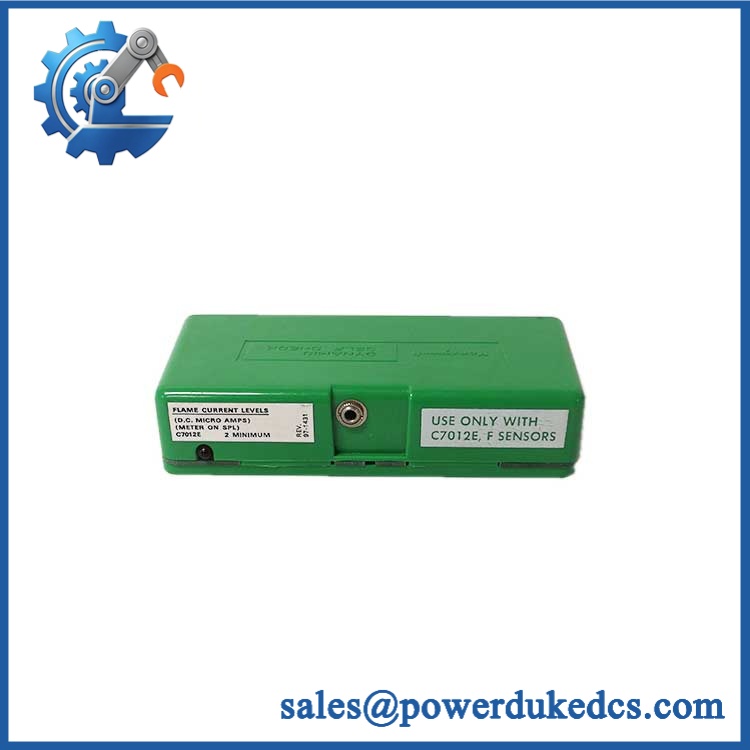
Honeywell R7247C1001
Module 5: Quality Assurance & Testing SOP
Because this component participates in flame-failure detection, pre-shipment inspection should verify both identity and application suitability. A cosmetic inspection alone is not sufficient.
- OEM anti-counterfeit visual inspection: Check Honeywell markings, green housing/color identification, labels, connector geometry, molded surfaces, and evidence of unauthorized refurbishment.
- Part-number verification: Confirm the complete designation; do not accept an R7247-series substitute solely on appearance.
- Physical inspection: Examine pins, contacts, housing, retaining features, and socket interface for oxidation, mechanical damage, contamination, or cracking.
- Electrical baseline check: Verify the unit has no abnormal short circuit or visible component damage before powered testing.
- Power-on functional test: Use an approved Honeywell-compatible test arrangement and confirm normal amplifier operation.
- Flame-signal simulation: Apply an appropriate simulated detector signal and verify correct flame-presence indication.
- Flame-failure response test: Remove or interrupt the simulated flame signal and verify behavior against the specified 2–4 second response characteristic.
- Dynamic self-check verification: Confirm the self-check function operates as expected within the approved test procedure.
- Primary-control compatibility test: Verify operation with the applicable BC7000/R4140/R4075/R4138/FSP5075 control family where the test environment permits.
- Final QC: Record part number, serial/lot information where available, test results, inspector approval, photographs, and packaging condition.
Published Honeywell combustion documentation identifies the /U as a Dynamic Self-Check Rectification Flame Amplifier, with a 2–4 second flame-failure response time, and specifies its compatible primary controls and UV flame-detector applications.
Module 6: Procurement & Lifecycle FAQ
Q1. Is Honeywell genuinely in stock, and what is the cutoff for emergency shipping?
A1. Physical warehouse quantity should be confirmed against the exact part number and requested condition. Because Honeywell discontinued the item on April 8, 2022, catalog availability should not be treated as proof of current inventory. Emergency dispatch depends on order receipt, payment clearance, QC completion, packaging, and carrier pickup.
Q2. How do you verify the condition and authenticity of this discontinued flame amplifier?
A2. Require exact part-number verification, Honeywell label and housing inspection, connector inspection, electrical checks, functional signal testing, and documented QC photographs. New-surplus material should also be inspected for original packaging and storage damage.
Q3. Are there any compatibility issues engineers should check before issuing the PO?
A3. Yes. Confirm the existing primary flame-safety control, flame detector type, response-time requirement, and amplifier application. Honeywell identifies the /U for BC7000, R4140, R4075C/D/E, R4138C/D, and FSP5075 applications and compatible UV flame detectors such as C7012E/F.
Q4. Is still supported by Honeywell, or is it an obsolete component?
A4. Available distributor lifecycle records identify as discontinued on April 8, 2022. The closely related is also listed as discontinued with no replacement by one current distributor record. Procurement should therefore treat verified remaining stock as a lifecycle-management item rather than assume normal replenishment.
Q5. What warranty and return protection should procurement require?
A5. The quotation should specify warranty duration, DOA coverage, functional-failure coverage, return authorization procedure, inspection window, and return-freight responsibility. For a discontinued combustion-control component, require the seller to state the exact condition classification and confirm that the shipped unit is , not merely another R7247-series variant.



 Start Chat


