

Description
- Model: D1961SH45TS02
- Brand: ABB
- Series: D1961SH / EUPEC
- Core Function: Rectifies high-power electrical current in drive systems
- Type: Diode Press-Pack / Power Semiconductor
- Key Specs: 4.5 kV class; high-power rectifier application; press-pack construction
- Associated ABB Part Number: 3BHE020725R0001
- Condition: New Surplus, non-refurbished
Product Introduction
ABB D1961SH45TS02 is a D1961SH / EUPEC diode press-pack used in high-power industrial converter applications. ABB catalog-derived information links this device to part number 3BHE020725R0001 and identifies it as a D1961SH45TS02 PR diode press-pack. Trade records also specifically identify the device for the bridge inverter of an ABB ACS1000 drive.
This is a power-semiconductor spare, not a general-purpose control module. The 4.5 kV class is reported by current component listings, but the exact forward-current, surge-current, thermal, and mounting specifications should be checked against the device datasheet before replacement. A wrong diode rating can turn a routine spare-parts change into a costly power-stage failure.
Key Technical Specifications
| Parameter | Specification |
|---|---|
| Manufacturer | ABB |
| Device Model | D1961SH45TS02 |
| ABB Ordering Part Number | 3BHE020725R0001 |
| Product Family | D1961SH |
| Manufacturer Designation | EUPEC |
| Product Type | Diode Press-Pack |
| Semiconductor Type | Power Rectifier Diode |
| Voltage Class | 4.5 kV class |
| Application | High-power converter / inverter systems |
| Known Application | ABB ACS1000 medium-voltage drive bridge inverter |
| Mounting | Press-pack / pressure-contact installation |
| Forward Current | Verify from original datasheet |
| Surge Current | Verify from original datasheet |
| Junction Temperature | Verify from original datasheet |
| Thermal Resistance | Verify from original datasheet |
| Weight | Verify from actual unit and packaging |
| Condition | New Surplus, non-refurbished |
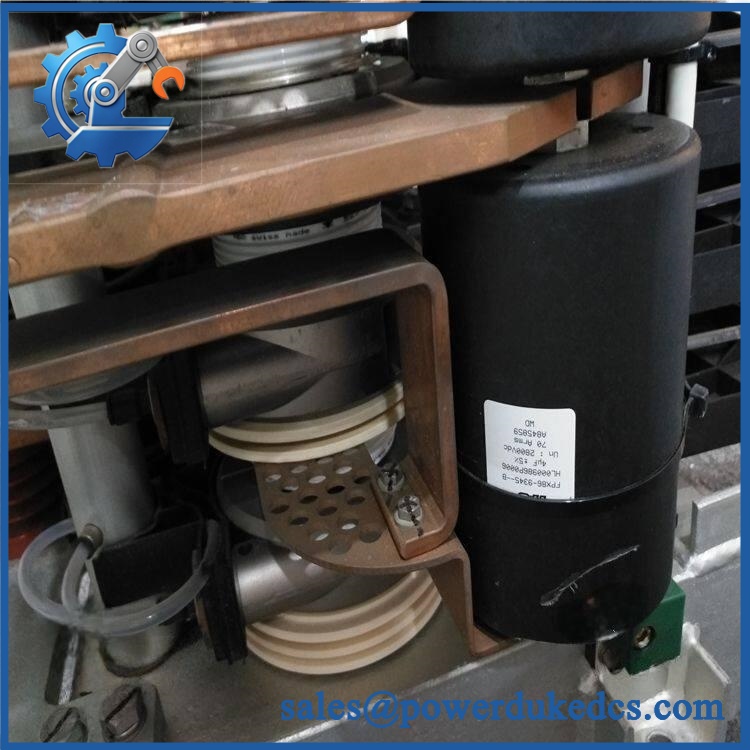
ABB D1961SH45TS02
The 3BHE020725R0001 → D1961SH45TS02 PR relationship is supported by an ABB catalog-derived listing.
Installation & Configuration Guide
Stage 1: Pre-Installation — About 15 minutes
⚠️ High-voltage equipment.
This component may be installed inside a medium-voltage drive or converter. Replacement should be performed only by qualified electrical personnel following the applicable ABB service procedure.
- Notify production of the planned shutdown.
- Place the drive in a safe operating state.
- Disconnect and isolate all power sources.
- Apply the required lockout/tagout procedure.
- Verify absence of voltage with approved equipment.
- Observe the manufacturer’s discharge and waiting requirements.
- Wear suitable electrical PPE and ESD protection where required.
- Photograph the existing diode position and busbar arrangement.
- Record the device marking and orientation.
- Document the mounting hardware and pressure-contact arrangement.
Do not treat this like a plug-in PLC module. Press-pack semiconductor installation depends on correct mechanical pressure, electrical polarity, and thermal contact.
Stage 2: Remove Existing Device — About 10 minutes
- Confirm the power stage is fully isolated.
- Verify zero voltage at the relevant terminals.
- Mark the diode orientation.
- Photograph the complete power-stack arrangement.
- Remove busbar or clamping hardware according to the drive service procedure.
- Release the press-pack assembly carefully.
- Remove the old diode without damaging adjacent insulators or conductors.
- Inspect the contact surfaces.
- Check for heat discoloration, arcing marks, or mechanical damage.
Stage 3: Install Replacement — About 10–15 minutes
- Verify the exact device marking.
- Compare the replacement with the removed unit.
- Check polarity and orientation.
- Inspect both contact faces.
- Clean contact surfaces using the approved procedure.
- Position the device correctly in the stack.
- Reinstall the pressure hardware.
- Apply the manufacturer-specified clamping force.
- Reconnect busbars and associated hardware.
- Confirm that the assembly is mechanically aligned.
⚠️ Do not estimate clamping force. Too little pressure can increase contact resistance and heating. Excessive pressure can damage the semiconductor package.
Stage 4: Power-On & Testing — About 20 minutes
- Perform a complete mechanical inspection.
- Confirm polarity and busbar connections.
- Check insulation and clearances according to the drive procedure.
- Verify the cooling path.
- Re-energize only after all safety checks are complete.
- Start the drive under controlled conditions.
- Monitor phase currents and DC-link behavior where applicable.
- Check for abnormal temperature rise.
- Monitor drive diagnostics.
- Record the replacement device serial/lot information where available.
For an ACS1000 installation, follow the drive-specific commissioning procedure rather than a generic diode test sequence.
Quality Inspection SOP
1. Incoming Inspection
- Verify D1961SH45TS02 marking.
- Check the ABB part number where present.
- Record manufacturer and device markings.
- Inspect the ceramic body and contact surfaces.
- Check for cracks, chips, corrosion, or impact marks.
- Verify packaging condition.
- Record serial/lot information where available.
2. Functional / Semiconductor Test
For a press-pack power diode, testing should focus on semiconductor characteristics rather than PLC communication.
Recommended checks, where permitted by the manufacturer:
- Forward-voltage test
- Reverse-leakage test
- Polarity verification
- Insulation condition
- Visual inspection
- Thermal/mechanical inspection
A suitable semiconductor tester or qualified power-electronics test bench should be used.
3. Electrical Inspection
Check:
- Forward conduction behavior
- Reverse blocking behavior
- Insulation to housing where applicable
- Contact resistance
- Electrical isolation of the assembly
Do not apply arbitrary test voltage. The test level and method should follow the semiconductor manufacturer’s specification.
4. Device Identification
Record:
- Exact model
- ABB ordering code
- Manufacturer marking
- Lot/date code where available
- Polarity
- Test results
Keep these records with the spare-parts inventory entry.
5. Final QC & Packaging
- QC inspector signs the inspection record.
- Protect contact surfaces from contamination.
- Use suitable antistatic and shock protection.
- Prevent the device from moving inside the carton.
- Add a QC label with inspection date.
- Store in a dry, controlled environment.
Test photos and inspection records can be supplied when available.
Technical Pitfalls Before Replacement
1. Confusing the Device Type
Some online pages incorrectly describe this exact part as an IGBT or generic industrial control module. Other sources identify it as a diode press-pack. The ABB catalog-derived listing is much more specific: D1961SH, EUPEC; DIODE PRESSPACK PR.
For procurement, classify it as a power semiconductor only after checking the physical marking and technical documentation.
2. Polarity Error
A diode is not orientation-neutral.
Before removal:
- Photograph the original position.
- Mark the cathode/anode orientation where identifiable.
- Compare the replacement marking.
- Verify against the power-stack schematic.
❗ Never install by appearance alone.
3. Incorrect Clamping Force
This is the classic press-pack trap.
The electrical connection depends on mechanical pressure. A loose stack can create local heating and increased contact resistance. An excessive force can damage the device.
Use the ABB/semiconductor manufacturer’s specified assembly method and torque or force values.
4. Wrong Electrical Rating
A device can physically fit and still be electrically unsuitable.
Verify:
- Repetitive reverse voltage
- Average forward current
- Surge current
- Junction temperature
- Switching characteristics where applicable
- Cooling requirements
The reported 4.5 kV class is useful for initial identification, but it is not enough for a replacement decision.
5. Replacing One Device Without Checking the Power Stage
If a diode has failed, do not automatically assume the diode was the root cause.
Check for:
- Overcurrent
- Shorted semiconductor devices
- Cooling problems
- Loose busbar connections
- Abnormal DC-link conditions
- Insulation faults
Replacing the diode without checking the surrounding power stage can result in another failure shortly after startup.
Spare Parts Inventory Recommendation
| Inventory Factor | Recommendation |
|---|---|
| Demand Pattern | Slow-moving |
| Criticality | High for affected MV drive |
| Lead Time Variability | Potentially high |
| Buffer Stock | 1 unit for a critical drive |
| Safety Stock | 1–2 units for sites with multiple matching drives |
| Reorder Point | Trigger before the last verified spare is consumed |
| Last-Time-Buy | Consider when OEM lifecycle status is confirmed |
| Vendor Strategy | Use a supplier capable of device-level identification and testing |
| Cross-Site Sharing | Recommended if several drives use the same device |
| TCO Focus | Compare spare cost against MV drive downtime |
For a single non-critical drive, two units may be excessive. For several ACS1000 installations using the same semiconductor, shared inventory can make much more financial sense.
FAQ
1. What is ABB ?
It is a D1961SH / EUPEC diode press-pack used in high-power converter applications. ABB catalog-derived information associates it with ABB ordering number 3BHE020725R0001.
2. Is used in ABB ACS1000 drives?
Yes. Trade records specifically identify as a diode used in the bridge inverter of an ABB ACS1000 drive.
3. Is this an IGBT?
No—available ABB catalog evidence identifies it as a diode press-pack. Some third-party pages incorrectly describe the device as an IGBT, so verify the actual marking before purchasing.
4. What voltage rating does it have?
Current component listings identify the as a 4.5 kV-class device. The exact repetitive reverse-voltage specification should be confirmed from the applicable datasheet before installation.
5. Can I replace it with another D1961SH device?
Not automatically. Check the complete device designation, voltage rating, current rating, mechanical dimensions, contact arrangement, and power-stack requirements. A similar number is not sufficient evidence of compatibility.
6. What should I check when buying a spare?
Request:
- Clear device-marking photo
- Exact part number
- ABB ordering number, if available
- Manufacturer marking
- Condition
- Test report
- Packaging photos
- Warranty information
For this type of semiconductor, physical identification and electrical test records are particularly useful.
7. Should I keep one in stock?
For an MV drive where this diode is critical and sourcing time is uncertain, one verified spare is a sensible buffer stock level. If several identical drives operate at the same site, 1–2 shared units may provide better capital efficiency than one spare per drive.


 Start Chat