

Description
- Brand: GE / GE Fanuc / VMIC
- Full Model Number: VMIVME-7750-746
- System/Series Family: VMIC VME-7750 Single Board Computer
- One-Sentence Core Function: VMEbus single-board computer for industrial embedded processing, legacy control, data acquisition, and machine-management applications
- Top 3 Hardcore Specs: Intel Pentium III 1.26 GHz; 128 MB PC133 SDRAM; dual 10/100Base-TX Ethernet
- VME Interface: A32/A24/A16, D32/D16/D8, BLT32/BLT64 support
- Stock Status: New Surplus / Fully Tested Refurbished subject to actual inventory inspection
Module 3: Commercial-Technical Deep Dive
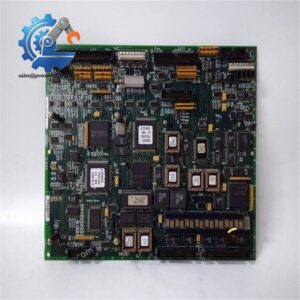
Legacy VME systems are often limited by a single processor board long before the backplane or peripheral cards become unusable. The GE VMIVME-7750-746 is a configuration-specific VMIVME-7750 VME single-board computer built around an Intel Pentium III processor running at 1.26 GHz. GE’s ordering matrix identifies option 7 as the 1.26 GHz Pentium III with 512 KB cache, while option 4 in the memory field corresponds to 128 MB SDRAM. The VMIVME-7750 architecture provides a 133 MHz system bus through the Intel 815E chipset, a PMC expansion site, and VMEbus master/slave functionality.
For a replacement project, the important performance characteristics are tied directly to system integration. The board provides two Ethernet controllers, supporting 10Base-T and 100Base-TX through dual RJ45 interfaces, two 16550-compatible serial ports with baud rates up to 115.2 kbaud, an internal AGP SVGA controller with 4 MB display cache, and support for operating environments including Windows XP, Windows 2000, VxWorks, Solaris, QNX, LynxOS, and Linux. The 746 configuration is therefore far more specific than the generic VMIVME-7750 family number. Matching processor speed and memory matters when an existing application depends on a known boot image, driver stack, or real-time operating environment.
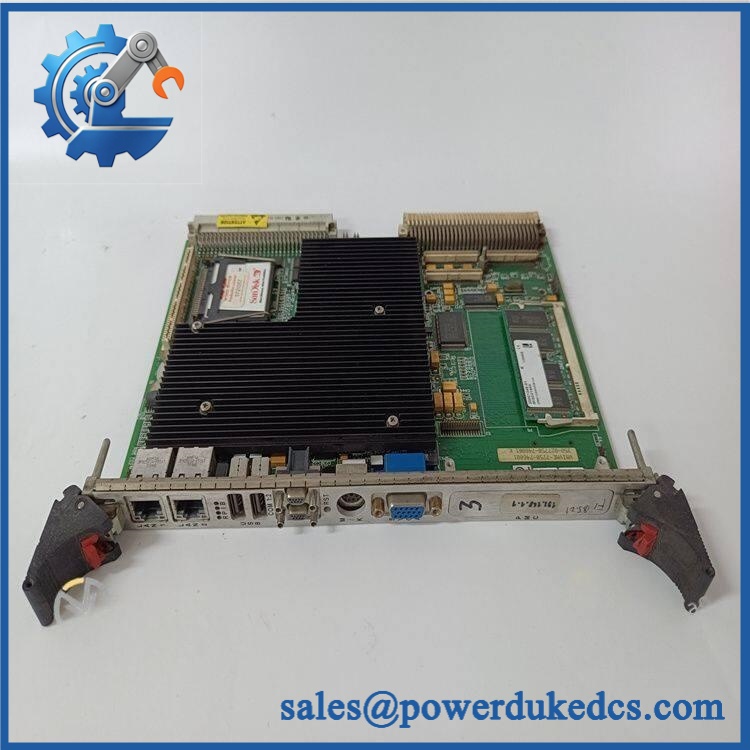
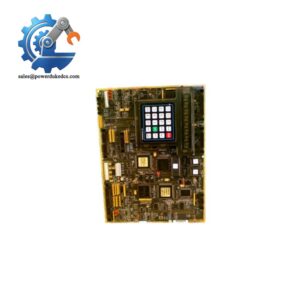
GE VMIVME-7750-746
Module 4: Compatibility & Installation Traps
Migration/Compatibility
- Replacement status: Configuration-specific GE/VMIC VMIVME-7750 VME single-board computer
- Logic rewrite: Usually not required for a one-for-one hardware replacement when the same operating system, application image, memory configuration, and VME address settings are retained.
- Firmware flash: Configuration dependent. System and video BIOS are stored in reprogrammable flash memory; verify the original BIOS/boot environment before altering it.
- Processor configuration: 1.26 GHz Pentium III with 512 KB cache for option 7.
- Memory configuration: 128 MB PC133 SDRAM for option 4 in the ordering code.
- Drop-in status: Potentially direct, but verify VME address settings, PMC usage, CompactFlash configuration, BIOS settings, operating system, and rear-I/O requirements before installation.
- VME architecture: Supports VMEbus master/slave operation with A32/A24/A16 addressing and D32/D16/D8 transfer modes.
⚠️ Field Traps (Watch Out)
- BIOS and boot-image mismatch: A replacement board can complete POST yet fail to boot the installed operating environment because BIOS configuration, CompactFlash content, or boot-device order differs.
- VME address/configuration: Record the original board’s VME requester, interrupter, arbitration, and address-related configuration before replacement. GE specifies programmable requester modes and VME interrupt functions.
- Thermal derating: The standard operating range is listed as 0–50°C, while specific extended-temperature processor options have different limits and airflow requirements. The 1.26 GHz option is associated with a 0–55°C extended-temperature specification in the GE ordering data.
- PMC/rear-I/O dependency: If the existing application uses the PMC expansion site or rear-I/O path, confirm the replacement board has the same installed options.
- ESD: The board contains CPU, SDRAM, flash, and VME interface electronics. Use grounded ESD handling and antistatic packaging during removal and installation.
Module 5: Quality Assurance SOP
Before shipment, the should undergo a single-board-computer-specific inspection:
- OEM anti-counterfeit visual inspection — verify GE/GE Fanuc/VMIC markings, identification, complete -746 configuration, PCB revision, connectors, and board construction.
- Configuration reconciliation — verify that the physical configuration corresponds to the 1.26 GHz / 128 MB option combination.
- Mechanical inspection — inspect VME P1/P2 connectors, front-panel connectors, PMC interface, CompactFlash interface, mounting hardware, heatsink, and PCB surfaces.
- Power-rail verification — apply controlled VME rack power and verify +5 V, +12 V, and -12 V supply behavior against the applicable limits. GE’s published typical +5 V current is 6 A, with a maximum of 7 A.
- Power-on self-test (POST) — verify CPU initialization, BIOS startup, memory detection, display initialization, and diagnostic behavior.
- Memory verification — confirm recognition and stable operation of the installed 128 MB SDRAM configuration.
- VMEbus communication handshake — verify VME master/slave access using a compatible test chassis and known-good test module.
- Ethernet verification — test both Ethernet ports for 10/100Base-TX link establishment and bidirectional packet communication.
- Serial-port verification — test both 16550-compatible serial channels at representative baud rates, including high-speed communication up to the supported range.
- Storage and boot verification — test the applicable CompactFlash or local boot medium and confirm stable operating-system startup where the test configuration provides one.
- Final QC record — document complete part number, processor/memory configuration, BIOS identification, test environment, VME and communication results, photographs, and packaging condition.
For a VME CPU board, a successful POST is only the first checkpoint. Memory recognition, VMEbus operation, Ethernet, serial communication, and application boot behavior provide much stronger evidence of serviceability.
Module 6: CRO-Driven Buyer FAQ
1. Is GE -746 obsolete, and how do I verify an authentic replacement?
The is a legacy VME single-board-computer platform, and GE’s published documentation identifies the configurable processor and memory architecture. The -746 configuration corresponds to the 1.26 GHz processor option and 128 MB memory option. For procurement, verify the full marking rather than purchasing a generic .
2. Can I hot-swap the -746?
Do not assume hot-swap capability. The is a VMEbus CPU board with extensive power and bus connections. Shut down the system, isolate the chassis power, follow site LOTO procedures, and use ESD protection before removal.
3. Will replacing the board require reinstalling the operating system?
Not necessarily. A like-for-like replacement can often boot the existing operating environment from its existing storage medium. However, BIOS settings, boot order, CompactFlash content, VME configuration, and installed device drivers must be verified before returning the system to service.
4. What processor and memory does -746 use?
The GE ordering matrix identifies option 7 as the 1.26 GHz Intel Pentium III with 512 KB cache, while option 4 in the SDRAM field identifies 128 MB. The broader family supports up to 512 MB PC133 SDRAM, so the exact configuration suffix matters.
5. What warranty and technical support are available?
Warranty duration should be stated according to the actual inventory condition, such as new surplus or tested refurbished. Technical support should cover exact configuration verification, processor and memory matching, BIOS/boot-environment checks, VMEbus compatibility, Ethernet and serial-port testing, and documented pre-shipment test results. Operating-system migration, application recovery, and live VME system commissioning remain the responsibility of qualified system personnel.



 Start Chat


