

Description
- Brand: GE
- Full Model Number: 151X1235BC01SA01
- System/Series Family: EX2100e / Mark VIe / Mark VIeS
- One-Sentence Core Function: UCSB controller combined with a CSLA copper high-speed serial-link expansion module for EX2100e excitation control
- Top 3 Hardcore Specs: Copper HSSL interface; 10 Ethernet ports; UCSB processor/controller architecture
- Controller Type: UCSB / CSLA combined module
- Application: GE EX2100e Excitation Control
- HSSL Medium: Copper
- Ethernet: 10-port Ethernet switching/interface assembly
- Other Interface: USB service port
- Controller Architecture: Standalone UCSB controller with CSLA expansion
- Control Topology: Simplex or redundant controller configurations
- I/O Architecture: I/O data exchanged through standardized HSSL interfaces
- Related Fiber Version: 151X1235BC01SA02
- Stock Status: New Surplus / Fully Tested Refurbished subject to availability
GE technical documentation identifies 151X1235BC01SA01 as the UCSB/CSLA module with copper HSSL, while the closely related 151X1235BC01SA02 is the fiber-optic version. The UCSB controller is a standalone computer executing application-specific control logic, while the CSLA provides additional high-speed serial-link channels.
Module 3: Commercial-Technical Deep Dive
A failed 151X1235BC01SA01 can interrupt an EX2100e excitation-control processor path even when the connected power electronics and field wiring remain physically intact. This assembly combines a UCSB standalone controller with a CSLA high-speed serial-link expansion board, using copper HSSL connections to exchange I/O data with the excitation-control system. GE documentation identifies the UCSB as an application-specific computer that does not host conventional local application I/O; instead, the controller receives its system data through standardized HSSL interfaces. This architecture is fundamentally different from a conventional PLC I/O rack.
The copper/fiber distinction is critical. GE identifies SA01 as the copper-HSSL version, while SA02 is the fiber-optic version, and the two should not be treated as interchangeable merely because both belong to the UCSB/CSLA family. Field records also describe the complete SA01 assembly as a 10-port Ethernet switch/controller module with a USB port, consistent with the EX2100e controller architecture. One technical caution: public commercial listings use inconsistent labels such as “UCSA/CSLA” and “UCSB/CSLA”; GE’s EX2100e documentation supports the UCSB/CSLA designation for this part.
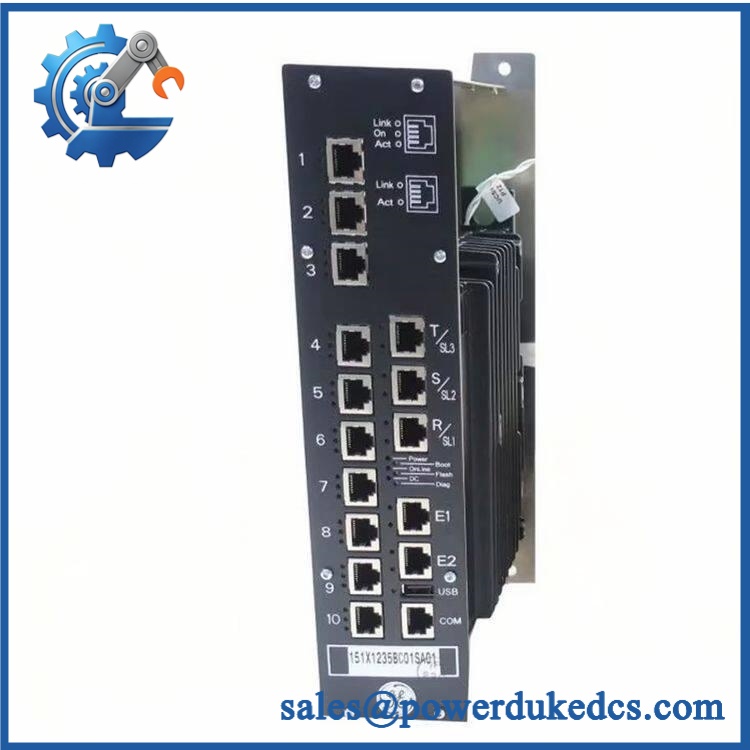
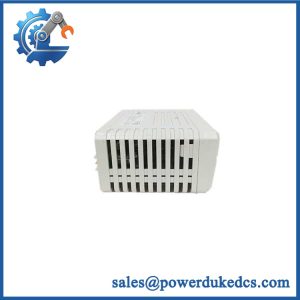
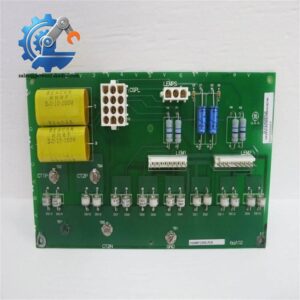
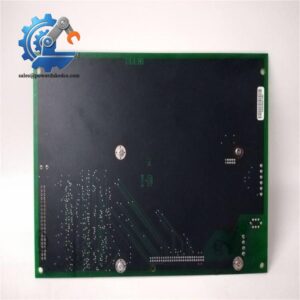
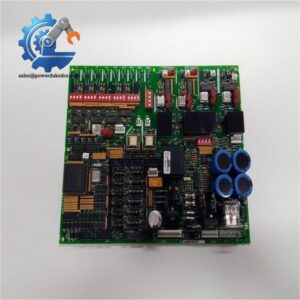
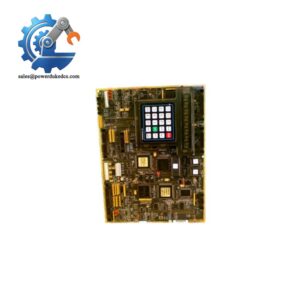
GE 151X1235BC01SA01
Module 4: Compatibility & Installation Traps
Migration/Compatibility
- System: GE EX2100e Excitation Control
- Controller Family: UCSB
- Expansion: CSLA compact high-speed serial-link expansion
- Full Part Number: 151X1235BC01SA01
- HSSL Type: Copper
- Related Fiber Version: 151X1235BC01SA02
- Ethernet: 10-port Ethernet interface/switch assembly reported for the complete module
- USB: 1 service/interface port
- System Architecture: Simplex or redundant controller configurations
- I/O Architecture: Standardized HSSL interface to distributed excitation-system data
- Replacement Type: Exact SA01 replacement strongly preferred
- Configuration: Preserve controller application image, network assignments, HSSL topology, redundancy role, and system-specific parameters
- Logic Rewrite: Normally not required for an exact replacement, but application-image and configuration restoration are required
- Fiber/Copper Migration: Not a drop-in cable change; SA01 and SA02 use different physical HSSL media
⚠️ Field Traps (Watch Out)
1. Do not substitute SA02 for SA01 without redesign review.
GE identifies SA01 as copper HSSL and SA02 as fiber HSSL. A fiber controller cannot simply be connected to existing copper HSSL cabling with a passive adapter. The physical interface and link architecture are different.
2. Preserve the UCSB application image.
The UCSB operates as a standalone controller running application-specific control logic. A replacement that reaches the operating environment but lacks the correct EX2100e application image is not a service-ready spare.
3. Verify simplex versus redundant architecture.
GE documentation states that a simplex system uses one controller, while redundant systems use three identical controllers. Replacing one controller in a redundant EX2100e system therefore requires confirmation of its assigned controller position and redundancy configuration.
4. Do not treat every Ethernet port as a process-I/O channel.
The complete assembly is described as a 10-port Ethernet switch/controller module, but the UCSB/CSLA control architecture relies on defined network and HSSL roles. Preserve the original cable-to-port mapping and controller network configuration during replacement.
Module 5: Quality Assurance SOP
Each available GE 151X1235BC01SA01 should undergo a documented EX2100e controller inspection and functional test before shipment:
- OEM anti-counterfeit visual inspection: Verify GE identification, complete 151X1235BC01SA01 catalog number, UCSB/CSLA designation, copper-HSSL identification, connector layout, Ethernet labeling, and manufacturing marks.
- Variant verification: Confirm , not SA02 fiber.
- Mechanical inspection: Check enclosure, mounting hardware, Ethernet connectors, USB interface, HSSL connections, and front/rear panels for damage.
- PCB condition inspection: Examine accessible electronics for corrosion, contamination, thermal discoloration, cracked components, loose hardware, and evidence of previous repair.
- HSSL interface inspection: Check copper high-speed serial-link connectors for bent contacts, contamination, mechanical damage, and retention problems.
- Power precheck: Perform controlled resistance and continuity measurements before applying controller power.
- Power-on self-test (POST): Energize the module in an approved EX2100e test fixture and verify normal processor initialization and diagnostic status.
- UCSB application test: Load an approved EX2100e diagnostic/application image and verify controller startup and cyclic execution.
- HSSL handshake verification: Connect a controlled excitation-system HSSL test environment and verify data exchange through the CSLA expansion interface.
- Ethernet-port test: Verify the applicable Ethernet ports individually for link establishment and controlled packet transfer.
- USB service-port test: Verify USB device recognition using an approved service test.
- Controller redundancy test: For units intended for redundant systems, verify the appropriate controller role and synchronization behavior in a dedicated test setup.
- I/O-data validation: Inject controlled simulated excitation-system data through the HSSL test environment and confirm correct delivery to the UCSB application.
- Network configuration check: Verify controller identity, network addresses, and expected communication assignments.
- Fault-diagnostic test: Interrupt a controlled HSSL or Ethernet path and verify the expected diagnostic response.
- Final QC record: Record exact part number, copper/fiber variant, application image, firmware where accessible, HSSL results, Ethernet results, redundancy role, and technician sign-off.
- ESD-safe packaging: Package the assembly in ESD-protective material with mechanical protection around the HSSL and Ethernet connectors.
The decisive QC test is HSSL data exchange under the intended EX2100e architecture. A module that merely boots or shows Ethernet link activity has not demonstrated that the UCSB and CSLA functions operate correctly together.
Module 6: CRO-Driven Buyer FAQ
What is GE 151X1235BC01SA01?
GE 151X1235BC01SA01 is an EX2100e UCSB/CSLA copper module. It combines the standalone UCSB controller with the CSLA high-speed serial-link expansion architecture used for excitation-system I/O communication.
What does UCSB/CSLA mean?
UCSB is the Universal Controller Stand-Alone processor that executes application-specific control logic. CSLA is the Compact High-Speed Serial Link Expansion board that adds HSSL I/O channels. GE describes the combined assembly as an EX2100e controller platform.
Is 151X1235BC01SA01 the copper or fiber version?
is the copper-HSSL version. GE identifies 151X1235BC01SA02 as the corresponding fiber-optic version. This distinction must be preserved when ordering a replacement because the physical HSSL interface is different.
Can this controller be replaced with a standard UCSB module?
Not automatically. The 151X1235BC01SA01 is a combined UCSB/CSLA assembly. A UCSB-only module may lack the additional HSSL channels required by the installed EX2100e architecture. GE also documents separate UCSB-only part numbers from UCSB/CSLA assemblies.
Can the 151X1235BC01SA01 be replaced while powered?
Do not assume live replacement. This controller is part of an excitation-control system and participates in controller, HSSL, and network communications. Follow the approved EX2100e maintenance procedure and place the applicable controller architecture in the required maintenance state before removal.
What should I verify before ordering 151X1235BC01SA01?
Confirm the complete 151X1235BC01SA01 identifier, copper HSSL interface, EX2100e controller architecture, UCSB/CSLA configuration, simplex or redundant role, application image, network assignments, and existing HSSL cable topology. The part should not be substituted solely because another UCSB or CSLA module has a similar enclosure.
What warranty and technical support should I expect?
Warranty duration should be stated for the exact unit condition and test status on the quotation. Technical support should cover part-number verification, copper-interface matching, UCSB/CSLA compatibility, HSSL testing, application-image review, network configuration checks, and documented bench-test results. Excitation-system tuning, regulator commissioning, and production startup should be treated separately unless explicitly included.


 Start Chat