

Description
- Brand: GE Fanuc / GE Intelligent Platforms
- Full Model Number: IC698PSD300
- Lifecycle Status: Active in published GE documentation; legacy platform support should be verified
- Core Function: PACSystems RX7i rack power supply
- Top 3 Technical Specs: 18–30 VDC input; 300 W total output; +5 VDC / +12 VDC / -12 VDC outputs
- Rack Position: Slot 0 / leftmost power-supply position
- Cooling Requirement: Forced-air cooling required for full rated output
- Protection: Overcurrent; overvoltage; overtemperature; airflow monitoring
- Indicators: FIELD OK; OUTPUT OK; OVER TEMP
- Stock & Condition: Exact stock confirmation required; New Surplus / Tested Refurbished; Emergency shipping subject to cutoff
The published RX7i documentation identifies IC698PSD300 as the 300 W, 24 VDC-input power-supply option, with 18–30 VDC input and +5 VDC, +12 VDC, and -12 VDC backplane outputs.
Module 3: Obsolescence & Supply Chain Deep Dive
A failed IC698PSD300 can shut down an entire RX7i rack even when the CPU and I/O modules remain healthy. This module occupies the leftmost slot and converts a 24 VDC field supply into the rack’s required DC rails. Its 300 W capacity is intended for higher-load RX7i configurations, while forced-air cooling and airflow monitoring become part of the operating requirement at the rated capacity.
From a TCO standpoint, replacing the power supply is usually far less disruptive than redesigning the control rack around a different PLC platform. The existing CPU, I/O, rack, wiring, and application program can remain in service when the failure is isolated to the power-supply module. The IC698PSD300 accepts 18–30 VDC, delivers up to 300 W total, and provides three backplane rails, so an exact-match spare can restore the installed architecture without a system migration. (For emergency maintenance, having a tested spare already staged can matter more than the nominal component price.)
Module 4: Compatibility & Replacement Matrix
| Approval Item | Engineering Assessment |
|---|---|
| Replacement Classification | Drop-in Replacement for a matching RX7i rack configured for IC698PSD300 |
| Software Compatibility | Not normally applicable to the power-supply module itself |
| Hardware Modification | Normally none |
| Rack Position | Slot 0 / leftmost slot |
| Input Requirement | 18–30 VDC, 24 VDC nominal |
| Rated Output | 300 W total across +5 VDC, +12 VDC, and -12 VDC rails |
| Estimated Physical Swap | 30–90 minutes for qualified controls personnel, excluding LOTO and troubleshooting |
| Estimated Engineering Cost | 150–750 planning allowance |
| Cooling Requirement | Forced-air cooling required for full-capacity operation |
The installation documentation states that IC698PSD300 is a plug-in module installed in the leftmost slot of a standard RX7i rack. GE’s published RX7i comparison also identifies the PSD300 as the 300 W supply with an 18–30 VDC source.
⚠️ Field Traps — Watch Out
- DC Input Mismatch: Do not connect the PSD300 to an AC source. Its specified power source is 18–30 VDC. Confirm polarity, grounding, field wiring, and upstream DC capacity before energization.
- Cooling / Airflow Failure: The 300 W rating depends on the rack’s forced-air cooling arrangement. The supply uses airflow monitoring and can shut down outputs if the required airflow is interrupted.
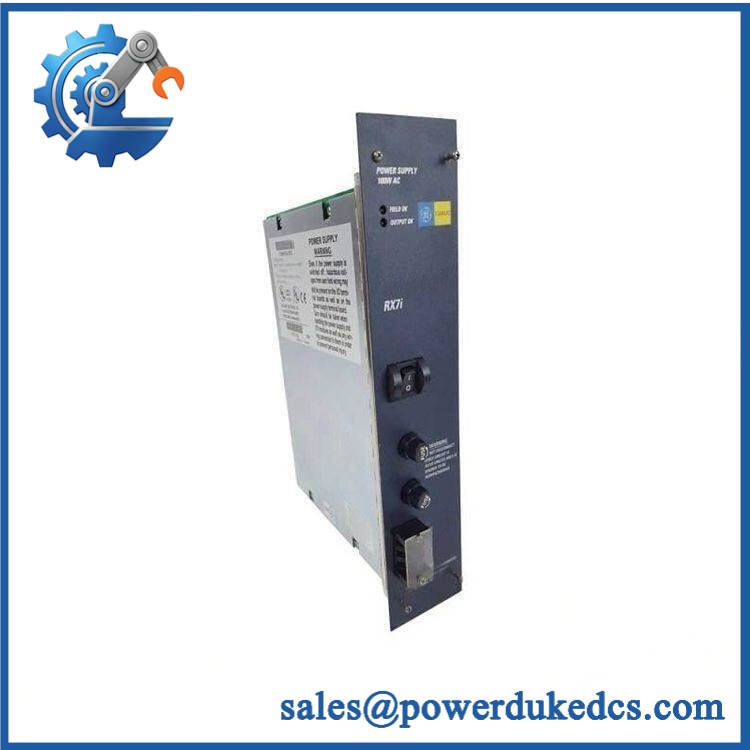
GE IC698PSD300
Module 5: Quality Assurance & Testing SOP
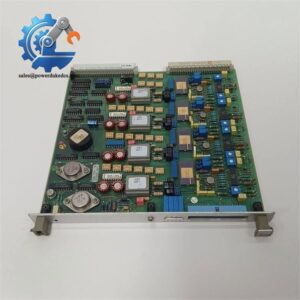
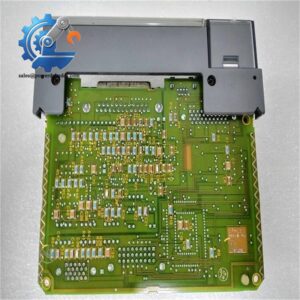
- OEM anti-counterfeit visual inspection — verify GE/GE Fanuc identification, catalog number , labels, housing, terminal block, connector interfaces, and board condition.
- Revision and traceability check — record the full catalog number, hardware/revision markings, serial information, and visible production labels.
- Mechanical inspection — inspect the mounting interface, terminal hardware, fan/airflow interface, and front-panel switch for damage, contamination, corrosion, or overheating.
- Electrical pre-screening — verify input-to-ground condition, polarity path, continuity, grounding integrity, and absence of abnormal short circuits before applying power.
- Power-on self-test (POST) — energize the module using a controlled 24 VDC source and verify expected startup behavior.
- LED verification — confirm FIELD OK, OUTPUT OK, and OVER TEMP indications respond correctly during controlled test conditions. GE documentation identifies these three front-panel status functions.
- Output-rail testing — measure and record the +5 VDC, +12 VDC, and -12 VDC rails under no-load and controlled-load conditions.
- Load testing — apply representative rack load and verify regulation, stability, thermal behavior, and absence of nuisance shutdown.
- Protection testing — where the test fixture permits, verify overcurrent, overtemperature, and airflow protection behavior without exceeding approved test limits.
- Extended energized run — monitor output stability, temperature rise, airflow status, and intermittent faults over an extended operating period.
- Final QC release — photograph the identification label, attach the test record, package the unit using ESD protection, and retain serial-number traceability.
The published specifications identify all three output rails, while the RX7i documentation specifically calls out overcurrent, overvoltage, overtemperature, and airflow-related protection. A valid acceptance test therefore needs more than a simple voltage check.
Module 6: Procurement & Lifecycle FAQ
Q1. Is genuinely in stock, and what is the cutoff for emergency shipping?
Exact inventory should be confirmed against , quantity, condition, and destination before the PO is released. For emergency requirements, provide the required delivery date early enough to confirm warehouse allocation, testing status, and the available carrier cutoff.
Q2. How do you verify the condition and authenticity of an ?
A controlled inspection should verify the OEM markings, catalog number, revision/serial information, terminal condition, electrical integrity, three DC output rails, LED status, thermal behavior, and protection functions. The shipped unit should remain traceable to its QC record.
Q3. Are there firmware compatibility issues I should warn engineers about before issuing the PO?
The is a rack power-supply module, so it does not carry the same firmware-substitution concerns associated with CPUs or intelligent I/O modules. The critical compatibility checks are the RX7i rack type, slot-0 installation, 18–30 VDC input, required power capacity, and forced-air cooling arrangement.
Q4. Can be replaced by another RX7i power supply?
Not automatically. GE’s RX7i family includes different supplies with different input sources and power ratings. For example, IC698PSA100 and IC698PSA350 use AC/125 VDC input, while is specifically the 18–30 VDC, 300 W option. Match the replacement to the site’s power architecture and rack load calculation.
Q5. What warranty and return terms should procurement require?
The quotation should state the exact warranty period, DOA criteria, return-authorization process, serial-number traceability, and exclusions for incorrect wiring, overvoltage, inadequate cooling, or installation damage. For a legacy control asset, those terms should be documented before the PO is approved.


 Start Chat