

Description
- Brand: GE General Electric
- Full Model Number: IS215UCVGM06A
- Functional Acronym: UCVG
- Lifecycle Status: Legacy / Obsolete Mark VI controller hardware
- Core Function: Single-slot UCV controller board running turbine application code
- Top 3 Technical Specs: Intel Ultra Low Voltage Celeron 650 MHz; 128 MB SDRAM; 128 MB flash memory
- Operating System: QNX real-time operating system
- Bus Interface: VME
- Ethernet: Dual 10BaseT/100BaseTX
- Operating Voltage: 14–32 VDC
- Operating Temperature: 0–70°C
- Board Size: Approx. 16.2 × 8.6 cm
- Stock & Condition: New Surplus / Tested Inventory — physical stock confirmation before PO
Obsolescence & Supply Chain Deep Dive
When a Mark VI UCV controller fails, the procurement problem extends well beyond the PCB itself. This board is the processing element that executes turbine application code and communicates with Mark VI I/O through the VME bus. The IS215UCVGM06A uses a 650 MHz Intel Ultra Low Voltage Celeron processor, 128 MB SDRAM, 128 MB flash, QNX, and dual 10/100 Ethernet interfaces. Those specifications make exact part-number identification important; a visually similar UCV board is not automatically an acceptable substitute. Current specialist inventories list the IS215UCVGM06A primarily as replacement or limited-availability stock, which is consistent with its legacy Mark VI role.
For a plant with an operating Mark VI system, replacing the controller board can preserve the existing rack, field wiring, application infrastructure, and commissioning procedures. That can materially reduce TCO compared with a complete turbine-control migration: the alternative may involve new controller hardware, engineering configuration, software validation, cabinet work, FAT/SAT activity, and a longer outage window. The IS215UCVGM06A is also documented by multiple parts references as the successor to IS215UCVDH1A for a specified two-ISB POR application, so engineers should validate the intended replacement relationship rather than treating every UCV-family board as interchangeable. —For emergency maintenance, verified physical stock can eliminate procurement delays associated with factory production lead times.
Compatibility & Replacement Matrix
| Buyer Check | Assessment |
|---|---|
| Replacement Type | Software Compatible / Hardware-Compatible Replacement when replacing an approved UCV controller configuration |
| Direct Board Swap | Potentially direct within the validated Mark VI VME rack and controller application |
| Software/Firmware | Application software, QNX environment, configuration files, and controller-specific data must be verified before startup |
| Hardware Modification | None normally expected for an exact approved replacement; rack and connector compatibility must be confirmed |
| Typical Physical Replacement Time | Approximately 1–2 hours for qualified maintenance personnel |
| Configuration and Functional Testing | Approximately 2–6 hours depending on application backup, network setup, and site validation requirements |
| Engineering Review | Approximately 2–8 hours for part-number, application, rack, network, and software checks |
| Migration Scope | Controller-level replacement rather than complete Mark VI system replacement |
The IS215UCVGM06A is identified as a UCVG controller board for the GE Mark VI Speedtronic system. It operates as a single-slot computer, uses VME communication to the I/O boards, and provides two Ethernet ports for system communications. One current technical reference identifies GEH-6421J as the associated manual and specifies 14–32 VDC operation and 0–70°C operating temperature.
Field Traps — Watch Out
- Replacement Equivalence: Some industry parts lists identify IS215UCVGM06A as replacing IS215UCVDH1A for a specific two-ISB POR configuration. Do not generalize that relationship to every IS215UCVDH1A installation without checking the turbine application and rack configuration.
- Application and Network Configuration: The second Ethernet interface can be assigned to a separate subnet for Modbus or private EGD use, with configuration validated against the hardware at rack power-up. Record the existing network parameters and application configuration before swapping the controller.
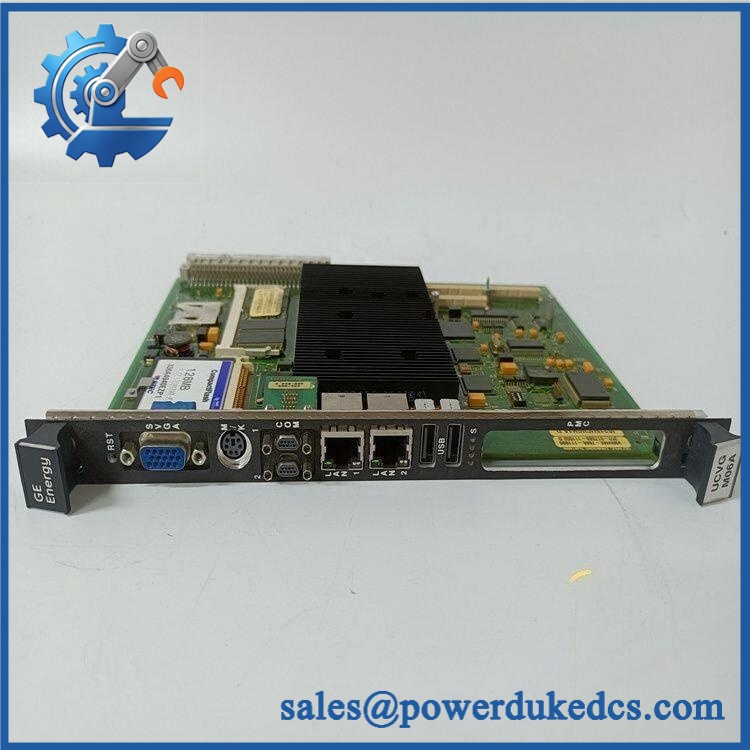
GE IS215UCVGM06A
Quality Assurance & Testing SOP
A controller board requires both hardware inspection and functional verification. A clean PCB is not enough.
- Part-number verification: Confirm and revision marking against the purchase specification.
- OEM anti-counterfeit visual inspection: Examine GE identification marks, PCB artwork, component population, connector geometry, labels, solder work, and evidence of unauthorized modification.
- PCB condition inspection: Check capacitors, inductors, ICs, connectors, battery area, board edges, mounting hardware, contamination, corrosion, and thermal damage.
- Backplane connector inspection: Verify all VME mating contacts are clean, straight, secure, and free from mechanical damage.
- Power-on self-test (POST) checking for ERR/RUN LEDs: Apply controlled power and verify expected front-panel diagnostic behavior. Record any abnormal LED sequence before release.
- Processor and memory verification: Confirm successful controller startup and stable operation of the processor, SDRAM, and flash-memory subsystem within the approved bench setup.
- VME communication test: Connect the controller to a compatible test rack and verify communication with representative Mark VI I/O hardware across the VME bus.
- I/O load testing: Exercise representative simulated I/O traffic and controller response under controlled load conditions to confirm stable cyclic communication rather than merely checking for power-up.
- Ethernet verification: Test both 10BaseT/100BaseTX interfaces with controlled network traffic and confirm link stability.
- Operating-voltage test: Verify operation within the specified 14–32 VDC supply range using controlled laboratory equipment.
- Thermal soak: Where the test facility supports it, operate the controller under elevated-duration conditions and monitor for resets, communication faults, or abnormal temperature behavior.
- Final traceability: Record board number, revision, serial information where available, test results, photographs, condition grade, and packaging inspection.
Procurement & Lifecycle FAQ
Is the GE genuinely in stock, and what is the cutoff for emergency shipping?
Physical inventory should be confirmed before the PO is released. Emergency dispatch depends on completed QA, export documentation, destination, and carrier collection time. A same-day shipment should be committed only after the exact unit has been allocated.
How do you verify the condition and authenticity of an obsolete ?
The purchasing record should contain the exact part number and revision, PCB photographs, connector inspection results, functional test records, and shipment traceability. For turbine-critical applications, retain these records with the maintenance asset file.
Are there firmware or software compatibility issues my engineers should check?
Yes. The controller runs the turbine application and participates in the Mark VI software and communications architecture, so the engineering team should verify application files, controller configuration, QNX environment, Ethernet parameters, and the installed rack configuration before startup. The board itself should not be treated as a generic VME computer.
What warranty and return terms should procurement require?
The quotation should specify the warranty period, DOA criteria, functional-failure coverage, inspection window, and return-authorization process. The delivered condition should also be explicitly stated, such as New Surplus or Tested Inventory, rather than using a generic “new” description.
Can this controller be used to extend the life of an existing Mark VI system?
Yes, as a component-level lifecycle strategy, provided the exact UCVG hardware is validated against the installed application. It can avoid the cost and outage scope of replacing a larger control subsystem, but long-term planning should account for declining availability of legacy Mark VI controller hardware.


 Start Chat