

Description
- Model: IS420ESWBH3A
- Brand: GE
- Series: Mark VIe / Mark VIeS
- Part Type: Industrial Ethernet / IONet Switch
- Functional Abbreviation: ESWB
- Core Function: Provides the Ethernet communication path between Mark VIe controllers and distributed I/O packs.
- Copper Ports: 16 × 10/100Base-TX RJ-45
- Fiber Ports: None
- Ethernet: Auto-negotiating 10/100 Mbps
- Power Input: 24/28 VDC, 1 A maximum
- Power Redundancy: Two independent diode-OR’d power inputs
- Mounting: DIN rail with a qualified mounting clip
- Cooling: Convection
- Ambient Operating Temperature: -40°C to +70°C
- Storage Temperature: -40°C to +85°C
- Buffer: Minimum 256 KB
- MAC Addresses: 4,000
- Safety Classification: Classified-location capability exists for the ESWB family under specified installation conditions.
GE’s Mark VIeS functional-safety documentation explicitly lists IS420ESWBH3A as a 16-port IONet switch, while the ESWB specification table identifies the H3A variant as having 16 copper ports and no fiber ports.
Product Introduction
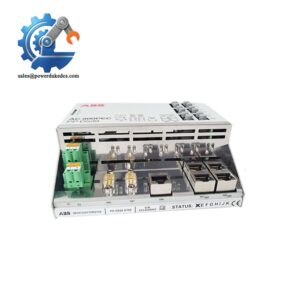
A Mark VIe I/O network failure can remove communication from an entire group of field I/O packs even when the I/O electronics themselves remain powered. The GE IS420ESWBH3A is the 16-port ESWB industrial Ethernet/IONet switch used to provide that communication path in Mark VIe and Mark VIeS systems. The H3A version uses sixteen 10/100Base-TX copper RJ-45 ports and does not include fiber ports.
This is an unmanaged industrial switch intended for real-time control networking rather than general enterprise switching. It supports Ethernet 802.3/802.3u/802.3x functions, automatic speed and duplex negotiation, HP-MDIX sensing, front-panel status indication, and redundant DC power inputs (a useful distinction when troubleshooting a turbine cabinet).
Core Technical Specifications
| Parameter | Specification |
|---|---|
| Manufacturer | GE |
| Part Number | IS420ESWBH3A |
| Product Family | Mark VIe / Mark VIeS |
| Product Type | Industrial Ethernet / IONet Switch |
| Functional Abbreviation | ESWB |
| Network Architecture | Industrial Ethernet / IONet |
| Number of Copper Ports | 16 |
| Copper Port Type | 10/100Base-TX, RJ-45 |
| Fiber Ports | None |
| Fiber Interface | Not applicable for H3A |
| Ethernet Standards | IEEE 802.3, 802.3u, 802.3x |
| Speed | 10/100 Mbps with auto-negotiation |
| Duplex | Full/half duplex auto-negotiation |
| HP-MDIX | Yes |
| Packet Buffer | Minimum 256 KB |
| MAC Address Capacity | 4,000 |
| Power Input | 24/28 VDC |
| Maximum Current | 1 A |
| Power Inputs | 2 independent inputs |
| Power Redundancy | Diode-OR’d |
| Power Connector | Phoenix contact MC 1.5/S-STF-3.81, 2 connectors |
| Cable Type | Cat 5e UTP with RJ-45 connectors |
| Cooling | Convection cooled |
| Mounting | DIN rail with qualified mounting clip |
| Operating Temperature | -40°C to +70°C |
| Storage Temperature | -40°C to +85°C |
| Dimensions | Approximately 188 × 86 × 56 mm |
| Safety Rating | Non-interfering; classified-location applications depend on the applicable Mark VIeS certification and installation conditions |
| Firmware | No user application firmware; unmanaged switch architecture |
The 16-port/no-fiber configuration, electrical requirements, dimensions, temperature range, and mounting information are identified in the GE ESWB specification table.
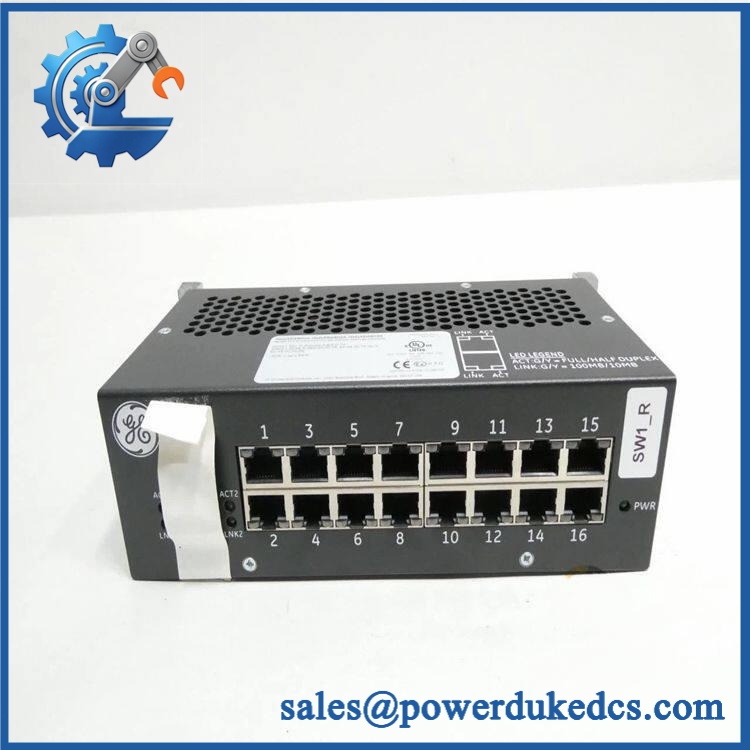
GE IS420ESWBH3A
Application Scenarios & Pain Points
Mark VIe Distributed I/O Networks
In a typical Mark VIe cabinet, the IONet switch provides the Ethernet path linking control processors with distributed I/O packs. GE’s Mark VIeS example bill of material specifically shows IS420ESWBH3A as a 16-port IONet switch.
High-Density I/O Cabinet Segments
Sixteen copper ports make the H3A suitable for cabinets where many I/O packs are concentrated around the same network segment. This is particularly useful when a single switch must service a large group of I/O devices without using fiber expansion.
Turbine Control System Maintenance
A failed switch can look like a controller or I/O-pack problem because multiple devices may disappear simultaneously. GE identifies loss of communication from a group of I/O packs as a characteristic network-switch failure symptom, especially when the switch repeatedly resets.
Classified Industrial Installations
The ESWB family is documented for Mark VIeS applications with classified-location capability, including Class I Division 2 / Zone 2 / ATEX configurations under specified conditions. The certification must be checked against the actual system, enclosure, wiring method, and installation environment.
High-Temperature Control Cabinets
At cabinet temperatures approaching 50°C or higher, inspect the switch power-input section carefully. GE specifically notes that extended exposure to temperatures above normal operating conditions can reduce the life of electrolytic capacitors in Mark VIe network switches.
Common Error Codes & Diagnostic Symptoms
Symptom: Multiple I/O packs lose communication simultaneously
→ Diagnosis: Check the IS420ESWBH3A power inputs, link LEDs, common Ethernet connections, and switch reset behavior. A switch-level fault can interrupt communication from an entire I/O group while the field devices remain energized.
→ Action: Replace module after verifying upstream power and network cabling.
Symptom: Network communication repeatedly disappears and returns
→ Diagnosis: Inspect the switch’s DC supply for instability and monitor for periodic resets. GE service documentation identifies repeated network loss following switch resets as a characteristic failure symptom.
→ Action: Replace module after confirming the external supply and network infrastructure.
Symptom: Audible hissing or crackling from the switch area
→ Diagnosis: GE identifies audible hissing/crackling as a possible symptom associated with power-supply capacitor leakage/failure in Mark VIe network switches.
→ Action: Replace module and investigate the associated DC supply environment.
No specific numerical GE fault-code table has been reliably verified for itself, so unsupported numeric fault codes should not be assigned to this switch.
Cross-Reference & Lifecycle Migration
The belongs to the ESWB family of GE Mark VIe IONet switches. GE defines five ESWB variants, H1A through H5A, with the principal difference being fiber-port configuration. The H3A variant is the 16-port copper-only version.
The documented ESWB family includes:
| Variant | Copper Ports | Fiber Configuration |
|---|---|---|
| IS420ESWBH1A | 16 | 1 × 100Base-FX / 100Base-LX10 configuration |
| IS420ESWBH2A | 16 | 2 × fiber ports |
| 16 | No fiber ports | |
| IS420ESWBH4A | 16 | 1 × 100Base-FX + 2 × 100Base-LX10 |
| IS420ESWBH5A | 16 | 2 × fiber configuration |
Because the H3A has no fiber interfaces, it should not be substituted for a fiber-equipped ESWB variant simply because the enclosure and port count appear similar.
GE’s published specification table lists the ESWB variants as Active in the referenced documentation. A definitive manufacturer EOL date specifically for was not established from the current public evidence, so it is preferable to distinguish documented lifecycle status from actual current production availability.
Spare-stock implication: Where the switch is supporting a critical Mark VIe I/O network, maintaining at least one tested spare is appropriate. Record the exact H3A variant because replacing it with an H1A/H2A/H4A/H5A changes the fiber configuration.
Field Engineer’s Tech Notes
Tech Note 1 — Count ports before condemning the switch.
The H3A is a 16-port copper-only unit. When a replacement arrives, verify all sixteen RJ-45 interfaces and confirm there are no fiber ports. A visually similar ESWB variant can still be electrically unsuitable for the cabinet’s installed network topology.
Tech Note 2 — Check both DC feeds independently.
The switch has two independent 24/28 VDC power inputs that are diode-OR’d for redundancy. Measuring only one input can produce a misleading diagnosis, particularly when one source has failed while the switch remains partially operational.
Strict QA & Testing SOP
Step 1 — Inbound Inspection
Verify , GE identification markings, serial/revision information, connector condition, enclosure integrity, and evidence of storage or transport damage.
Step 2 — Mechanical Inspection
Inspect all 16 RJ-45 ports, the two Phoenix-style power connectors, mounting holes, enclosure, LEDs, and DIN-rail attachment points. Check for bent contacts, cracked housings, corrosion, or prior repair.
Step 3 — Power Input Test
Apply controlled 24/28 VDC power to the primary input and verify normal startup. Measure operating current and confirm stable power behavior. The specified maximum input current is 1 A.
Step 4 — Redundant Power Test
Test each independent power input separately and then together. Confirm that removal of one source does not interrupt switch operation when the second qualified supply remains within specification.
Step 5 — Port-by-Port Ethernet Test
Test all 16 RJ-45 ports with a controlled Ethernet test setup. Verify link establishment at 10 and 100 Mbps, auto-negotiation, duplex operation, and stable packet transfer.
Step 6 — IONet Functional Test
Connect the switch to a representative Mark VIe test environment and verify communication between the intended controller and simulated I/O endpoints.
Step 7 — Thermal / Extended Run Test
For critical spare inventory, operate the switch for 24 hours or longer under representative network loading while monitoring power stability, link status, enclosure temperature, and reset behavior.
Step 8 — Final QC and Packaging
Record part number, revision, serial number, power-test data, all 16 port results, and physical photographs. Apply ESD protection, cap/protect connectors as appropriate, and use shock-resistant traceable packaging.
QC Documentation: Retain the functional test report and available test video with the inventory record so the switch has documented acceptance evidence before emergency deployment.
Buyer’s FAQ
Q1. What is GE ?
It is a GE Mark VIe/Mark VIeS 16-port industrial Ethernet/IONet switch. The H3A configuration provides sixteen 10/100Base-TX copper RJ-45 ports and no fiber ports.
Q2. Is a managed network switch?
No. GE describes the ESWA/ESWB product line as industrial unmanaged Ethernet switches intended for real-time control applications.
Q3. Does the H3A version have fiber ports?
No. is the no-fiber ESWB variant. The other H1A–H5A versions provide different fiber-port combinations.
Q4. What should be verified before purchasing?
Confirm the complete part number, the 16-port/no-fiber configuration, two-input 24/28 VDC power arrangement, hardware condition, and test evidence. For critical Mark VIe installations, also verify the applicable hazardous-location and system certification requirements before deployment. GE’s current published material continues to identify this model within the Mark VIeS IONet architecture.



 Start Chat