

Description
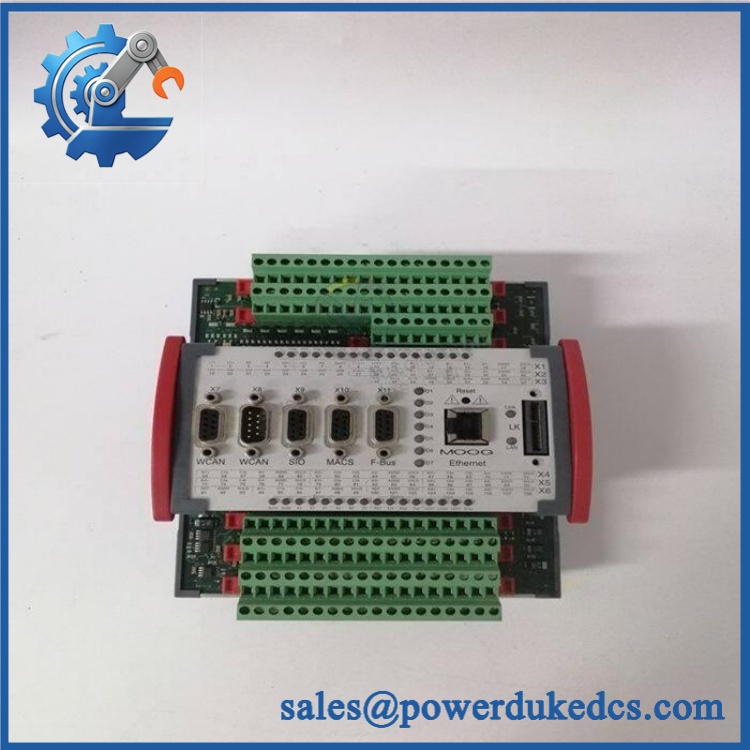
- MOOG D136-001-007 | Factory Sealed Automation Controller
2. At-A-Glance Executive Brief
- Model: MOOG D136-001-007
- Brand: MOOG
- Series: MSC I Motion Controller
- Part Type: Industrial Motion Controller / Servo Control Module
- Core Function: Executes motion control programs and manages communication between servo systems, field devices, and higher-level automation networks.
- Primary Use: Industrial servo applications, hydraulic motion control systems, test equipment, and automated machinery.
- Key Specifications:
- 32-bit PowerPC RISC processor with floating-point unit
- 4 MB Flash EEPROM
- Ethernet, CAN, PROFIBUS-DP interfaces
- 8 configurable digital I/O channels
- DIN-rail mounting design
3. Product Introduction
The MOOG D136-001-007 is installed as the main processing unit within the MSC I Motion Controller architecture. It combines PLC functionality with motion control capability, providing coordinated control for servo systems, hydraulic actuators, and industrial automation equipment. The controller integrates communication interfaces including Ethernet, CAN, PROFIBUS-DP slave, and serial connections (which makes it suitable for legacy machine upgrades where multiple field networks must remain connected).
In field deployments, this module is often maintained as a critical spare because motion controllers directly affect machine availability. Before replacement, verify the application program, communication parameters, expansion modules, and license requirements. The controller stores application data through non-volatile memory, but configuration transfer may still be required after installation.
4. Core Technical Specifications
| Parameter | Value |
|---|---|
| Manufacturer | MOOG |
| Model Number | D136-001-007 |
| Product Series | MSC I Motion Controller |
| Controller Type | Industrial Motion Controller with PLC Functionality |
| Processor | 32-bit PowerPC RISC processor with floating-point unit |
| Flash EEPROM | 4 MB |
| Data Retention | Typically 10 years |
| Ethernet Interface | 10 Mbit/s 10Base-T RJ45 |
| CAN Interface | 2 independent CAN interfaces |
| PROFIBUS-DP | Slave interface, up to 12 Mbit/s |
| Serial Interface | 2 × EIA-232 |
| Digital I/O | 8 configurable channels |
| Digital I/O Type | IEC 61131-2 Type 1 |
| Power Supply | 24 VDC (18–36 VDC) |
| Idle Current Consumption | Approx. 0.5 A |
| Full Load Current Consumption | Approx. 2 A |
| Mounting Method | NS 35/7.5 DIN rail |
| Dimensions (W × D × H) | Approx. 160 × 170 × 85.5 mm |
| Protection Rating | IP20 |
| Operating Temperature | +5°C to +55°C |
MOOG D136-001-007
5. Application Scenarios & Pain Points
A motion controller failure can stop an entire production cell even when mechanical components remain healthy. The D136-001-007 is typically investigated when servo positioning, communication, or sequence execution becomes unstable.
- Hydraulic servo test systems: Used in precision test benches where actuator response and repeatability are critical. Controller communication interruptions can affect closed-loop testing accuracy.
- Industrial machinery: Applied in automated production equipment requiring coordinated axis movement and PLC-style logic control.
- Legacy automation upgrades: During modernization projects, this MSC I controller can help maintain existing machine architectures without replacing complete motion platforms.
- Material processing equipment: Supports motion sequences where repeatable positioning is required under continuous operation conditions.
- Research and simulation systems: Used in specialized motion platforms requiring CAN and serial communication integration.
6. Common Error Codes & Diagnostic Symptoms
Symptom/Code: Controller Does Not Boot / No Application Startup
→ Diagnosis: Possible power supply instability, corrupted application memory, or processor board failure.
→ Action: Verify 24 VDC supply quality and replace controller if internal hardware failure is confirmed.
Symptom/Code: Communication Timeout / Network Device Missing
→ Diagnosis: Ethernet, CAN, or PROFIBUS communication interface failure, incorrect addressing, or configuration mismatch.
→ Action: Check communication parameters and replace the D136-001-007 module if the interface hardware is defective.
Symptom/Code: Unexpected Motion Sequence Stop / Servo Control Fault
→ Diagnosis: Controller program execution interruption, I/O processing fault, or corrupted configuration data.
→ Action: Reload verified application parameters or replace the controller module.
7. Cross-Reference & Lifecycle Migration
- Compatible Product Family: MOOG MSC I Motion Controller series.
- Related Revision: D136-001-008 belongs to the same MSC I family but has different interface configuration and does not include the PROFIBUS-DP option.
- Migration Notes: Replacement should verify:
- Application software version
- Communication configuration
- Expansion module compatibility
- License requirements
- Firmware Requirement: Controller software or application download may be required after replacement.
- Lifecycle Status: Considered a legacy industrial motion controller.
- Stock Strategy: Maintain tested spare inventory for machines still using MSC I architecture because migration projects often require engineering validation before hardware replacement.
8. Field Engineer’s Tech Notes (Anti-Pitfall Guide)
- Do not forget the application backup before removal.
A new controller may power up correctly but remain unusable without the correct motion program, network parameters, and machine-specific configuration. - Check terminal strips and DIN rail mounting carefully.
The controller uses plug-in terminal connections, and incorrect terminal placement can create false I/O faults during commissioning. The module requires proper 24 VDC supply verification before connection.
9. Strict QA & Testing SOP
Step 1 — Incoming Inspection
- Confirm MOOG D136-001-007 identification label.
- Verify serial number and hardware revision.
- Inspect housing, DIN rail clips, connectors, and terminal interfaces.
- Photograph external condition.
Step 2 — Electrical Testing
- Apply controlled 24 VDC power supply.
- Check startup sequence.
- Measure idle current and operating current.
- Verify status indicators.
Step 3 — Communication Testing
- Test Ethernet communication.
- Verify CAN interface response.
- Confirm PROFIBUS-DP communication where applicable.
- Check serial port operation.
Step 4 — Functional Rig Testing
- Load approved test configuration.
- Verify digital input/output operation.
- Confirm controller processing stability.
- Monitor extended runtime behavior.
Step 5 — Packaging Control
- Place tested unit in anti-static packaging.
- Protect terminal connectors.
- Add shock protection for international shipment.
Test videos are available for verified inspection records.
10. Buyer’s FAQ (Dynamic Q&A)
Q: Can the MOOG D136-001-007 be hot-swapped during machine operation?
A: No assumption should be made. The MSC I controller is a central processing unit, and removal during operation may interrupt motion sequences or create safety-related machine conditions. Follow the machine manufacturer’s shutdown procedure.
Q: How do I confirm this is a New Original D136-001-007?
A: Check the MOOG identification label, serial number, hardware revision, packaging condition, and functional test documentation. Factory-sealed units should retain original packaging indicators.
Q: Does the controller require programming after replacement?
A: Usually yes. The hardware contains controller memory, but machine-specific application software, parameters, and communication settings must match the existing installation.
Q: What warranty information should be requested before purchase?
A: Confirm warranty duration, test coverage, replacement policy, and whether the warranty includes functional verification after delivery. A tested automation spare should include traceable inspection records.


 Start Chat