

Description
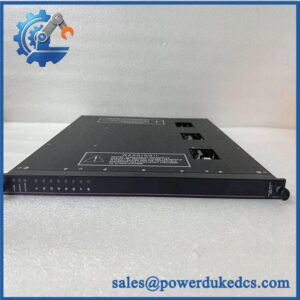
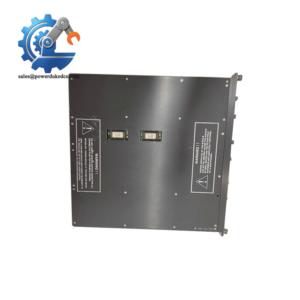
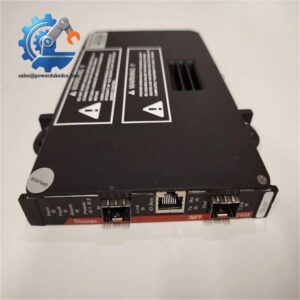
Unboxing & Physical Snapshot
- Model & Brand: TRICONEX 3700A
- Equipment type: TMR Analog Input (AI) Module for Tricon safety systems.
- Input capacity: 32 differential, DC-coupled inputs.
- Input range: 0–5 VDC, with the 3700A supporting over-range measurement to approximately 5.3 VDC.
- Resolution: 12 bits.
- Physical dimensions: Verify the exact mechanical drawing for the applicable Tricon chassis/module revision before cabinet planning.
- Estimated shipping weight: Approximately 3 kg packed based on a current supplier listing; use the actual scale weight for freight and customs documentation.
- What’s in the box: 3700A module; external termination panel/cable only if explicitly included with the inventory lot.
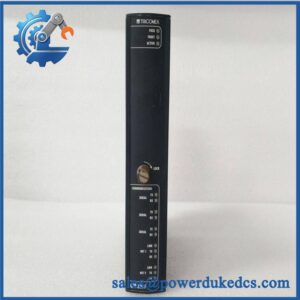
- Front identification: Yellow color code with PASS, FAULT, and ACTIVE status indicators.
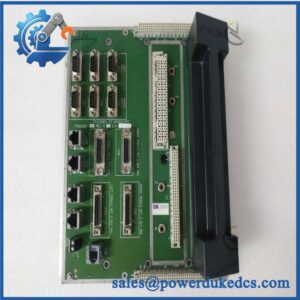
- Receiving inspection: Photograph the nameplate, serial/date code, front LEDs, chassis connector, keying features, and any certification markings.
Product Introduction
Architecture hook: The TRICONEX 3700A is a TMR analog input module within the Tricon safety-system architecture. It processes 32 differential DC-coupled inputs, and its three independent input channels support the TMR architecture used to identify and tolerate certain hardware faults.
The module is not a generic 0–5 V analog card. The 3700A requires the appropriate Tricon chassis and external termination arrangement, and its mechanical keying prevents incorrect installation in the chassis. That matters during spare replacement because field wiring, termination hardware, channel configuration, and the Tricon control-system database must all correspond to the replacement module.
Core Technical Specifications
| Parameter | Value |
|---|---|
| Manufacturer | TRICONEX |
| Product Family | Tricon |
| Model | 3700A |
| Module Type | TMR Analog Input |
| Input Signals | 32 differential, DC-coupled |
| Input Voltage | 0–5 VDC |
| Over-Range Measurement | +6%, approximately 0–5.3 VDC |
| Resolution | 12 bits |
| Input Update Rate | 55 ms |
| Accuracy | <0.15% of full-scale range, 0–60 °C |
| Minimum Input Resistance | 30 MΩ DC |
| Power-Off Input Resistance | 30 kΩ typical |
| Common-Mode Rejection | −80 dB typical, DC–100 Hz |
| Common-Mode Range | −12 to +12 V peak |
| Channel-to-Channel Isolation | 200 kΩ typical |
| Input Over-Range Protection | 150 VDC continuous / 115 VAC continuous |
| Input Current Range | 0–20 mA using 250 Ω shunt |
| Logic Power | <10 W |
| Status Indicators | PASS, FAULT, ACTIVE |
| Color Code | Yellow |
| Installation | Tricon chassis with external termination arrangement |
| Firmware | Module firmware; verify actual revision before deployment |
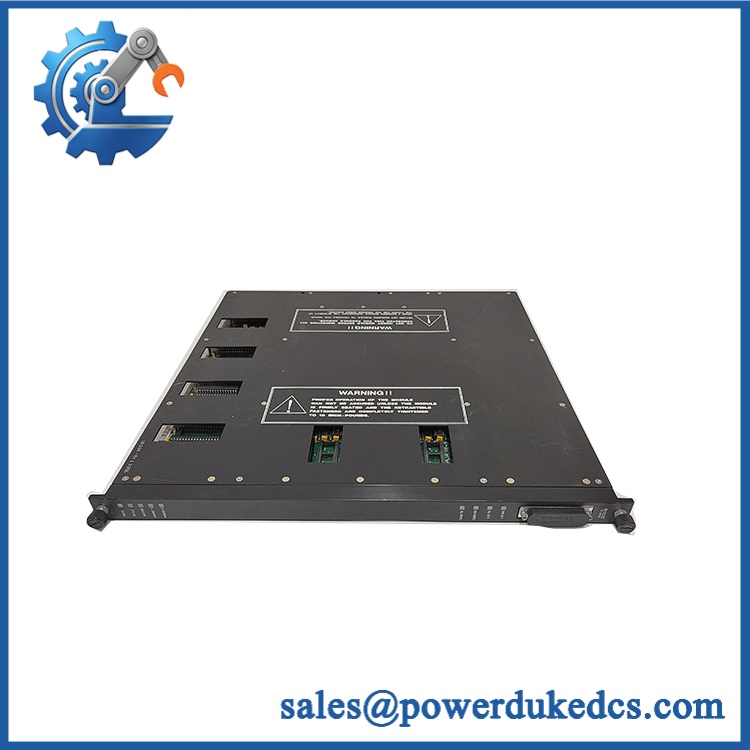
TRICONEX 3700A
The published Tricon documentation specifically distinguishes the 3700A from the 3700: both provide 0–5 VDC analog input, while the 3700A adds +6% input over-range measurement.
? Global Compliance & Industry Certifications
For a safety-system I/O module, certification must be evaluated against the exact hardware revision and the complete Tricon installation.
- CE Mark: Verify the applicable Triconex/Schneider Electric declaration for the exact 3700A revision.
- UL/cUL: Verify the applicable North American certification and installation conditions.
- IEC 61508 / SIL: Tricon systems are designed for functional-safety applications, but do not treat the 3700A module alone as an independently certified safety function. The safety claim belongs to the evaluated system and approved configuration.
- ATEX / IECEx: Verify the exact system certification before use in a hazardous area. The module’s presence in a Tricon system does not automatically establish hazardous-area approval.
- Marine approvals: DNV or equivalent classification must be confirmed for the exact hardware and installation.
- EMC/environmental qualification: Verify the applicable Tricon system documentation and installation requirements.
The TMR architecture is safety-relevant because the module receives and processes redundant channel information; an incorrect replacement can therefore affect the diagnostic and fault-tolerance assumptions of the SIS.
Verify specific lot certifications with OEM.
? Long-Term Storage & Asset Preservation Guide
- Protect the backplane connector. Keep the module in its original protective packaging and prevent dust, moisture, and conductive particles from contacting the rear connector. Do not touch connector contacts unnecessarily.
- Maintain ESD control. Store the 3700A in an ESD-safe shielding bag or equivalent packaging. Avoid ordinary polyethylene bags that can accumulate electrostatic charge around exposed electronics.
- Control humidity and condensation. Maintain a clean, dry storage environment, preferably below 60% RH, and avoid rapid temperature transitions before opening the packaging.
The 3700A contains electronics that can remain unused for years, so inspect the connector, PCB enclosure, status indicators, and mechanical keying before installation. Do not perform an uncontrolled power-up simply to establish whether an old spare “still works.”
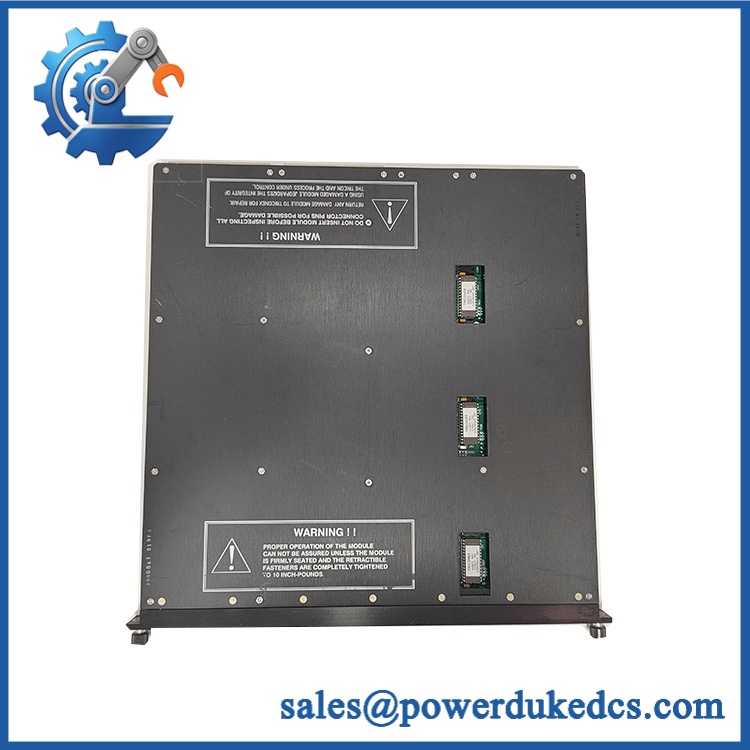
TRICONEX 3700A
Physical Installation Prerequisites
- Install the 3700A only in the specified Tricon chassis and keyed module position.
- Use the appropriate external termination panel (ETP) and system cable for the installed architecture; Tricon documentation specifies that analog input modules require a separate termination arrangement.
- Inspect the rear connector and chassis receptacle for bent contacts, contamination, or mechanical damage before insertion.
- Confirm that the module keying corresponds to the intended chassis position.
- Provide the cabinet environment specified for the Tricon system, including temperature, humidity, vibration, and contamination controls.
- Maintain sufficient clearance for module removal and front-panel access; do not substitute an arbitrary 50 mm clearance for the actual Tricon chassis arrangement.
- Verify field signal polarity, 0–5 V scaling, shield/grounding arrangements, and termination hardware before commissioning.
- If a 0–20 mA signal is being used through the specified 250 Ω shunt, verify the complete termination design before energization.
- Confirm the approved SIS configuration and channel mapping before returning the module to service.
Buyer’s FAQ
Q: What HS Tariff Code should be used for TRICONEX 3700A?
A: Classify the unit according to its actual function as a 32-channel industrial analog input module and the applicable destination-country tariff schedule. Do not classify it as a generic PLC card without retaining technical evidence supporting the final classification.
Q: What Country of Origin should be declared?
A: Use the actual manufacturing origin supported by the physical nameplate, OEM documentation, or supplier declaration. The Triconex brand and seller’s shipping location do not establish COO.
Q: Should shipping insurance be purchased?
A: For a safety-system spare, insurance is generally prudent when the replacement value or operational consequence is material. Use ESD packaging, immobilize the module inside the carton, protect the rear connector, and photograph the serial number and physical condition before shipment.
Q: Does the 3700A include the latest firmware?
A: Do not assume it does. The 3700A has module-level firmware, but the critical commissioning requirement is compatibility with the installed Tricon system’s approved hardware and software configuration. Record the module revision/date code and firmware information where accessible before replacing an installed unit. The 3700A’s electrical characteristics—including its 0–5 V range and +6% over-range capability—must also match the configured application.



 Start Chat