

Description
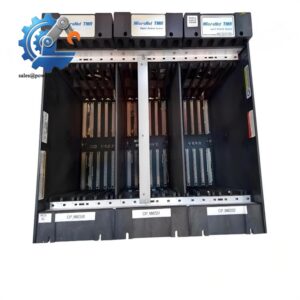
- Model & Brand: Woodward 5453-279 | MicroNet TMR Main Chassis
- Series: MicroNet TMR / MicroNet+ TMR
- Part Type: TMR control chassis / VME card cage
- Physical Dimensions: Approx. 483 W × 356 H × 305 D mm (19.0 × 14.0 × 12.0 in) for the 5009FT control chassis configuration.
- Chassis Architecture: 18-slot VME motherboard in the documented 5009FT configuration; three isolated 6-slot kernel sections support the A, B, and C TMR paths.
- Estimated Bare-Chassis Shipping Weight: Budget approximately 10–12 kg packed; published documentation gives 25 kg / 56 lb for a fully loaded 5009FT system, so the actual freight weight depends heavily on installed modules.
- What’s in the Box: 5453-279 chassis; protective packaging; mounting hardware only when specifically included; CPU, kernel power supplies, I/O modules, cables, and FTMs are not assumed included
- Cooling: Forced-air architecture with kernel-level fans; every active slot or unused position must be handled according to the applicable MicroNet chassis installation requirements.
- Important Identification: 5453-279 = MicroNet TMR Chassis in Woodward’s published 5009FT system documentation.
Product Introduction
Compliance begins with the exact chassis, not with a visually similar card cage. Woodward identifies 5453-279 as the MicroNet+ TMR main chassis used in the 5009FT fault-tolerant steam-turbine control system. The documented architecture contains three isolated kernel sections, each with a kernel power supply, CPU, and I/O resources, with the motherboard providing separate data paths among the three CPUs. This physical arrangement is what permits TMR signal comparison, voting, fault annunciation, and continued operation after defined single-point failures.
The chassis is specified at approximately 19 × 14 × 12 inches, with an 18-slot VME motherboard in the 5009FT implementation. Woodward’s manual shows 5466-1049 kernel power supplies, 5466-1047 CPUs, and multiple TMR I/O modules installed across the A/B/C kernel sections. A replacement chassis therefore has to match the installed MicroNet generation and backplane arrangement; a later MicroNet Plus chassis may occupy a similar cabinet space while still representing a different hardware architecture (critical during legacy asset reconciliation).
Core Technical Specifications
| Parameter | Value |
|---|---|
| Manufacturer | Woodward |
| Part Number | 5453-279 |
| Product Type | MicroNet TMR Main Chassis |
| Primary System | MicroNet TMR / 5009FT |
| Architecture | Triple Modular Redundant (TMR) |
| Motherboard | 18-slot VME architecture |
| Kernel Sections | 3 isolated sections: A, B, C |
| CPU Configuration | One CPU per TMR kernel in the documented 5009FT configuration |
| I/O Capacity | Configuration-dependent; documented 5009FT arrangement uses multiple TMR I/O modules |
| Power Supply Interface | Dedicated MicroNet kernel power-supply modules |
| CPU Example | 5466-1047 PowerPC5200 400 MHz |
| Kernel PSU Example | 5466-1049, 24 VDC input |
| Field Interface | External FTMs connected through dedicated I/O cables |
| Communication Architecture | Redundant kernel-to-kernel and slot-to-slot data paths |
| Mechanical Width | Approx. 483 mm |
| Mechanical Height | Approx. 356 mm |
| Mechanical Depth | Approx. 305 mm |
| Chassis Environment | Forced-air cabinet installation |
| 5009FT Cabinet Ambient | 0–40 °C surrounding air for the cabinet-system configuration |
| 5009FT Kit Ambient | 0–55 °C for components purchased as a kit |
| Approx. Fully Loaded System Weight | 25 kg / 56 lb |
| Compliance for 5009FT Configuration | CE / CSA; additional hazardous-area conditions apply by marked configuration |
| Safety-System Use | Included in Woodward’s listed MicroNet TMR safety-system hardware set |
Woodward’s 5009FT documentation specifically associates 5453-279 with the MicroNet+ TMR main chassis, while Product Specification 03373 gives the 5009FT chassis dimensions and environmental limits.
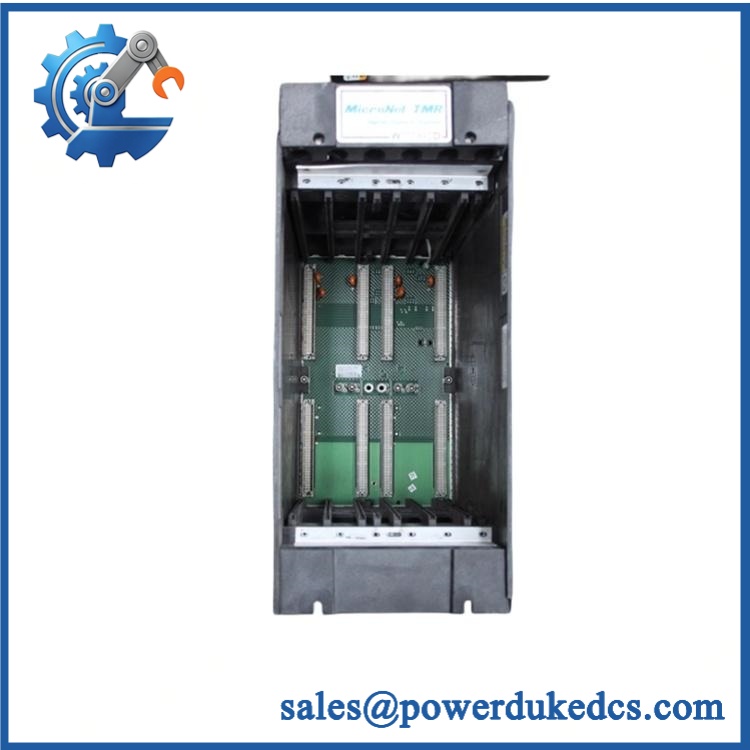
Woodward 5453-279
🚨 Global Compliance & Industry Certifications
For this asset, certification has to be recorded against the actual chassis and installed system configuration. Do not copy an approval from another MicroNet chassis into the 5453-279 asset record.
- CE Mark: Woodward’s 5009FT Product Specification identifies European CE compliance under the EMC Directive 2014/30/EU and Low Voltage Directive 2014/35/EU.
- CSA: The same specification identifies CSA certification for ordinary locations in the United States and Canada, under CSA Certificate 2291171.
- UL/cUL: MicroNet documentation identifies UL-based hazardous-location provisions for appropriately marked equipment. Do not treat this as proof that every 5453-279 unit carries an individual UL/cUL listing.
- ATEX / IECEx: MicroNet documentation describes suitability for European Zone 2, Group IIC when installed in a suitable enclosure and under the stated conditions. The referenced documentation specifically calls for a minimum IP54 enclosure and appropriate transient protection. Standalone IECEx certification for 5453-279 was not established in the reviewed records.
- Class I, Division 2: The MicroNet documentation identifies suitability for Class I, Division 2, Groups A, B, C, D, T4A under stated installation and temperature conditions, with the warning that substitution of components can impair suitability.
- Marine / DNV GL: The reviewed MicroNet documentation references Det Norske Veritas certification conditions within the MicroNet equipment family, but an individual 5453-279 certificate was not established from the records reviewed.
The hazardous-area distinction matters. A Class I, Division 2 or Zone 2 approval is tied to controlled ignition risk in locations where flammable gas may be present under abnormal conditions; incorrect component substitution can therefore create both a safety and audit problem.
Verify specific lot certifications with OEM.
🚨 Long-Term Storage & Asset Preservation Guide
Keep the bare chassis clean, dry, and mechanically supported. The backplane contains VME connectors and etched-circuit interconnects; dust, oxidation, and impact damage at those interfaces can produce difficult-to-trace system faults years later.
Protect every exposed connector from contamination. Use ESD-safe packaging around the chassis and especially around any retained modules. Woodward explicitly instructs personnel to keep electronic controls in their anti-static protective bags until installation and to avoid touching PCB conductors or connectors directly.
Do not store a populated chassis on an unsupported shelf edge. The documented 5009FT system can reach 25 kg / 56 lb fully loaded, and repeated mechanical loading can distort mounting hardware or damage card guides. For warehouse preservation, maintain stable temperature, avoid condensation, and keep the chassis in an enclosed area away from vibration.
Preserve the original hardware configuration record. Photograph the kernel sections, installed blanking plates, chassis labels, grounding points, and module positions before the asset enters long-term storage. This is particularly useful because the 5009FT architecture depends on A/B/C kernel separation and defined module placement.
Physical Installation Prerequisites
The 5453-279 is a cabinet/chassis assembly, not a DIN-rail device. The documented 5009FT control chassis is approximately 483 × 356 × 305 mm and uses an 18-slot VME motherboard.
Before installation:
- Confirm the cabinet can accommodate approximately 19 × 14 × 12 inches plus rear cable-routing space.
- Use the specified chassis mounting points and establish a low-impedance protective-earth connection to the cabinet.
- Do not assume a generic 50 mm air gap is adequate. The applicable MicroNet installation documentation should govern cabinet spacing and ventilation.
- Maintain unobstructed forced-air paths around the fan assemblies.
- Do not operate with missing slot hardware where the applicable chassis design requires a module or blanking plate to preserve cooling flow.
- Inspect every VME connector before insertion; bent or recessed contacts can damage both the chassis and the installed module.
- Verify the correct kernel power supplies, CPUs, and I/O cards before energization. The 5009FT configuration uses three kernel sections and separate redundant data paths.
- Confirm field cables are routed to the correct FTMs. Woodward’s documented 5009FT layout assigns specific cable and FTM part numbers to the installed I/O modules.
- For hazardous-area installations, verify the enclosure, field wiring method, component markings, temperature limitations, and transient-protection requirements before energizing the system.
- Allow sufficient front clearance for module insertion, retaining hardware, and service access; the chassis is designed around removable VME modules rather than fixed wiring at the card edge.
Buyer’s FAQ
Q1. What HS tariff code should be used for Woodward 5453-279?
A: Do not classify the shipment from the phrase “TMR chassis” alone. Because the 5453-279 is a control-system chassis containing the VME backplane and serving a dedicated industrial-control function, HS heading 8537 may be considered depending on the precise customs description and whether the imported item is classified as a control-panel assembly or as a component chassis. Confirm the final country-specific tariff code with the importer or customs broker.
Q2. Does the Country of Origin have to be the United States because Woodward documentation identifies U.S. manufacture?
A: Not automatically. A supplier’s warehouse location, Woodward corporate location, and manufacturing origin are separate data points. The COO should be taken from the actual unit’s traceability information or manufacturer documentation and then carried consistently into the commercial invoice, packing list, and Certificate of Origin when required.
Q3. How should a 5453-279 be insured and packed for international freight?
A: Use a rigid crate or heavy-duty carton with internal shock restraint, ESD protection for exposed electronics, edge protection around the chassis frame, and moisture protection appropriate to the transit route. The published 25 kg figure applies to a fully loaded 5009FT system, so the actual 5453-279 shipment weight should be established from the physical configuration being shipped. For a critical spare, insure against the full declared replacement value rather than a nominal scrap value.
Q4. Does the 5453-279 chassis include the latest firmware pre-loaded?
A: No firmware should be attributed to the bare chassis. Woodward’s 5009FT architecture places the application software and control processing in the CPU and associated CCT environment; the documented 5453-279 is the main physical chassis/backplane assembly. Before commissioning, verify the installed CPU hardware, CCT software revision, application configuration, and I/O compatibility.
Q5. Can I replace a 5453-279 with a newer MicroNet Plus chassis without engineering changes?
A: Do not treat that as a simple physical substitution. Woodward documents multiple MicroNet generations with different chassis architectures, including the 5453-279 MicroNet TMR chassis and newer MicroNet Plus chassis such as 5453-759 and 5453-829. A platform migration can require different CPU, power-supply, I/O, software, and configuration arrangements, so the exact installed system should be identified before approving a replacement.



 Start Chat


