

Description
- Brand: ABB
- Full Model Number: MWD 10 MO-SURGE
- Product Family: MWD
- Lifecycle Status: Established medium-voltage surge-arrester product family; exact ordering status requires confirmation
- Core Function in System: Metal-oxide surge arrester for transient overvoltage protection in medium-voltage AC equipment
- Top 3 Hardcore Specs: Uc 10 kVrms; Ur 12.5 kVrms; In 10 kA peak
- Arrester Class: IEC 60099-4 Station Low (SL), Line Discharge Class 2
- Housing: Direct-molded silicone, gapless metal-oxide design
- Installation: Indoor only
- System Frequency: 50/60 Hz application for this 10 kV configuration
- Condition & Lead Time: New replacement inventory subject to physical verification; emergency dispatch based on confirmed stock
The MWD family is a silicone-housed, gapless metal-oxide surge-arrester range intended for indoor medium-voltage AC systems. Current Hitachi Energy documentation lists the family at 10 kA nominal discharge current, with Uc from 4–44 kVrms and Ur from 5–55 kVrms; the specific MWD 10 configuration is documented in current technical records at Uc 10 kV and Ur 12.5 kV.
Module 3: Technical Intro & Downtime Impact
A medium-voltage surge arrester normally sits idle until a transient arrives; when lightning or switching overvoltage appears, its job is immediate. The ABB MWD 10 MO-SURGE is an indoor MWD-series metal-oxide arrester intended to limit these transient overvoltages before they reach insulation systems, transformers, motors, cables, switchgear, or other medium-voltage equipment. ABB’s MWD design uses MO resistors without a spark gap and a directly molded silicone housing.
For protection coordination, the critical figures are Uc 10 kVrms, Ur 12.5 kVrms, and In 10 kA peak for the MWD 10 configuration. The MWD family is classified SL / Line Discharge Class 2, with a published thermal energy rating of 5.0 kJ/kV at Ur and 6.25 kJ/kV at Uc in the detailed technical data. The arrester is intended for indoor installation, so cabinet environment and system insulation coordination remain part of the selection calculation. —Do not substitute a different Uc or Ur simply because its housing appears identical.
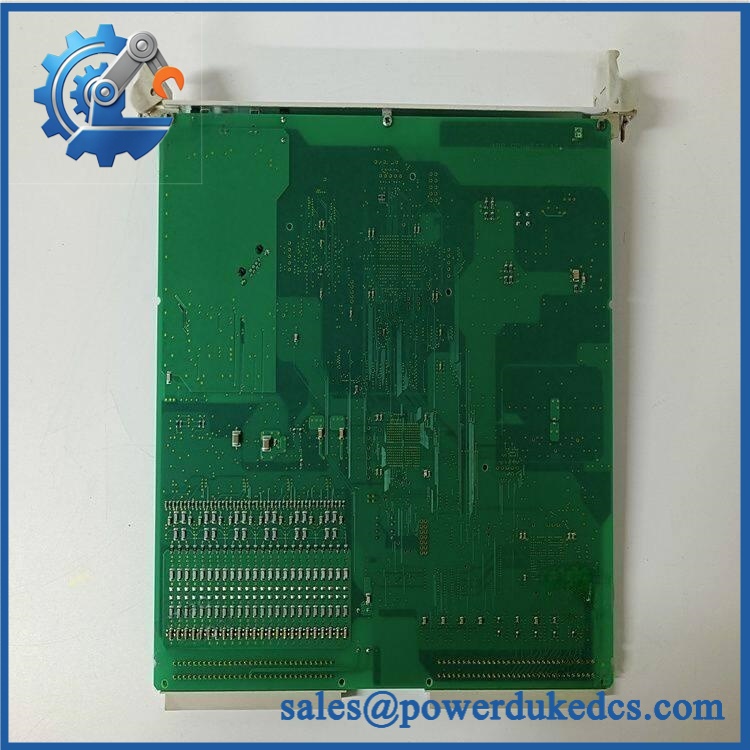
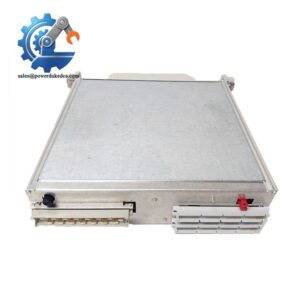
ABB MWD 10 MO-SURGE
Module 4: Dynamic Emergency Swap & Configuration Guide
1. Pre-Swap Prep — Verify system voltage first
- Obtain the single-line diagram and arrester schedule for the affected medium-voltage circuit.
- Confirm the replacement is the MWD 10 configuration and verify Uc = 10 kV / Ur = 12.5 kV against the installed design.
- Isolate the associated medium-voltage circuit using the site’s approved switching and lockout procedure.
- Verify absence of voltage with an appropriately rated MV test instrument.
- Apply grounding procedures required for the equipment and work location.
- Inspect the replacement nameplate and mounting hardware before opening the existing assembly.
2. Removal — Release the arrester mechanically and electrically
- Confirm the circuit remains isolated and discharged.
- Photograph the existing arrester, terminals, grounding connection, and mounting orientation.
- Disconnect the line and earth connections according to the approved MV procedure.
- Remove the specified mounting hardware without applying side loads to the silicone housing.
- Inspect the disconnected conductors, terminals, and mounting surfaces for tracking, corrosion, overheating, or mechanical damage.
- Do not reuse damaged hardware or compromised terminals.
3. Installation & Configuration — Preserve protection coordination
- Verify ABB MWD 10 MO-SURGE before installation.
- Confirm the replacement voltage class matches the original Uc/Ur selection.
- Install using the original mounting orientation and approved clearances.
- Reconnect line and earth conductors exactly as shown on the equipment drawing.
- Apply terminal torque according to the approved installation specification.
- Confirm the arrester is connected to the intended earth path with low-impedance bonding.
- Do not change arrester voltage class merely to obtain a physically compatible replacement.
4. Power-On Self-Test (POST) — Validate the protected circuit
- Complete the required insulation, grounding, and switching checks before re-energization.
- Inspect the silicone housing for abnormal tracking, cracking, contamination, or installation damage.
- Where an external failure indicator or disconnector is fitted, verify its status.
- Re-energize the circuit under the approved MV commissioning procedure.
- Monitor for abnormal leakage-current, alarm, or protection indications where the installation provides such monitoring.
- Check the downstream equipment for normal insulation/protection status after energization.
An MWD surge arrester is a passive protective device rather than a PLC-style controller, so it does not have a universal RUN/ERR LED POST sequence. The relevant acceptance criteria are electrical isolation, correct Uc/Ur selection, proper grounding, physical integrity, and any installation-specific monitoring or disconnector indication.
Module 5: Quality Assurance & Testing SOP
For a medium-voltage arrester, incoming inspection must establish that the voltage class and mechanical condition are correct before the unit reaches an energized cabinet.
1. OEM identity verification
- Verify ABB
- Verify MWD 10 MO-SURGE
- Verify MWD family identification and applicable nameplate data
- Confirm Uc 10 kVrms
- Confirm Ur 12.5 kVrms
- Perform OEM anti-counterfeit visual inspection
- Photograph nameplate, housing markings, and terminals
2. Physical inspection
- Inspect the molded silicone housing for cracks, cuts, punctures, tracking, contamination, or foreign material
- Check terminals, inserts, studs, and mounting hardware
- Inspect the housing surface for shipping damage
- Verify dimensional compatibility with the installed mounting arrangement
- Confirm indoor-service application
3. Electrical screening
- Perform appropriate terminal continuity checks before installation
- Verify earth-path continuity where applicable
- Inspect for abnormal resistance characteristics only with a test method approved for the device
- Do not apply arbitrary megohmmeter or hipot voltages directly across a populated MO arrester
- Use the manufacturer’s approved test procedure for any dielectric or leakage-current testing
4. Functional and protection verification
- Confirm voltage-class identification against the project protection study
- Verify the specified 10 kA nominal discharge-current class
- Check applicable mechanical disconnector or indication hardware
- Verify grounding connection integrity
- Inspect associated surge-protection wiring and conductor routing
- Record incoming condition, test method, measured values, and acceptance result
5. Final QC release
- Independent QC sign-off
- Protective packaging around the silicone housing and terminals
- Moisture and contamination protection
- Final cross-check of MWD 10 MO-SURGE
- Retain inspection photographs and test records with the shipment documentation
The MWD technical documentation specifies 10 kA peak nominal discharge current, 100 kA peak high-current impulse, 550 A for 2,000 μs long-duration current impulse, and 20 kA rms for 0.2 s short-circuit rating. These are product-family engineering characteristics, while the exact voltage configuration still has to match the ordered MWD 10 variant.
Module 6: Maintenance & Reliability FAQ
Q1. Is ABB MWD 10 MO-SURGE a direct drop-in replacement, or does it require a firmware flash?
There is no firmware to flash. This is a passive metal-oxide surge arrester. A replacement is suitable only when its Uc, Ur, discharge-current class, mechanical dimensions, terminal arrangement, and installation environment match the protected circuit. For the MWD 10 configuration, the documented voltage values are Uc 10 kV and Ur 12.5 kV.
Q2. Is it safe to hot-swap this surge arrester while the system is running?
No. Treat replacement as medium-voltage electrical work. The circuit must be isolated, tested for absence of voltage, and grounded according to the site’s approved switching and safety procedure before the arrester is removed.
Q3. Will replacing the MWD 10 cause my current program or configuration to be lost?
There is no application program stored in the arrester. The key configuration issue is protection coordination: preserve the existing Uc/Ur selection, phase-to-ground arrangement, grounding path, clearances, and monitoring/disconnector configuration.
Q4. What is the main technical difference between MWD and a generic MV surge arrester?
The MWD is a gapless metal-oxide arrester with directly molded silicone insulation, classified as Station Low (SL), Line Discharge Class 2 under IEC 60099-4. Its intended applications include indoor medium-voltage transformers, switchgear, generators, cables, motors, and related equipment.
Q5. What should I verify before ordering an MWD 10 replacement?
Start with the complete MWD 10 designation, then verify Uc 10 kV, Ur 12.5 kV, 10 kA nominal discharge current, indoor installation, mounting geometry, terminal arrangement, and grounding configuration. Protection selection should also be checked against the system’s maximum voltage and insulation coordination study. The broader MWD family spans Uc 4–44 kV and Ur 5–55 kV, so using the wrong voltage variant can materially change protection performance.



 Start Chat