

Description
- Model: REG670
- Brand: ABB
- Series: Relion 670 Series
- Core Function: Generator protection and control
- Type: Generator Protection IED
- Key Specs: Generator differential protection; 100% stator earth-fault protection; up to 24 analog inputs
- Communication: IEC 61850-based communication
- Typical Application: Hydro, turbo and pump-storage generators
Product Introduction
ABB REG670 is a Relion 670 Series generator protection IED designed for protection, control, measurement and supervision of generators. It supports applications ranging from generator differential protection to stator and rotor earth-fault protection.
For demanding generator applications, the platform can integrate main and backup protection in one device. The B30 configuration can provide up to 24 analog inputs, while ABB documentation reports a typical generator differential protection operating time of about 15 ms.
Key Technical Specifications
| Parameter | Specification |
|---|---|
| Manufacturer | ABB |
| Product Family | Relion 670 Series |
| Model | REG670 |
| Product Type | Generator Protection IED |
| Primary Application | Generator protection and control |
| Generator Differential Protection | Supported |
| Stator Earth-Fault Protection | Supported |
| Rotor Earth-Fault Protection | Supported |
| 100% Stator Earth-Fault Protection | Supported with injection-based application |
| Analog Inputs | Up to 24 with B30 configuration |
| Communication | IEC 61850-based communication |
| Engineering Tool | PCM600 |
| Generator Applications | Hydro, turbo and pump-storage generators |
| Control Functions | Generator control, synchronization and excitation-related control |
| Protection Functions | Differential, overcurrent, power direction, pole-slip, over/under-excitation |
| Typical Differential Protection Operating Time | Approx. 15 ms |
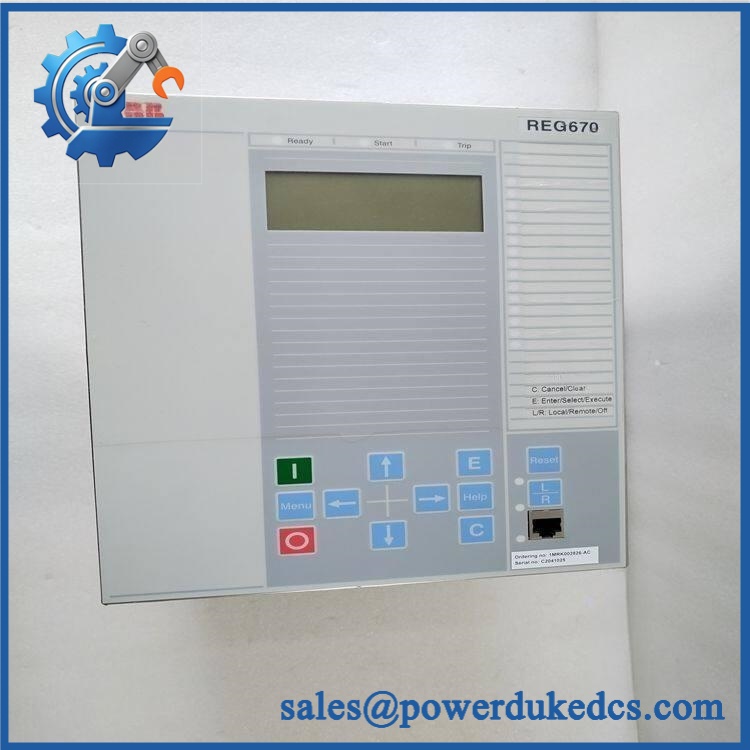
REG670
ABB states that the injection-based stator earth-fault function can protect the complete stator winding, including the star point, and can operate even when the machine is at standstill.
Configuration warning: REG670 is a configurable IED. The exact hardware, I/O count, protection functions, communication interfaces and power-supply arrangement depend on the complete ordering code. The short model name alone should not be used to confirm a one-for-one replacement.
Installation & Configuration Guide
Estimated engineering and replacement time: 30–60 minutes for physical replacement; protection testing and commissioning require additional time.
Stage 1 — Pre-Installation | About 10 minutes
- Obtain an approved generator outage window.
- Place the generator in a safe operating state.
- Isolate auxiliary and control power according to the site’s switching procedure.
- Apply the required electrical safety and lockout procedures.
- Wear an ESD wrist strap when handling the IED.
- Back up the existing REG670 configuration through the approved PCM600 engineering workflow.
- Record the existing firmware and configuration information.
- Photograph terminal wiring and communication connections.
Stage 2 — Remove the Existing IED | About 10–15 minutes
- Verify that the IED is de-energized.
- Label each terminal and cable before disconnection.
- Record CT and VT wiring carefully.
- Disconnect binary I/O and communication cables.
- Remove the mounting hardware.
- Withdraw the IED from the panel or rack.
- Inspect connectors for bent pins, contamination or mechanical damage.
CT circuit warning: Generator protection circuits can involve dangerous secondary voltages if CT circuits are incorrectly opened. Follow the site’s approved CT isolation procedure.
Stage 3 — Install the Replacement | About 10–15 minutes
- Check the complete ordering code against the existing REG670.
- Verify the analog input configuration.
- Check the auxiliary power arrangement.
- Confirm the communication interface configuration.
- Mount the replacement IED.
- Reconnect CT, VT, binary I/O and communication wiring according to the approved drawings.
- Check terminal tightness.
- Verify protective grounding.
Stage 4 — Power-On and Testing | 20 minutes or more
- Perform a complete wiring inspection before energization.
- Apply auxiliary power.
- Check the local HMI and diagnostic indications.
- Connect the engineering workstation.
- Identify the IED through PCM600.
- Verify firmware and hardware information.
- Load the approved configuration if required.
- Check protection settings against the approved setting file.
- Test binary inputs and outputs.
- Verify IEC 61850 communication.
- Perform the required protection injection tests.
- Verify generator differential and earth-fault protection functions.
- Record the final commissioning results.
Do not return the generator to service based only on successful IED startup. Protection injection tests and functional checks must be completed according to the site’s commissioning procedure.
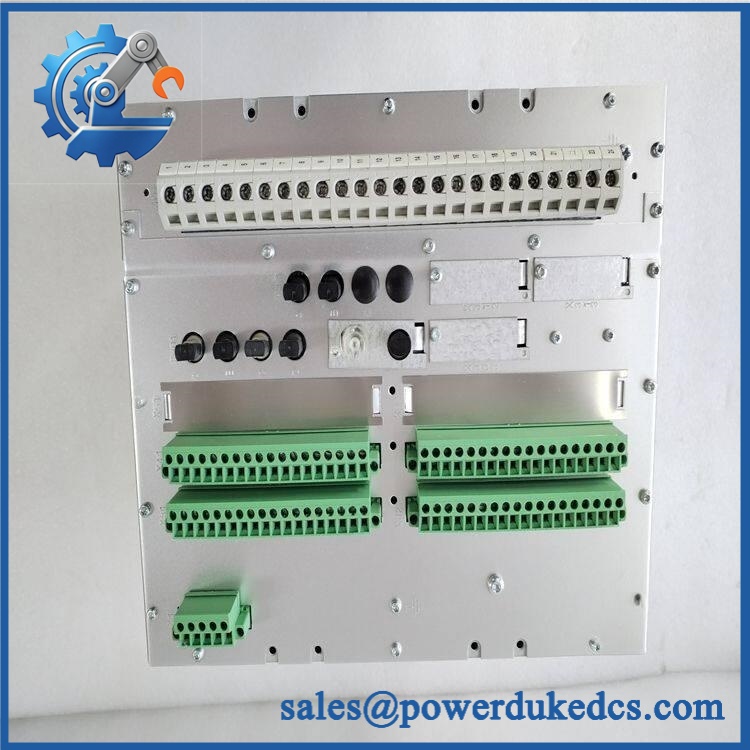
REG670
FAQ
1. What is ABB used for?
is a generator protection and control IED. Typical functions include generator differential protection, overcurrent protection, earth-fault protection, pole-slip protection and excitation-related protection.
2. Can provide 100% stator earth-fault protection?
Yes, an injection-based application can provide 100% stator earth-fault coverage, including the star-point area. ABB also documents operation under machine standstill conditions for this protection method.
3. How fast is the generator differential protection?
ABB documentation gives a typical operating time of approximately 15 ms for the generator differential protection. Actual performance depends on the configured application and system conditions.
4. How many analog inputs can have?
The B30 configuration can provide up to 24 analog inputs, allowing main and backup protection functions to be integrated into one IED.
5. Does support IEC 61850?
Yes. belongs to ABB’s Relion protection and control family, which was designed around IEC 61850. The platform supports station communication and advanced protection/control communication functions.
6. Can I directly replace an old with another ?
Not from the model name alone. Check the complete ordering code, hardware configuration, I/O arrangement, communication interfaces, firmware and application configuration before ordering. This is particularly important for generator protection because incorrect CT/VT or protection-function configuration can prevent commissioning.
7. Is suitable for a spare-parts inventory?
For a critical generator bay, keeping one correctly configured spare can be reasonable as buffer stock. The spare should be selected against the installed hardware and configuration, not simply because the front label says . ABB identifies for demanding generator applications including hydro and turbo machines, making configuration matching especially important for replacement planning.
Source note: ABB documentation confirms as a Relion generator protection IED and documents its generator differential, stator/rotor earth-fault and communication capabilities. Exact replacement specifications should be checked against the unit’s complete ordering code and the applicable ABB technical documentation.


 Start Chat