

Description
- Brand: Emerson
- Full Model Number: MVME7100-0171
- System/Series Family: MVME7100 VMEbus Single Board Computer
- Core Function: VMEbus host processor for embedded control and computing systems
- Top 3 Hardcore Specs: MPC8641D dual-core PowerPC e600 at 1.33 GHz; 2 GB DDR2 ECC; 8 GB NAND Flash
- VMEbus Interface: Tsi148 bridge with 2eSST support up to 320 MB/s
- Expansion: Dual PMC-X sites plus PCI Express interface for XMCspan
- Network: Four Gigabit Ethernet interfaces
- Form Factor: 6U 4HP VME; 233 × 160 × 20 mm
- Weight: 0.680 kg
- Front Panel: SCANBE handles
- Stock Status: New Surplus — verify exact revision and fitted accessories before PO
The published MVME7100 documentation identifies the -0171 variant as the 1.33 GHz MC8641D configuration with 2 GB DDR2, 8 GB NAND Flash, and SCANBE handles.
Commercial-Technical Deep Dive
When an installed VME processor fails, the expensive part is often the surrounding application environment, not the board itself. The Emerson MVME7100-0171 provides a 6U VMEbus computing platform built around the Freescale MPC8641D, with dual PowerPC e600 cores and integrated memory, DMA, PCI Express, Ethernet, and local I/O functions. Four Gigabit Ethernet interfaces reduce the need for separate communication hardware in many legacy embedded architectures. Its VMEbus interface uses the Tsi148 bridge and supports 2eSST transfers, with published system-level throughput up to 320 MB/s.
Memory and storage configuration are the key procurement details. The 2 GB DDR2 ECC memory provides the installed processing platform with error-correcting system RAM, while the 8 GB NAND Flash configuration distinguishes the -0171 from lower-capacity MVME7100 variants. Maximum board power is published at approximately 60 W, with typical consumption around 45 W for the 0171 configuration. Mechanical dimensions are 233 × 160 × 20 mm, with a board weight of 0.680 kg. That makes chassis fit and airflow verification straightforward during a replacement review, though thermal performance still depends on the actual VME enclosure and airflow path.
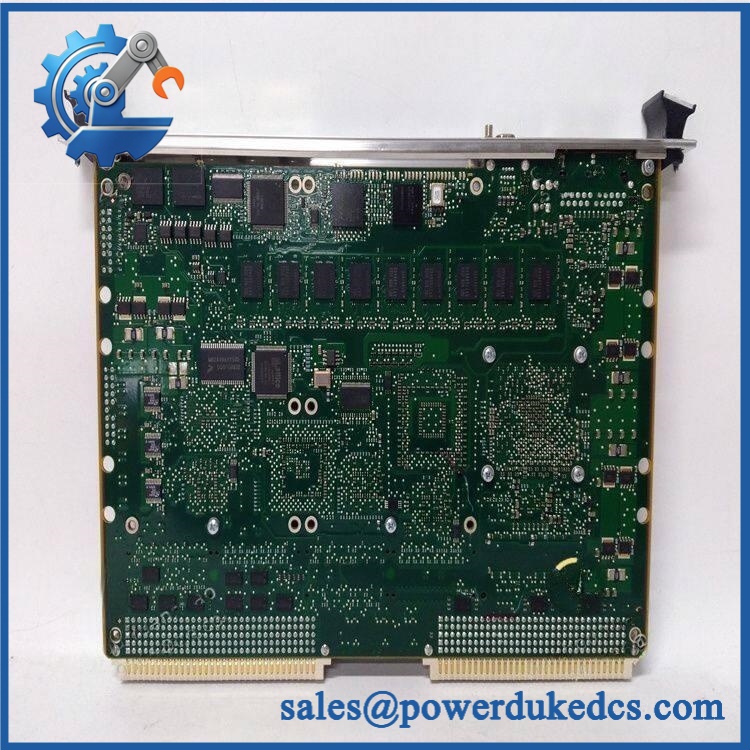
Emerson MVME7100-0171
Compatibility & Installation Traps
Migration/Compatibility
For a direct replacement of an existing MVME7100-0171, the hardware form factor remains a standard 6U, 4HP VMEbus board. No application logic rewrite is inherently required by replacing the same board revision. The real compatibility checks concern the installed operating environment, boot image, VMEbus configuration, PMC/XMC accessories, transition module, and front-panel handle configuration.
The specifically uses an MPC8641D at 1.33 GHz, 2 GB DDR2, and 8 GB NAND Flash with SCANBE handles. Do not substitute the -0173 merely because the processor and memory appear similar; the documented distinction is the front-panel handle configuration.
Software also deserves attention. The family supports VxWorks, LynxOS, and Linux, while MOTLoad provides board-level firmware functions. A replacement board may require restoration of the site’s existing boot image, environment variables, VME settings, or application image even when the hardware is nominally identical.
⚠️ Field Traps (Watch Out)
Trap 1 — Incorrect PMC or XMC population.
The board provides two PMC-X sites and an 8x PCI Express expansion path. Check installed mezzanine cards and rear I/O routing before moving the replacement into the chassis. A different accessory configuration can change the required I/O path.
Trap 2 — Power and airflow assumptions.
The -0171 can require about 45 W typical and 60 W maximum at +5 V input. Check the chassis power budget and forced-air path before installation. Do not use the commercial-temperature specification as evidence for an extended-temperature installation; the MVME7100ET is the separately designated extended-temperature family.
Quality Assurance SOP
Each should first undergo an OEM anti-counterfeit visual inspection. QA records the Emerson identification label, exact model number, board revision, serial or traceability markings, processor identification, memory configuration, NAND Flash identification, connector condition, handle type, and PCB condition. Any corrosion, damaged edge fingers, lifted components, contamination, or evidence of unauthorized rework is documented before shipment.
The functional sequence begins with controlled installation in a compatible VME test chassis. Power-on self-test (POST) checking for ERR/RUN LEDs is performed where the board revision exposes the applicable status indicators. The test then confirms board recognition, processor initialization, memory detection, NAND Flash access, and boot behavior. Communication handshake verification follows through available Ethernet and VMEbus test paths. Where the customer’s configuration is known, technicians can also verify PMC/XMC recognition and the selected operating environment. Firmware identity is recorded rather than overwritten without customer authorization; this matters because an unexpected firmware change can alter an otherwise known boot configuration.
CRO-Driven Buyer FAQ
Is the Emerson -0171 obsolete?
The is an older VME computing platform, and current availability is primarily dependent on remaining inventory and service stock. Current listings show the as a limited-availability or sold-out item in some channels. This makes the exact installed part number, revision, memory configuration, and condition important during sourcing.
Can the -0171 be hot-swapped?
The standard installation manual does not treat the as a hot-swappable field module. Follow the VME chassis manufacturer’s power-down procedure before removing or inserting the board. Also protect the board against ESD during handling. The documentation specifically includes safety guidance covering powered installation and electrostatic discharge risks.
Does a replacement board require firmware programming?
Not necessarily. A same-model replacement can use the site’s existing software environment, but the board’s MOTLoad settings, boot parameters, VME configuration, and application image must be checked. The exact process depends on how the original system was commissioned.
What should I verify before ordering -0171?
Verify , the 1.33 GHz MPC8641D processor, 2 GB DDR2, 8 GB NAND Flash, SCANBE handles, installed PMC/XMC accessories, and any required rear transition module. These details prevent a visually similar variant from being shipped in error.
What warranty and technical support are provided?
Warranty duration should be confirmed on the quotation for the specific inventory unit or lot. Technical support can cover model verification, revision checking, configuration review, visual inspection records, and pre-shipment functional test results. Site-specific software recovery, application validation, and final VME system acceptance remain dependent on the customer’s installed architecture.



 Start Chat