

Description
- Brand: GE
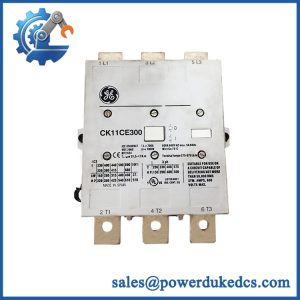
- Full Model Number: CK11CE300
- System/Series Family: GE CK11CE Motor Control
- One-Sentence Core Function: Three-pole electromagnetic contactor for switching high-current three-phase industrial loads
- Top 3 Hardcore Specs: 600 A; 600 V AC maximum; 3 poles
- NEMA Size: Size 6
- Phase Configuration: 3-phase
- Main Contacts: 3 normally open power poles
- Rated Current: 600 A according to GE part-catalog listings
- Rated Voltage: 600 V AC according to GE part-catalog listings
- Coil: Configuration-specific; verify nameplate before energizing
- Mounting: Panel mounted
- Auxiliary Contacts: Optional / configuration dependent
- Application: Motor starting, transformer switching, heaters, and other high-current loads
- Product Type: AC Contactor / Motor Control
- Stock Status: New Surplus / Factory Sealed / Fully Tested Refurbished subject to availability
GE part-catalog data identifies CK11CE300 as a Size 6, 3-phase, 600 V, 600 A contactor. Secondary technical listings agree on the three-pole configuration and heavy-current switching role, although some sources publish different AC-3 current interpretations; the exact nameplate and applicable GE rating table should therefore govern field sizing.
Module 3: Commercial-Technical Deep Dive
A contactor failure can stop a large motor, pump, heater bank, or transformer auxiliary circuit even when the PLC and control system remain healthy. The GE CK11CE300 is a high-current three-phase contactor from the CK11CE family, identified in GE part-catalog data as a Size 6, 600 V, 600 A motor-control device. Its primary job is straightforward: electrically connect and disconnect a three-phase power circuit through electromagnetic actuation. For maintenance procurement, the important match is therefore the exact contactor frame, pole configuration, current/voltage rating, and coil arrangement—not simply the overall enclosure size.
The electrical rating requires one important qualification. Some secondary sources describe CK11CE300 as 600 A at 600 V, while another technical listing gives lower AC-3 values at particular operating voltages and identifies a 690 V maximum system voltage. Those figures can represent different utilization categories rather than an outright contradiction. The correct field rating must therefore come from the GE application table, load category, system voltage, and actual nameplate. For replacement planning, confirm the coil voltage, auxiliary-contact arrangement, line/load terminal configuration, and intended AC-1 or AC-3 duty before installation.
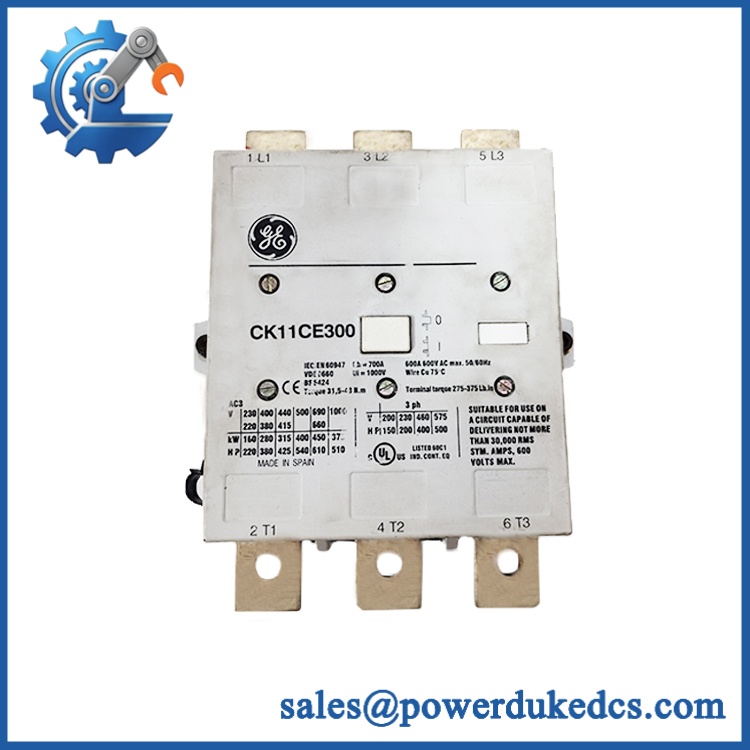
GE CK11CE300
Module 4: Compatibility & Installation Traps
Migration/Compatibility
- Product Family: GE CK11CE motor-control contactor
- Full Model: CK11CE300
- Frame Size: Size 6
- Poles: 3
- Part-Catalog Rating: 600 A / 600 V AC
- Primary Duty: Three-phase motor and high-current load switching
- Mounting: Panel mount
- Auxiliary Contacts: Configuration dependent
- Replacement Type: Exact CK11CE300 replacement preferred
- Coil Configuration: Must match the installed contactor nameplate
- Application Check: Verify motor horsepower, voltage, utilization category, and starting duty before substitution
- Control Logic: Normally unchanged because the contactor is an electromechanical switching component
- Mechanical Compatibility: Verify mounting dimensions, terminal arrangement, coil connection, and auxiliary-contact accessories before installation
⚠️ Field Traps (Watch Out)
1. Do not size the replacement from “600 A” alone.
GE part-catalog data identifies as 600 A / 600 V, but published secondary engineering data also distinguishes AC-3 ratings by operating voltage. For motor applications, use the applicable utilization category and motor full-load current rather than treating 600 A as a universal continuous motor rating.
2. Verify the coil voltage from the physical unit.
The CK11CE family appears with different coil configurations in secondary records. Do not energize a replacement until the actual coil marking has been matched to the control circuit.
3. Check auxiliary-contact accessories.
The power poles may match while the auxiliary-contact arrangement does not. Interlocks, seal-in logic, PLC feedback, and breaker-status circuits can depend on those auxiliary contacts.
4. Inspect contact wear before reusing a suspect contactor.
Severe arcing, pitted contacts, contact welding, or discoloration may indicate a downstream short-circuit or abnormal inrush condition. Simply installing another contactor without finding the initiating fault can produce another failure.
5. Confirm available fault current and coordination.
A high-current contactor is not a substitute for proper upstream short-circuit protection. Verify fuse/breaker coordination and the load’s prospective fault current before commissioning.
Module 5: Quality Assurance SOP
Each available GE should undergo a documented electromechanical inspection and controlled switching test before shipment:
- OEM anti-counterfeit visual inspection: Verify GE identification, complete designation, CK11CE family markings, frame size, terminal labels, coil markings, and manufacturing information.
- Part-number verification: Confirm the physical nameplate reads and record the actual coil voltage.
- Mechanical inspection: Check the contactor frame, mounting points, armature, terminal hardware, arc-control components, and auxiliary-contact mounting interfaces.
- Contact inspection: Examine all three main poles for pitting, welding, erosion, overheating, and abnormal discoloration.
- Coil inspection: Measure coil resistance and verify it against the applicable GE reference for the exact coil variant.
- Insulation inspection: Perform appropriate low-voltage insulation/continuity tests before energizing the coil or power poles.
- Power-on self-test (POST): Energize the control coil using the correct test voltage and verify clean armature pickup and release.
- Main-contact test: Confirm each power pole transitions from open to closed reliably when the coil is energized.
- Contact-resistance test: Measure closed-contact resistance using a suitable low-resistance ohmmeter and record channel-by-channel results.
- Auxiliary-contact test: Verify all installed auxiliary contacts for NO/NC continuity and correct mechanical sequencing.
- Dropout test: Remove coil power and confirm clean contact release without sticking or residual closure.
- Repeated-cycle test: Perform controlled pickup/dropout cycles to identify mechanical chatter, delayed release, coil overheating, or contact bounce.
- Thermal inspection: Under approved load-test conditions, monitor terminal and contact temperature for abnormal heating.
- Terminal torque inspection: Verify line, load, coil, and auxiliary terminals are mechanically secure according to the applicable installation specification.
- Final QC record: Record catalog number, coil voltage, pole/contact resistance, auxiliary-contact results, cycle-test results, and technician sign-off.
- ESD-safe and mechanical packaging: Protect the contactor against impact, contamination, and terminal damage during shipment.
For a high-current contactor, a credible test record should include actual coil voltage, contact resistance, pickup/dropout behavior, and auxiliary-contact sequencing. A simple continuity test does not establish that the electromagnetic and mechanical sections are serviceable.
Module 6: CRO-Driven Buyer FAQ
What is GE ?
The is a heavy-duty three-phase AC contactor in the CK11CE motor-control family. GE’s part-catalog data identifies it as Size 6, 3-phase, 600 V, 600 A.
What is the current and voltage rating of ?
GE part-catalog information lists 600 A and 600 V for . However, application-specific AC-3 ratings can differ with system voltage and load category, so motor applications should be sized from the applicable GE utilization table rather than the catalog headline alone.
Is a three-pole contactor?
Yes. Available technical records identify it as a 3-pole / 3-phase contactor. The three main poles switch the three-phase power circuit, while auxiliary contacts can be added or configured separately.
What coil voltage does use?
Do not assume one universal coil voltage from the model number alone. Secondary records show multiple coil-voltage descriptions for the , including 250/500 V AC and other configuration ranges. The physical coil/nameplate marking on the exact unit should be treated as the controlling specification.
Can I use to control a large motor?
Yes, provided the motor current, system voltage, utilization category, starting duty, and short-circuit coordination are within the contactor’s applicable GE rating. A 600 A catalog rating should not automatically be interpreted as a 600 A AC-3 motor rating under every voltage condition.
Can be replaced while energized?
No assumption of live replacement should be made. A contactor carries potentially hazardous line voltage and high fault energy. Isolate the control and power circuits, verify absence of voltage, and follow the plant’s electrical safety procedure before removal.
What warranty and technical support should I expect?
Warranty duration should be stated for the exact unit condition and test status on the quotation. Technical support should cover part-number verification, coil-voltage matching, load-duty review, contactor/accessory compatibility, installation guidance, and documented electromechanical testing. Motor-starting studies, protection coordination, and field commissioning should be treated separately unless explicitly included.


 Start Chat