

Description
High-Converting SEO Title Matrix
- GE Hydran 201Ti Online Transformer Gas Monitor Transmitter
- GE Hydran 201Ti In Stock Transformer Fault Gas Transmitter
- GE Hydran 201Ti Direct Replacement for Legacy DGA Systems
- GE Hydran 201Ti RS-485 Modbus 4-20mA DGA Transmitter
- GE Hydran 201Ti OEM Original Fast Shipping Transformer Monitor
The 10-Second Procurement Snapshot
- Brand: GE / GE Vernova
- Full Model Number: HYDRAN 201Ti / H201Ti
- Lifecycle Status: Active product line
- Core Function: Online transformer fault-gas monitoring and early-warning transmitter
- Top 3 Technical Specs: 25-2000 ppm H₂ equivalent measurement range; ±10% of reading ±25 ppm accuracy; 10-minute response time to 90% of a step change
- Gas Sensor: Composite gas sensor or hydrogen-only configuration
- Communications: Isolated RS-485; Modbus or Hydran protocol; USB local configuration interface
- Analog Output: 4-20 mA gas-level output
- Alarm Outputs: 3 SPDT dry-contact relays, up to 3 A at 250 VAC resistive / 3 A at 30 VDC resistive
- Power: 90-132 VAC or 180-264 VAC switchable, 47-63 Hz, 475 VA maximum
- Enclosure: NEMA Type 4X certified; 178 mm diameter × 180 mm length
- Installed Weight: 5.6 kg
- Stock & Condition: New Original, New Surplus, or tested inventory subject to unit-level confirmation
- Shipping: Dispatch timing based on verified physical stock, payment clearance, destination, and carrier cutoff
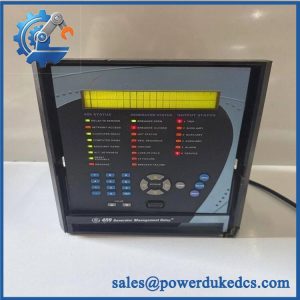
GE identifies the Hydran 201Ti as an online early-warning transmitter for transformer fault gases, with current documentation covering RS-485, Modbus/Hydran communications, 4-20 mA output, self-diagnostics, local event logging, and a 25-2000 ppm measurement range in its current configuration.
Obsolescence & Supply Chain Deep Dive
A failed transformer gas monitor creates a different procurement problem from a conventional PLC spare: the replacement must interact correctly with the transformer valve, sensing membrane, alarm circuits, and remote monitoring system. The GE Hydran 201Ti remains listed by GE Vernova as a current product, while the Hydran M2-X is presented as the next-generation member of the same product family. For maintenance teams supporting an installed 201Ti population, sourcing the exact model can therefore make sense when the objective is to preserve existing wiring, alarm logic, operator procedures, and commissioning records rather than trigger a wider monitoring-system change. —Actual availability should be confirmed against the physical serial-numbered unit, especially for emergency replacement requirements.
From a TCO perspective, replacing a failed transmitter can avoid the engineering cost associated with redesigning the transformer monitoring interface. The 201Ti provides composite fault-gas measurement, local LCD indication, remote communications, configurable gas alarms, trend monitoring, and a 4-20 mA output, allowing an existing monitoring architecture to remain substantially unchanged when the replacement configuration matches the installed unit. GE’s earlier Hydran documentation also describes M2-X as capable of replacing an H201Ti in Hydran 201i systems, which gives maintenance planners a documented migration path when exact 201Ti stock becomes difficult to secure. For a like-for-like replacement, a reasonable planning allowance is approximately 2-4 hours for verification, installation, signal checks, and return to service; an upgrade to a different monitoring platform should be budgeted separately for engineering, configuration, and site validation.
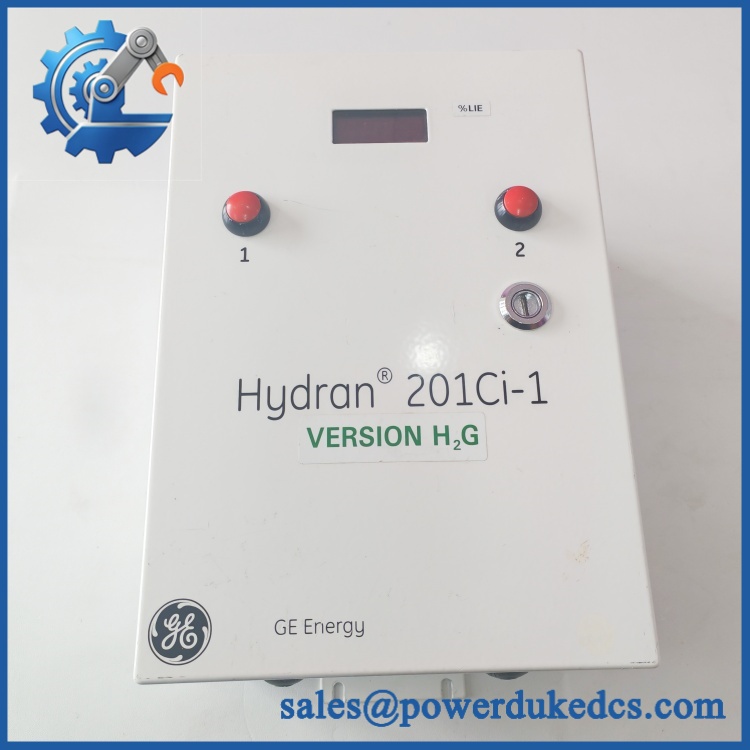
GE HYDRAN 201Ti
Compatibility & Replacement Matrix
| Replacement Scenario | Assessment | Procurement / Engineering Action | Planning Allowance |
|---|---|---|---|
| HYDRAN 201Ti → HYDRAN 201Ti | Drop-in Replacement, provided the same electrical and sensor configuration is ordered | Match sensor type, supply voltage, valve connection, communications, analog scaling, and alarm wiring | Approx. 2-4 hours for controlled replacement and commissioning |
| H201Ti → Hydran M2-X | Software / System Compatible Migration, not a blind same-model substitution | GE documentation states M2-X can replace H201Ti in Hydran 201i systems; verify controller, host-software, wiring, and configuration requirements | Approx. 1-2 days for engineering, installation, validation, and records update |
| Different sensor configuration | Configuration Change Required | Composite-gas and hydrogen-only versions are separate ordering configurations; confirm the installed process requirement before PO release | Several hours of configuration and validation |
| Different valve arrangement | Hardware Adaptation May Be Required | Verify the existing transformer valve is compatible with the specified NPT mounting or order the appropriate adapter | Site-dependent |
| Legacy remote monitoring architecture → new platform | Hardware / System Modification Required | Review communication protocol, analog scaling, relay assignments, and control-system mapping before migration | Typically several engineering shifts plus field commissioning |
Field Traps — Watch Out
Sensor Configuration Mismatch: The current GE documentation distinguishes between a composite-gas sensor and a hydrogen-only sensor. For mineral-oil applications, ordering references include H201Ti_CE for composite gas and H201Ti_CE-H2 for hydrogen-only sensing. Natural-ester oil support is configuration-specific; synthetic-ester oil is not listed as a standard option in the current ordering table.
Valve, Power, and Heat Conditions: The transmitter is designed for installation on a 1″, 1.5″, or 2″ female NPT valve, with operating ambient temperature of -40 °C to +55 °C. A finned heat-sink adapter is specified for conditions above 40 °C ambient or above 90 °C oil temperature. Power is also selectable between 90-132 VAC and 180-264 VAC, so the actual site supply must be checked before energization.
Communication Mapping: RS-485 is isolated to 2000 VAC RMS, and gas data can be transmitted using Modbus or Hydran protocol. Existing SCADA or PLC register mapping should be backed up before replacement so that an otherwise successful field change does not create a data-integration fault.
Quality Assurance & Testing SOP
The Hydran 201Ti should be handled as a measurement instrument, not simply as an electrical spare. Unit-level inspection and functional verification are therefore required before shipment.
- OEM anti-counterfeit visual inspection: Check GE identification markings, model designation, enclosure condition, display assembly, terminal connections, sensor assembly, labels, and visible manufacturing details against documented OEM references.
- Part-number verification: Record the exact HYDRAN 201Ti / H201Ti designation together with available serial number, revision, sensor configuration, and nameplate information.
- Power-on self-test (POST): Energize the transmitter under the specified AC supply range and verify startup sequence, LCD operation, keypad response, self-diagnostic status, and absence of service or system-fault indications. The 201Ti is not a PLC rack module, so conventional RUN/ERR LED checks are not applicable.
- Sensor functional check: Verify gas-sensing electronics respond correctly using an approved test method or controlled simulator appropriate to the installed sensor configuration.
- 4-20 mA output test: Confirm the analog output produces the expected current range and scaling over representative test points.
- Digital communication test: Verify isolated RS-485 communication using the configured Modbus or Hydran protocol and confirm stable register/data transmission.
- Alarm relay test: Exercise the three dry-contact alarm outputs and verify NO/NC operation and correct state transitions.
- I/O load testing: Apply controlled loads to the analog and relay outputs within their specified limits and confirm there is no intermittent contact or signal instability.
- Local interface test: Confirm backlit LCD readability, keypad operation, alarm acknowledgment, and access to configuration/status information.
- Extended observation: Run the unit through repeated monitoring cycles and record abnormal resets, communication interruptions, unstable readings, or service alarms before packing.
The current GE specification lists three Type C/SPDT relays, 4-20 mA output, RS-485 communications, USB local configuration, self-test functions, and local logging of data and significant events.
Procurement & Lifecycle FAQ
Is the HYDRAN 201Ti genuinely in stock, and what is the cutoff for emergency shipping?
The model remains listed by GE Vernova as a current Hydran product, with a direct product page and current technical documentation. Physical warehouse availability should still be confirmed before a PO is issued. Emergency dispatch depends on stock verification, payment clearance, destination, and the carrier’s same-day cutoff.
How do you guarantee the condition and authenticity of a HYDRAN 201Ti?
For an individual unit, the purchasing file should include the exact model marking, serial or revision information when available, actual-unit photographs upon request, visual inspection results, power-up records, analog and relay test results, communication verification, and the agreed warranty terms. For higher-value transformer monitoring equipment, traceable unit-level documentation is preferable to a generic stock declaration.
Are there any firmware or configuration issues engineers should check before issuing the PO?
Yes. Confirm the sensor configuration, communication protocol, RS-485 parameters, 4-20 mA scaling, relay assignments, transformer valve interface, and software environment used at the site. A Hydran M2-X migration is documented by GE as a replacement path for H201Ti in Hydran 201i systems, but it should be engineered as a migration rather than assumed to be an identical physical and software exchange.
Is the HYDRAN 201Ti a direct replacement for every Hydran 201i installation?
A same-configuration 201Ti replacement is the most straightforward path. However, the installed application may use different sensor types, valve adapters, controller arrangements, communication settings, or power conditions. Those variables should be checked against the existing installation before approval.
What are the warranty and return terms?
The exact warranty period, DOA coverage, inspection window, and return/RMA conditions should be stated on the quotation and PI for the specific unit supplied. The procurement record should retain the quoted model, condition, serial information, test evidence, and agreed return terms.




 Start Chat