

Description
- Model & Brand: GE Fanuc / GE Intelligent Platforms IC754VSF15CTD, 15-inch QuickPanel View operator interface terminal.
- Product Family: QuickPanel View, fully loaded color TFT configuration.
- Display: Approximately 15.1-inch color TFT, 1024 × 768 resolution, resistive touchscreen.
- Physical Dimensions: The published panel cutout is approximately 379 × 305 × 71 mm (W × H × D); the front-of-panel envelope is approximately 399 × 323 × 10 mm. These are installation dimensions rather than shipping-carton dimensions.
- Estimated Shipping Weight: Approximately 10 lb / 4.54 kg packed, with one current supplier listing the product at about 8.99 lb / 4.08 kg as the unit weight.;
- Shipping Carton Reference: Approximately 16 × 14 × 8 in. / 406 × 356 × 203 mm from published logistics data.
- Power Input: 12–30 VDC; published technical data lists approximately 24 W operating power.
- Communications: Two Ethernet interfaces, one RS-232/RS-485 serial interface, a second RS-232 port, and two USB interfaces.
- Memory: Approximately 64 MB DRAM, 512 KB SRAM, and 512 KB ROM/boot memory according to published hardware data.
- What’s in the Box: The HMI terminal is the controlled asset. Do not assume the HMI-CAB communication cable, mounting hardware, CompactFlash media, manual, or software media are included unless they appear on the quotation or packing list.
Product Introduction
For panel-mounted machinery, the IC754VSF15CTD forms the operator-facing layer of the GE QuickPanel View architecture. Its 15.1-inch color TFT display, resistive touchscreen, Ethernet connectivity, serial interfaces, USB ports, and Windows CE operating environment place visualization, data entry, alarms, and machine-level communication in one enclosure. The hardware documentation identifies the XScale PXA255 processor family, while current technical listings specify a 300 MHz processor and 64 MB memory.;
This is a legacy HMI asset, and its preservation requirements differ from a simple display panel. The internal BR2032 lithium battery supports the real-time clock and battery-backed SRAM, with an approximate life of five years under the published design data. The hardware guide also warns that Windows CE configuration changes should be committed to Flash using the Backup utility before power removal (a small procedural detail that matters when preserving a field image).;
Core Technical Specifications
| Parameter | Value |
|---|---|
| Manufacturer | GE Fanuc / GE Intelligent Platforms |
| Catalog Number | IC754VSF15CTD |
| Product Line | QuickPanel View |
| Product Type | Operator Interface / HMI |
| Display | 15.1-inch class color TFT |
| Display Resolution | 1024 × 768 pixels |
| Touch Technology | Resistive touchscreen |
| Processor | Intel XScale PXA255 |
| Processor Speed | 300 MHz |
| Operating System | Windows CE |
| Application Environment | Proficy / CIMPLICITY Machine Edition View |
| DRAM | 64 MB |
| SRAM | 512 KB |
| ROM / Boot Memory | 512 KB |
| Ethernet | 2 interfaces |
| Serial Communications | RS-232 / RS-485 plus RS-232 |
| USB | 2 ports |
| Expansion | Expansion bus |
| CompactFlash | Type II interface |
| Input Voltage | 12–30 VDC |
| Nominal Power | Approx. 24 W |
| Internal Backup Battery | BR2032, 3 V, 190 mAh |
| Approx. Battery Life | 5 years |
| Panel Cutout | Approx. 379 × 305 × 71 mm |
| Front-of-Panel Envelope | Approx. 399 × 323 × 10 mm |
| Shipping Reference | Approx. 406 × 356 × 203 mm |
| Approx. Shipping Weight | 10 lb / 4.54 kg |
| Environmental Construction | NEMA 4/4X application class when properly installed |
| Hazardous Location | UL Class I, Division 2 / ATEX conditions as documented |
| Product Lifecycle | Discontinued / Obsolete |
Published product data identifies 24 W real power and a 12–30 VDC supply range, while the original QuickPanel documentation establishes the PXA255 architecture, memory subsystems, battery arrangement, communications interfaces, and panel installation requirements.;
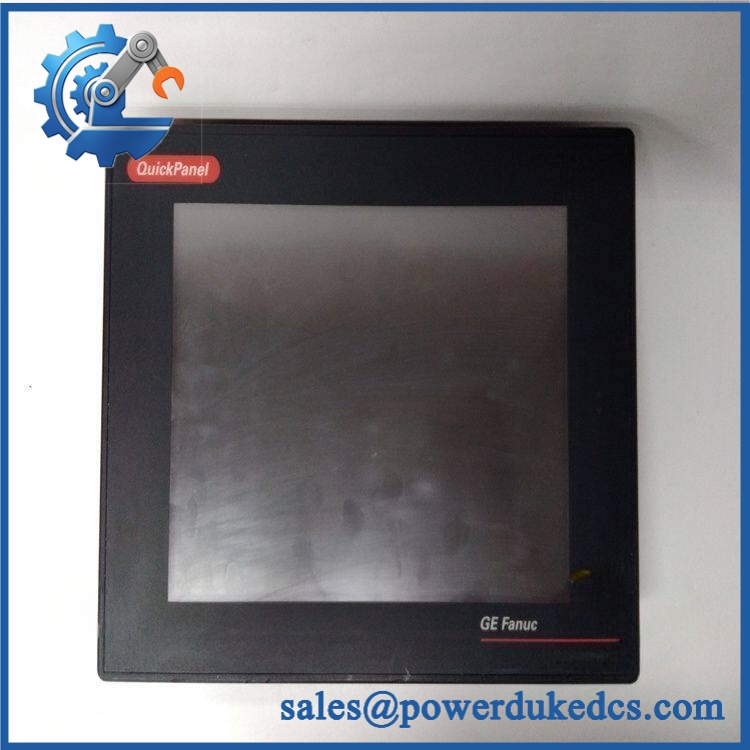
GE IC754VSF15CTD
🚨 Global Compliance & Industry Certifications
The QuickPanel View hardware documentation provides unusually specific agency information for this generation of HMI:
- UL 508 / C-UL: Certified for industrial control equipment.
- UL 1604 / C-UL: Hazardous-location certification for Class I, Division 2, Groups A, B, C, D.
- ATEX: Documentation identifies ATEX compliance for Equipment Group II, Category 3, subject to the stated installation conditions.
- CE Mark: Included in the documented agency approval set.
- NEMA 4/4X: The QuickPanel View literature identifies NEMA 4/4X environmental construction when properly mounted.
- IP65: The product literature identifies IP65 performance when the unit is properly installed in an appropriate enclosure.
- IECEx: No evidence reviewed establishes IECEx certification for this exact IC754VSF15CTD catalog number.
- Marine approvals: No reliable evidence reviewed establishes DNV GL, ABS, BV, or LR marine certification for the exact model.
The hazardous-location certification is not merely a paperwork issue. The manual explicitly warns that substitution of components can impair suitability for Class I, Division 2, and it requires power to be removed before replacing or wiring modules in hazardous locations.;
Verify specific lot certifications with OEM.
For an audit package, retain the nameplate image, certification marks, catalog number, hardware revision, serial number, and installation-condition documentation.
🚨 Long-Term Storage & Asset Preservation Guide
Protect the touchscreen surface first. Store the HMI in a clean ESD-safe package with a non-abrasive protective layer over the display. The glass/touch assembly is much harder to replace economically than an external cable, and scratches or pressure marks can remain invisible until the unit is powered.
Control humidity and condensation. Maintain a dry, temperature-stable warehouse environment, preferably around 40–60% RH, non-condensing. Do not move the sealed HMI directly from a cold storage area into a hot, humid service room and immediately energize it.
Audit the internal BR2032 battery. The published design data specifies a 3 V, 190 mAh lithium battery with an approximate five-year life. Long-term strategic stock should therefore have a battery inspection date in the asset register. When preserving an unused spare for many years, battery removal can reduce leakage risk, but doing so sacrifices SRAM and clock retention; make that decision only after confirming that retained data are not required.
A second preservation point is often missed: the QuickPanel uses Flash to retain Windows CE registry and user configuration changes. The manual instructs users to run Backup after configuration changes and warns against immediately removing power afterward.
Physical Installation Prerequisites
The IC754VSF15CTD is a panel-mounted HMI, not a DIN-rail module. The enclosure uses a large cutout, with the published opening at approximately 379 × 305 mm, while the front panel envelope is approximately 399 × 323 mm.
Prepare the enclosure before installation. The opening must be flat and free from burrs so that the panel gasket or sealing interface can seat correctly. The mounting area should also provide service space behind the unit for power, serial, Ethernet, and USB connections.
As a practical cabinet-planning rule, allow approximately 50 mm or more of free service space behind the HMI connectors where wiring bends and connector removal require hand access. That is an installation-planning allowance, not a manufacturer-certified minimum clearance.
Power wiring requires particular care. The QuickPanel documentation specifies a DC supply connection with +24 VDC, 0 V, and frame ground terminals, and its electrical-shock warning requires the DC source to be disconnected before attaching the power conductors.
For hazardous-area applications, follow the exact enclosure, wiring, grounding, and installation conditions attached to the certification. A certified HMI does not automatically make the entire panel hazardous-location compliant.
Buyer’s FAQ — Logistics & Compliance Focus
Q1. What HS tariff code should be used for IC754VSF15CTD?
A commonly published classification is HS 853710, with some commercial records using the national extension 8537101190 for this type of programmable industrial control equipment. However, the final tariff number depends on the importing country’s schedule and customs interpretation.
Use the destination country’s tariff database or obtain written confirmation from the customs broker. Do not copy a supplier’s national extension into every export document.
Q2. What should be declared as Country of Origin?
Country of Origin should be supported by the actual product documentation and traceability records, not inferred from the brand name. One current commercial record lists USA for this model, but a compliance-controlled shipment should use the COO supported by the physical asset and supplier documentation for that particular lot.
Keep the COO consistent among the commercial invoice, packing list, Certificate of Origin, and customs declaration.
Q3. Do I need shipping insurance for this HMI?
For a discontinued 15-inch HMI, insurance is reasonable when the replacement cost or downtime exposure is significant. The touchscreen, front bezel, and mounting frame are vulnerable to impact even when the carton appears intact externally.
Record the serial number and photograph the powered-off front panel, rear connectors, and completed carton before dispatch. Those records are useful for both asset traceability and freight claims.
Q4. Does the include the latest firmware or software?
Not automatically. The unit belongs to a discontinued QuickPanel View generation, and firmware/software state can differ between stored assets. Published documentation also shows that the platform uses Windows CE, Flash-backed configuration storage, and an internal battery-backed SRAM area.;
Before accepting a replacement, request the actual firmware revision, Windows CE image/version, installed View/Machine Edition environment, internal battery status, serial number, and hardware revision. Do not assume that two units with the same catalog number contain identical application images.
Warehouse acceptance record: catalog number + hardware revision + firmware/software revision + serial number + battery inspection date + certification markings + display condition + incoming functional-tet result. This level of identification is appropriate for a discontinued HMI being retained as a strategic plant spare.


 Start Chat