

Description
- Model: GE IS220PSCAH1A
- Additional Identifier: 336A4940CSP9
- Brand: General Electric
- Series: Mark VIe / Mark VIeS
- Part Type: Serial Communication I/O Pack
- Core Function: Provides six independently configurable serial communication channels between the Mark VIe control architecture and external serial devices.
- Key Specs: RS-232, RS-422, and RS-485 half-duplex support; 6 channels; 28 VDC nominal; 0.36 A maximum; dual RJ-45 IONet connections; compatible with IS200SSCAH1A / IS200SSCAH2A terminal boards.
Product Introduction
A failed serial gateway can stop data exchange with an entire group of field instruments even when the main Mark VIe controller remains operational. The GE IS220PSCAH1A sits at that communication boundary, providing six configurable serial transceiver channels for RS-232, RS-422, and RS-485 half-duplex devices. It can also support serial Modbus master functions and, in a simplex architecture, Ethernet Modbus functions.
For legacy Mark VIe assets, this model is now primarily a legacy migration and spare-stock item. GE’s lifecycle notice identifies the IS220PSCAH1A as obsolete and names IS220PSCAH1B as the available successor technology, while stating that the updated I/O packs are backward-compatible with the earlier technology.
Core Technical Specifications
| Parameter | Value |
|---|---|
| Manufacturer | GE General Electric |
| Model | IS220PSCAH1A |
| Additional P/N | 336A4940CSP9 |
| Series | Mark VIe / Mark VIeS |
| Functional Acronym | PSCA |
| Product Type | Serial Communication I/O Pack |
| Serial Channels | 6 independently configurable channels |
| Supported Interfaces | RS-232, RS-422, RS-485 half-duplex |
| Serial Modbus | Master service supported |
| Typical Baud Rates | 300 to 115200 baud |
| RS-232 Maximum Cable Distance | Approx. 15 m / 50 ft |
| Ethernet Interfaces | 2 × RJ-45 |
| Terminal-Board Interface | DC-62 |
| Power Connector | 3-pin |
| Supply Voltage | 28.0 VDC nominal |
| Minimum Supply Voltage | 27.4 VDC |
| Maximum Supply Voltage | 28.6 VDC |
| Maximum Current | 0.36 A |
| Approx. Maximum Input Power | About 10 W at maximum rated voltage/current |
| Compatible Terminal Boards | IS200SSCAH1A, IS200SSCAH2A |
| Mounting | Mark VIe I/O architecture / surface-mounted assembly |
| Operating Temperature | Approximately -40°C to +70°C |
| Firmware | System/application dependent |
| Hot-Swap Status | Do not assume live replacement |
The electrical ratings above are consistent with GE’s hazardous-location documentation, which specifies 27.4–28.6 VDC for the H1A version and 0.36 A maximum current when used with the approved SSCA terminal-board combinations.
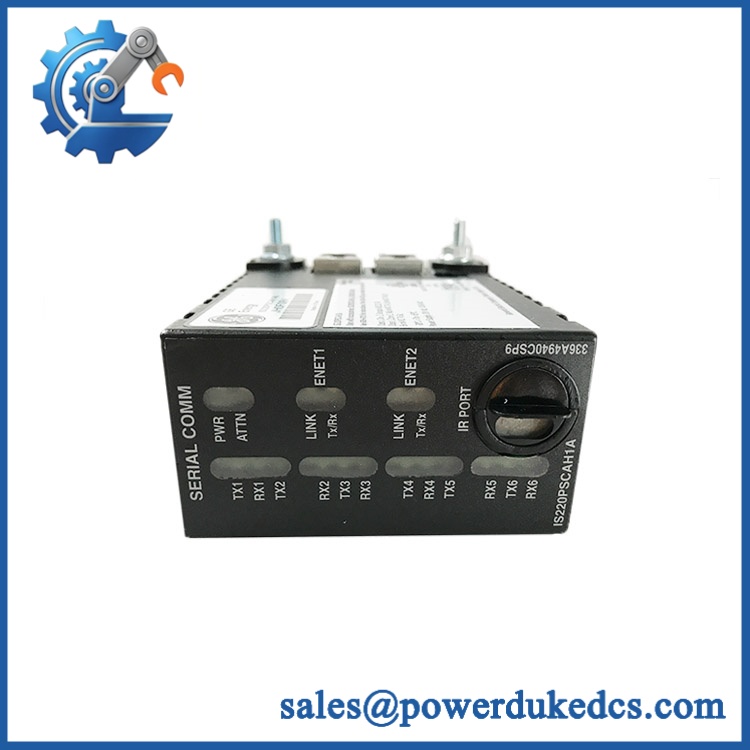
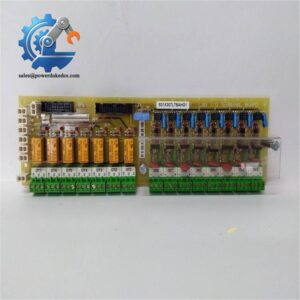
GE IS220PSCAH1A 336A4940CSP9
Application Scenarios & Pain Points
Serial device integration: In a turbine plant, a single PSCA installation may collect data from several serial instruments without requiring a separate communication pack for every device. The six channels can be assigned independently to match RS-232, RS-422, or RS-485 equipment.
Brownfield control migration: During a Mark VIe modernization, the H1A unit can appear attractive as a direct spare because the application already contains legacy hardware. The real question is revision compatibility, not visual similarity; GE’s documented lifecycle path moves from IS220PSCAH1A to IS220PSCAH1B.
Oil and gas communication networks: RS-485 links are common around packaged machinery and auxiliary skids where distance and electrical noise make interface selection important. Poor termination or incorrect polarity can mimic an I/O-pack failure.
Power-generation maintenance: When a serial communications path fails, maintenance teams often first investigate the external device or cable. The PSCA should also be tested independently because an internal transceiver fault can affect one channel while the remaining five continue operating.
High-temperature cabinets: At 50°C+ ambient temperatures, cabinet thermal loading becomes more relevant even though the module itself has a broad stated operating range. Adjacent Mark VIe packs, network equipment, and power supplies should be included in the cabinet heat calculation.
🚨 Common Error Codes & Diagnostic Symptoms
Symptom/Code: One serial channel stops communicating while other PSCA channels remain normal
→ Diagnosis: This pattern points toward a channel-specific transceiver, wiring, termination, or protocol/configuration issue rather than an immediate total-module failure.
→ Action: Verify the field interface standard, pinout, polarity, termination, baud rate, and station configuration; replace the PSCA if the affected channel fails controlled hardware testing.
Symptom/Code: Both IONet links show loss of communication or the controller reports an unavailable I/O pack
→ Diagnosis: A module power fault, internal processor fault, Ethernet interface problem, or incorrect Mark VIe configuration can produce this symptom.
→ Action: Confirm the 27.4–28.6 VDC supply first, then inspect Ethernet connections and system diagnostics before replacing the pack.
Symptom/Code: Serial devices repeatedly time out after a board replacement
→ Diagnosis: The new hardware may be electrically functional while its channel configuration, protocol parameters, or system software compatibility does not match the original installation.
→ Action: Compare the approved configuration with the previous asset record before declaring the replacement defective.
No single universal GE PSCAH1A front-panel fault code should be assumed across every Mark VIe software revision; use the installed system’s diagnostic records and hardware revision as the authority.
🚨 Cross-Reference & Lifecycle Migration
Lifecycle Status: Obsolete / Legacy
GE’s extended lifecycle notice explicitly lists:
IS220PSCAH1A → IS220PSCAH1B
The notice states that GE would offer the updated technology from February 1, 2015, and that the newer I/O packs were backward-compatible with the earlier technology.
That makes IS220PSCAH1B the principal lifecycle successor, not a claim that every installation can accept the replacement without engineering review.
Compatibility considerations
- Original H1A: Appropriate when preserving an existing legacy configuration and matching the installed asset exactly.
- H1B successor: The later technology is the preferred migration target when the control-system documentation supports the newer hardware.
- Terminal boards: H1A hazardous-location documentation identifies IS200SSCAH1A and IS200SSCAH2A as compatible terminal boards.
- Firmware flashing: Do not assume that firmware flashing alone converts H1A into H1B hardware. Software, firmware, ControlST revision, I/O configuration, and application requirements should be checked as a complete system.
- Buffer-stock strategy: Because the H1A is obsolete, maintaining a controlled quantity of verified New Original or tested replacement stock is sensible for sites that have not yet migrated to H1B hardware. Current secondary-market records also identify the manufacturer status as discontinued.
Field Engineer’s Tech Notes
Warning 1 — Do not confuse the communication interface with the field terminal board.
The PSCA pack and its SSCA terminal board form a functional installation. A correct paired with the wrong terminal hardware can create a wiring or certification problem even though the catalog number on the I/O pack is correct.
Warning 2 — RS-485 troubleshooting starts at the physical layer.
Before condemning the module, check A/B polarity, termination, shield bonding, station address, parity, and baud rate. One swapped pair can make a healthy transceiver look dead (especially after maintenance on an existing brownfield cable run).
Strict QA & Testing SOP
Step 1 — Inbound identity inspection
Verify , 336A4940CSP9, hardware revision, serial number, labels, connector condition, housing condition, and evidence of unauthorized repair.
Step 2 — ESD-controlled visual inspection
Inspect the board assembly, communication connectors, DC-62 interface, Ethernet ports, mounting features, and any conformal coating for contamination, corrosion, cracks, or mechanical damage.
Step 3 — Electrical verification
Check for abnormal resistance or visible short conditions before power application. Verify that the test fixture provides the correct 28 VDC nominal supply and remains within the documented 27.4–28.6 VDC range.
Step 4 — Power-up and diagnostic test
Energize the module on an approved Mark VIe-compatible test arrangement. Record startup behavior, status indications, Ethernet link behavior, and supply current.
Step 5 — Serial communications test
Exercise all six configurable channels individually. Test the applicable RS-232, RS-422, and RS-485 modes using a controlled communication fixture, then verify baud rate, parity, data format, and message integrity.
Step 6 — Network-level test
Verify the Mark VIe I/O Ethernet interface and, where applicable, a controlled Modbus communication sequence. Record intermittent faults rather than relying solely on a pass/fail power-up result.
Step 7 — Documentation and traceability
Capture test results, hardware revision, serial number, measured supply current, communication results, and inspection photographs. Test videos are available as part of the QA evidence package when requested.
Step 8 — Final packaging
Return the tested module to an ESD shielding bag, protect the connectors, apply the QC identification record, and use shock-resistant outer packaging suitable for international shipment.
Buyer’s FAQ — Dynamic Q&A
Q: Can I hot-swap the during a running turbine?
A: Do not assume it is safe to do so. The PSCA is a powered communication module within the Mark VIe architecture, and the maintenance procedure must be determined by the specific system design and approved GE/site procedure. Uncontrolled removal can interrupt communications and create secondary alarms.
Q: How do I know a “New Original” is actually authentic?
A: Check the complete catalog number, 336A4940CSP9 identifier, hardware revision, serial/traceability markings, label quality, connector condition, PCB construction, and documented QA results. “New Original” should mean unused OEM-origin hardware, not merely unused warehouse stock.
Q: Is still an active GE part?
A: No. GE’s lifecycle notice identifies and lists IS220PSCAH1B as the available updated technology. For an installed H1A system, retain verified spare stock while planning a controlled migration rather than waiting for a field failure.
Q: What warranty should I require when buying this legacy module?
A: Require a written warranty tied to the exact physical unit and condition supplied. For critical MRO purchases, the warranty should cover functional failure after documented incoming acceptance testing, with the serial number and test record linked to the invoice or packing documentation.



 Start Chat