

Description
- Model: IS220PTURH1B
- Brand: GE Energy / GE Mark VIe
- Series: Mark VIe / Mark VIeS Control Systems
- Part Type: Turbine Specific Primary Trip I/O Pack
- Functional Acronym: PTUR
- Functional Revision: B
- PCB Treatment: Conformal coated
- Nominal Supply: 28.0 VDC
- Allowed Supply Range: 27.4–28.6 VDC
- Maximum Current: 0.41 A DC
- Primary Terminal Board: IS200TRPAH1A for the documented PTUR configuration
- Alternative Architecture: Can be used with TTURH1C terminal-board arrangements
- Main Interfaces: Dual RJ45 Ethernet ports, 3-pin power input, DC-62 output connector
- Core Protection Signals: Four speed inputs, bus/generator voltage inputs, shaft voltage/current inputs, eight flame-sensor inputs, main-breaker output
- Approx. Module Weight: ~1.7 lb / 0.77 kg in secondary inventory records; actual packed weight should be measured
- Reported Shipping Package: Approximately 12 × 12 × 12 in
- What’s in the Box: IS220PTURH1B I/O pack only unless the PO explicitly includes the terminal board, cable, or mounting hardware
- Packaging: ESD shielding bag, rigid shock protection, connector protection, moisture-controlled outer carton
GE documentation identifies IS220PTURH1B as a Mark VIe Turbine Specific Primary Trip I/O Pack, with a processor board, turbine-specific board, and analog acquisition daughterboard. It connects through Ethernet and a dedicated terminal-board interface.
Product Introduction
Structure C — Compliance Hook
For turbine primary protection, the terminal-board and I/O-pack combination must be treated as a controlled safety-related assembly. GE identifies the IS220PTURH1B as a Turbine Specific Primary Trip pack, providing the electrical interface between one or two I/O Ethernet networks and the turbine-control terminal board. The pack handles turbine speed, electrical voltage, shaft-monitoring, flame-detection, and main-breaker-related signals depending on the associated terminal-board architecture.
The exact companion hardware matters. GE’s hazardous-location documentation explicitly approves IS220PTURH1B with IS200TRPAH1A as a Mark VIe PTUR combination, while the PTUR technical documentation also describes TTURH1C-based installations. For asset managers, that means the complete nameplate and terminal-board arrangement should remain attached to the spare record rather than storing the unit simply as “Mark VIe PTUR” (important when several turbine-protection architectures coexist in one plant).
Core Technical Specifications
| Parameter | Value |
|---|---|
| Manufacturer | GE Energy |
| Part Number | IS220PTURH1B |
| Series | Mark VIe / Mark VIeS |
| Functional Acronym | PTUR |
| Product Type | Primary Turbine Protection I/O Pack |
| Functional Revision | B |
| PCB Coating | Conformal coating |
| Processor Architecture | Processor board + turbine-specific board + analog acquisition daughterboard |
| Ethernet Interfaces | 2 × RJ45 |
| Power Connector | 3-pin |
| Terminal-Board Interface | DC-62 connector |
| Nominal Supply | 28.0 VDC |
| Supply Range | 27.4–28.6 VDC |
| Maximum Current | 0.41 A DC |
| Voltage Detection Inputs | 16–140 VDC through TRPA architecture |
| E-stop Input | 18–140 VDC in documented TRPA configuration |
| Speed Inputs | -15 to +15 VDC range |
| E-stop Power Output | 28 VDC open-circuit |
| E-stop Short-Circuit Current | 17 mA DC |
| Contact Output Voltage | 24–28 VDC |
| Contact Output Current | Up to 7 A DC through the TRPA interface |
| Flame Sensor Inputs | 8 channels |
| Speed Sensor Inputs | 4 channels per PTUR in the documented architecture |
| Bus / Generator Voltage | Supported with TTUR/TRPA architecture |
| Shaft Voltage / Current | Supported with TTUR architecture |
| Main Breaker Output | Supported with TTUR architecture |
| Power Consumption | Up to approximately 11.48 W at maximum specified current |
| Memory | Internal processor memory; exact user-memory capacity is not published in the accessible PTUR specification |
| Heat Dissipation | Approximately proportional to electrical load; cabinet calculation should use actual 28 VDC current |
| Hazardous Location | Approved combination with IS200TRPAH1A under documented certification |
| Approx. Weight | ~1.7 lb / 0.77 kg, secondary inventory reference |
| Reported Shipping Size | ~12 × 12 × 12 in, secondary inventory reference |
The maximum current of 0.41 A at 28 VDC corresponds to approximately 11.5 W maximum electrical input, which is useful when estimating cabinet thermal loading. GE’s published electrical characteristics also define the TRPA-side input and output limits.
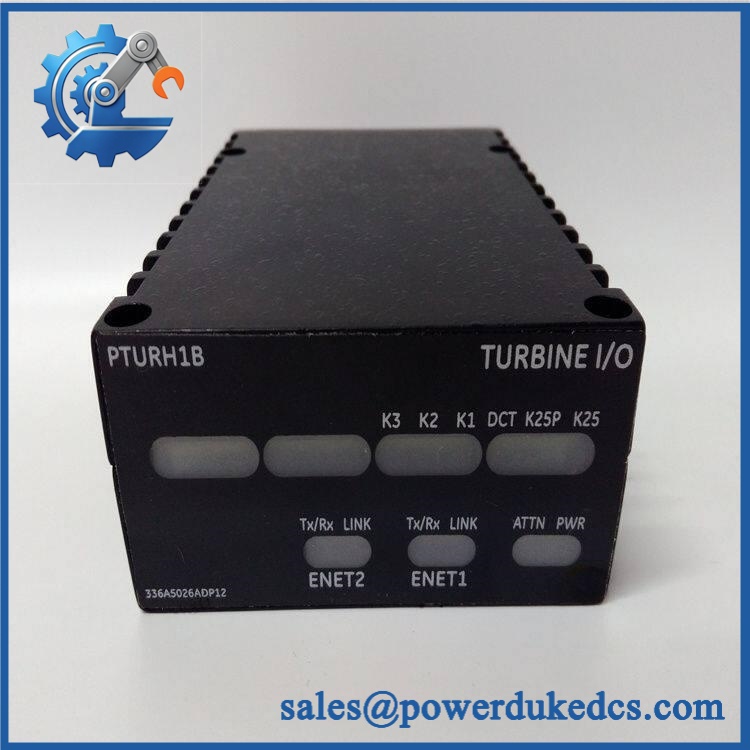
GE IS220PTURH1B
🚨 Global Compliance & Industry Certifications
- CE Mark: Applicable to the relevant Mark VIe equipment configuration where documented. Do not make a standalone CE claim for the I/O pack without the applicable declaration.
- UL/cUL: Certification may depend on the complete Mark VIe configuration and installation. Confirm the exact nameplate and certificate for the shipped revision.
- ATEX: GE’s Mark VIe type-examination certificate explicitly includes IS220PTURH1A and IS220PTURH1B with IS200TRPAH1A as the certified PTUR combination.
- IECEx: Do not automatically transfer ATEX status to IECEx. Check the exact certificate and equipment combination required at the destination site.
- Marine Approval: GE maintains a DNV Type Approval Certificate covering Mark VIe and Mark VIeS turbine-control configurations. Applicability must be matched to the actual marine installation and hardware configuration.
- Functional Safety: The PTUR belongs to turbine primary protection architecture. A system-level SIL claim must be based on the engineered protection topology and applicable safety documentation, not the part number alone.
- Hazardous-Area Importance: The documented hazardous-location approval is especially significant because incorrect substitution of a certified I/O pack or terminal board can invalidate the intended installation protection.
- Audit File: Retain the actual unit’s nameplate, revision, terminal-board designation, certification record, serial number, COO, and functional-test report.
Verify specific lot certifications with OEM.
🚨 Long-Term Storage & Asset Preservation Guide
Keep the PTUR in its original ESD shielding bag. The pack contains multiple populated electronic boards and an analog acquisition section, so static exposure and uncontrolled handling can create latent failures without visible physical damage.
Protect the RJ45, DC-62, and power interfaces. Keep protective caps installed where available. Do not allow dust, packing foam fragments, or moisture to enter the connectors. The DC-62 interface is particularly important because it mates directly with the turbine terminal-board architecture.
Control temperature and humidity. Store indoors in a clean environment, preferably below 60% RH when no more specific GE storage requirement is available. Use sealed secondary packaging and desiccant, while avoiding direct sunlight, condensation, salt spray, and corrosive vapors.
Do not casually energize stored protection packs. Record the hardware revision, serial number, terminal-board pairing, certification markings, packaging condition, and last functional-test date. Before field issue, perform a controlled rack or test-fixture verification rather than relying on an old “tested” label.
Physical Installation Prerequisites
- Terminal Board Match: Confirm the associated IS200TRPAH1A when using the certified TRPA architecture. GE explicitly identifies this combination in its hazardous-location documentation.
- TTUR Alternative: Where the installation uses TTURH1C, verify the complete signal architecture before replacing the pack.
- Power Supply: Provide 28.0 VDC nominal, staying inside the 27.4–28.6 VDC specified range.
- Current Capacity: Size the source for at least the documented 0.41 A maximum plus the appropriate engineering margin.
- Ethernet: Inspect both RJ45 Ethernet connections and verify whether the application requires simplex, dual-network, or TMR operation.
- DC-62 Interface: Check the connector for bent contacts, contamination, or damaged locking hardware before mating.
- Speed Inputs: Verify sensor type, polarity, shielding, and signal levels before commissioning.
- Flame Inputs: For configurations using flame detectors, verify all eight relevant channels and associated wiring.
- Voltage Inputs: Confirm the voltage-sensing architecture and applicable 16–140 VDC input range where TRPA is used.
- Cooling: Maintain unobstructed cabinet airflow around the I/O pack; do not obstruct ventilation openings with cable bundles.
- Grounding: Follow the Mark VIe cabinet grounding scheme and verify protective bonding before startup.
- ESD: Use grounded ESD controls whenever the pack is outside its shielding bag.
- Service Access: Maintain enough clearance for safe removal of the pack and access to both network connectors and the terminal-board interface.
GE’s Mark VIe documentation shows that turbine-specific I/O packs are intended to provide direct interfaces to specialized turbine field devices, reducing intermediate instrumentation and allowing more direct diagnostics.
Buyer’s FAQ
Q1. What HS tariff code should be used for GE ?
A provisional classification review may consider HS 8538 for a part of electrical control equipment, while some commercial records classify Mark VIe I/O packs under 85389091. This should not be treated as a universal tariff ruling. The final code depends on the importing country’s tariff schedule and the exact commercial function.
For the invoice, describe it precisely as “GE Mark VIe Turbine Specific Primary Trip I/O Pack” and have the importer or customs broker confirm the final national tariff classification.
Q2. What Country of Origin should appear on the COO?
Use the actual manufacturing origin of the physical I/O pack, supported by the unit’s nameplate and supplier documentation. One current commercial record identifies the origin as United States, but that should be independently verified for the actual serial-numbered unit.
Maintain the actual-unit photograph, serial number, supplier COO, and commercial invoice together for audit purposes.
Q3. Should I insure shipment of ?
Yes, particularly for turbine-protection inventory. Protect the DC-62 connector, RJ45 ports, three-pin power connector, and enclosure from impact. Photograph the complete pack, nameplate, connectors, revision marking, and packaging before dispatch.
For a critical spare, the insured value should reflect replacement procurement cost and the operational consequence of an unavailable turbine-protection pack.
Q4. Does include the latest firmware pre-loaded?
Do not assume that it does. The PTUR contains processing electronics and its operation depends on the Mark VIe system configuration. Record the hardware revision and installed software baseline before commissioning. GE documentation treats the PTUR as part of a defined turbine-protection architecture rather than as an independent generic I/O device.
Q5. Can I use with any Mark VIe terminal board?
No. The approved hardware combination matters. GE’s hazardous-location certificate specifically identifies IS220PTURH1A/ with IS200TRPAH1A, while the technical manual describes other PTUR arrangements involving TTURH1C. The terminal-board topology determines which turbine signals are actually available.



 Start Chat