

Description
- Brand: GE / Emerson
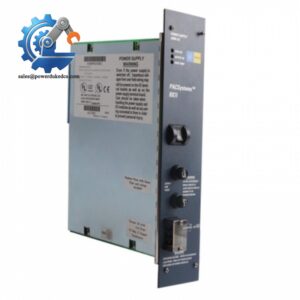
- Full Model Number: SLN042 IC086SLN042-A
- System/Series Family: GE PACSystems Industrial Ethernet
- Core Function: Unmanaged industrial Ethernet switching for PLC, controller, HMI, and process-network devices
- Top 3 Hardcore Specs: 4 × 10/100Base-T(X); 2 × 100Base-FX; 12–48 VDC dual power input
- Switch Architecture: Unmanaged; store-and-forward
- MAC Address Table: 2,048 addresses
- Power Consumption: Approximately 7 W typical
- Environmental Rating: IP30 enclosure; -40°C to +70°C operating temperature
- Stock Status: New Surplus / Fully Tested Refurbished — verify exact condition and test report before shipment
The SLN042 IC086SLN042-A is documented as a six-port industrial Ethernet switch with four 10/100Base-T(X) copper ports and two 100Base-FX fiber ports. Technical references also specify dual 12–48 VDC inputs, store-and-forward switching, flow control, IP30 housing, and a 2,048-entry MAC address table.
Module 3: Commercial-Technical Deep Dive
A failed industrial switch can disconnect multiple PLC, HMI, controller, and supervisory nodes at once, making the network fault look like a control-system problem. The GE SLN042 IC086SLN042-A is an unmanaged six-port Ethernet switch intended for industrial network deployment, with four 10/100Base-T(X) copper interfaces and two 100Base-FX fiber interfaces. That combination is useful in cabinets where copper field devices need to communicate across a fiber backbone or electrically isolated section. Because the switch is unmanaged, there is no IP configuration or switch-management database to restore after replacement.
The hard ROI comes from reducing network restoration work after a hardware failure. Dual 12–48 VDC power inputs provide two supply paths, while the approximately 7 W typical consumption keeps cabinet power demand modest. The switch uses store-and-forward processing and supports a 2,048-address MAC table, giving it enough address capacity for many small industrial segments without requiring managed-switch administration. Its stated operating range of -40°C to +70°C also makes it suitable for control cabinets exposed to substantial temperature variation. —The critical limitation is architectural: this is an unmanaged switch, so VLANs, port-level security, SNMP configuration, and other managed-network functions should not be expected.
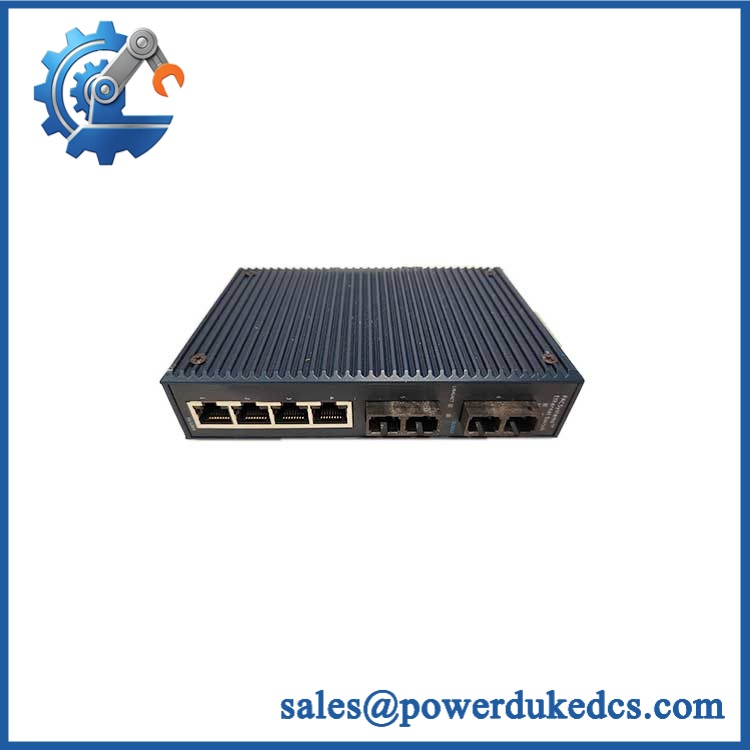
GE SLN042 IC086SLN042-A
Module 4: Compatibility & Installation Traps
Migration/Compatibility
For an existing installation specifying SLN042 IC086SLN042-A, the normal migration path is a like-for-like hardware replacement. No PLC logic rewrite is normally associated with replacing an unmanaged Ethernet switch because the switch does not execute the application program. Network devices connected through it retain their own IP addressing and application configuration.
The important checks are physical interface compatibility, fiber transceiver type, DC input arrangement, and cabinet mounting. Do not substitute a different switch simply because it has six Ethernet ports. The SLN042’s combination of four copper 10/100Base-T(X) ports and two 100Base-FX fiber ports is part of its system-level compatibility.
⚠️ Field Traps (Watch Out)
- Copper/fiber port mismatch: The two fiber interfaces are 100Base-FX, while the four copper interfaces support 10/100Base-T(X). Verify which field cables belong to copper ports and which belong to the fiber uplinks before replacement. A visually similar Ethernet switch with RJ45-only ports is not an equivalent substitute.
- Dual-power wiring mistake: The switch accepts dual 12–48 VDC inputs and includes reverse-polarity and overcurrent protection. Verify PWR1/PWR2 polarity and cabinet supply voltage before energizing. Do not assume the second input can be wired identically without checking the site’s redundancy design.
- Fiber specification: Confirm the installed fiber type and connector arrangement against the existing equipment documentation. A replacement switch with a different optical interface can leave the copper network operational while the critical fiber segment remains offline.
Module 5: Quality Assurance SOP
For surplus industrial network hardware, the pre-shipment inspection should include both physical verification and communication testing:
- OEM anti-counterfeit visual inspection — verify GE identification, model marking, PCB layout, port arrangement, housing condition, labels, and evidence of unauthorized modification.
- Part-number reconciliation — record and photograph the complete SLN042 / IC086SLN042-A identification before testing.
- Port inspection — examine all four copper interfaces and both 100Base-FX fiber interfaces for damaged housings, bent contacts, contamination, or loose connectors.
- Power-on self-test (POST) — apply the approved DC supply and verify the expected power LEDs, startup behavior, and absence of abnormal fault indications.
- Dual-power verification — test PWR1 and PWR2 independently where the test fixture supports it, confirming correct operation across the applicable supply range.
- Ethernet link verification — connect representative 10/100Base-T(X) devices and confirm link/activity indication and packet transmission.
- Fiber communication handshake — test the 100Base-FX interfaces with an appropriate optical test partner and verify stable link establishment and data transfer.
- Store-and-forward traffic test — pass representative Ethernet traffic through multiple ports and verify packet forwarding without unexpected link drops.
- MAC learning verification — confirm that connected devices are learned and forwarded correctly within the switch’s documented address capacity.
- Thermal/stability observation — operate the unit under controlled load and monitor for intermittent links, resets, abnormal heating, or LED behavior.
- Final QC release — archive identification photographs, power-test results, copper/fiber communication results, and packaging inspection records.
For an unmanaged switch, the meaningful functional check is simple: both power paths where applicable, every required copper/fiber interface, and actual packet forwarding must be verified. A power LED alone does not prove network health.
Module 6: CRO-Driven Buyer FAQ
1. Is the GE IC086SLN042-A an obsolete or difficult-to-source switch?
The is associated with GE PACSystems industrial networking and is now commonly encountered through replacement and installed-base inventory rather than as a new-generation network platform. Exact part-number verification remains important because visually similar industrial switches may have different copper/fiber arrangements or power specifications.
2. Is a managed Ethernet switch?
No. It is documented as an unmanaged Ethernet switch using store-and-forward switching. That means there is no conventional switch-management configuration to migrate, but it also means functions such as VLAN administration, SNMP configuration, and managed port controls should not be expected.
3. Can I hot-swap the ?
Do not assume hot-swap capability. The switch has external DC power inputs and may serve multiple live control-network connections. Follow the site’s electrical isolation and network-maintenance procedure unless the installed system documentation explicitly permits energized replacement.
4. What power supply does the require?
Published technical data specifies dual 12–48 VDC power inputs, with approximately 7 W typical power consumption. Verify the actual cabinet supply and polarity before installation rather than relying on the nominal voltage marking alone.
5. What warranty and technical support should I expect?
The quotation should clearly identify whether the unit is new surplus, unused, or tested refurbished and state the applicable warranty period. Technical support should cover exact-part verification, port and power compatibility, installation documentation, and available communication-test records. Network redesign, PLC programming, cybersecurity configuration, and site commissioning are separate engineering activities.



 Start Chat