

Description
- Brand: GE / GE Vernova
- Full Model Number: UCSC H1 / IS420UCSCH1A-B
- System/Series Family: Mark VIe / Mark VIeS
- One-Sentence Core Function: Standalone Mark VIe controller executing real-time control applications and communicating with distributed I/O through dedicated IONet interfaces
- Top 3 Hardcore Specs: AMD GX-412HC processor; 4 GB DDR3-1333 memory; 40 GB pSLC SSD
- CPU: AMD GX-412HC
- CPU Frequency: 1.2 GHz
- CPU Cores: 4
- Mark VIe Application Cores: 2
- Operating System: QNX 6.5 or QNX 7.1, application dependent
- Ethernet Ports: 6 × 100 Mbps Ethernet
- Additional USB: 2 × USB 2.0
- Nominal Supply: 24/28 VDC
- Input Range: 18–30 VDC
- Maximum Power: 31 W
- Cooling: Convection
- Operating Temperature: -40°C to +70°C
- Storage Temperature: -40°C to +85°C
- Weight: Approximately 1.327 kg
- NVRAM Capability: Up to 6139 non-volatile program variables, 338 forces, and 128 totalizers with supported ControlST versions
- Stock Status: New Surplus / Fully Tested Refurbished subject to availability
GE Vernova’s current Mark VIe controller data identifies IS420UCSCH1A/B as a UCSC controller using an AMD GX-412HC, with 1.2 GHz operation, four CPU cores, 4 GB DDR3-1333 memory, 40 GB pSLC SSD storage, six 100 Mbps Ethernet ports, and a 31 W maximum power figure. The same documentation specifies -40°C to +70°C operation and convection cooling.
Module 3: Commercial-Technical Deep Dive
A failed UCSC H1 can remove the control processor from a Mark VIe system while the distributed I/O hardware remains physically intact. The GE IS420UCSCH1A-B belongs to the UCSC controller family and executes application-specific Mark VIe control software under QNX. GE’s current technical data groups the H1A and H1B hardware together as IS420UCSCH1A/B, using an AMD GX-412HC processor at 1.2 GHz, with four physical CPU cores and two cores allocated to Mark VIe functions. Six 100 Mbps Ethernet ports provide the network interfaces required by the controller architecture.
The storage and environmental figures matter during spare selection. GE specifies 4 GB DDR3-1333 memory, a 40 GB pSLC SSD, 18–30 VDC input capability within a 24/28 VDC nominal system, and a maximum power consumption of 31 W. The controller is convection cooled and rated from -40°C to +70°C, with 95% non-condensing humidity. GE also documents QNX 6.5 or 7.1 support depending on the version, while the controller’s nonvolatile program-variable capacity depends on the supported ControlST release. Consequently, replacing the hardware without preserving the correct application image, network configuration, and redundancy role can produce a controller that boots correctly but cannot participate in the existing Mark VIe application.
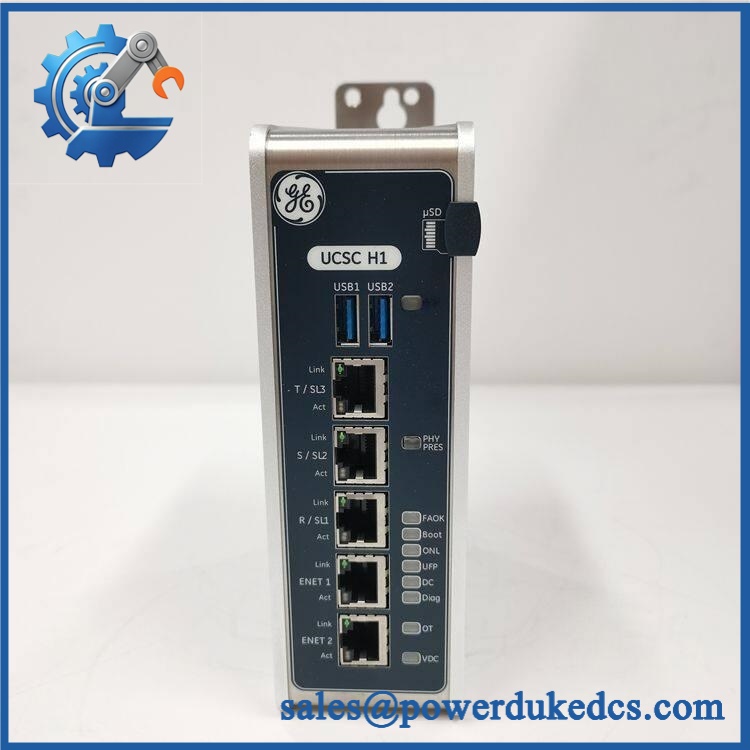
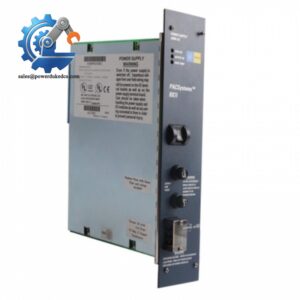
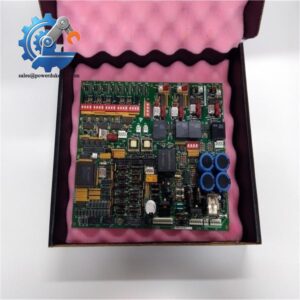
GE UCSC H1 IS420UCSCH1A-B
Module 4: Compatibility & Installation Traps
Migration/Compatibility
- System: GE Mark VIe / Mark VIeS
- Controller Family: UCSC H1
- Requested Model: IS420UCSCH1A-B
- GE Published Family: IS420UCSCH1A/B
- Processor: AMD GX-412HC, 1.2 GHz, quad-core
- Memory: 4 GB DDR3-1333
- Storage: 40 GB pSLC SSD
- Ethernet: 6 × 100 Mbps
- Additional Ports: 2 × USB 2.0
- Power: 18–30 VDC operating range, 24/28 VDC nominal
- Maximum Power: 31 W
- Cooling: Convection
- Operating Temperature: -40°C to +70°C
- Replacement Type: Exact model and revision matching strongly preferred
- Software: QNX version and Mark VIe application image must match the installed system requirements
- Configuration: Preserve IONet assignments, controller IP settings, time synchronization, application image, and redundancy configuration
- Logic Rewrite: Normally not required for a true like-for-like controller replacement; application restoration and system acceptance testing remain necessary
⚠️ Field Traps (Watch Out)
1. Treat the A/B revision designation as a real procurement parameter.
GE’s current data sheet groups in the same hardware family, but that does not establish that every software image, firmware package, or field configuration is interchangeable without verification. Match the exact installed suffix and document the revision before shipment.
2. Do not confuse six Ethernet ports with six independent I/O networks.
The UCSC is part of the Mark VIe network architecture. Network assignments, controller role, and IONet topology remain application-specific. Reconnecting Ethernet cables in arbitrary order can create link activity while leaving the actual I/O network assignment wrong.
3. Preserve the original application software image.
This controller runs QNX and GE application software rather than operating as a generic industrial PC. A successful QNX boot does not prove that the installed Mark VIe project, controller identity, or network configuration is correct.
4. Respect the 31 W power budget and cabinet airflow.
The current GE specification lists 31 W maximum power consumption and convection cooling. Verify the supply margin and cabinet heat load before commissioning a replacement, particularly in tightly packed turbine-control enclosures.
5. Verify Field Agent configuration when present.
GE documentation shows the can be supplied with an Embedded Field Agent, which uses the UCSC network interface for controller data collection and external connectivity. If the installed system uses that function, preserve its network configuration as part of the replacement procedure.
Module 5: Quality Assurance SOP
Each available GE -B should pass a documented controller-level inspection and functional test before shipment:
- OEM anti-counterfeit visual inspection: Verify GE identification, complete marking, UCSC H1 designation, connector layout, Ethernet-port labeling, power interface, mounting arrangement, and manufacturing identifiers.
- Revision verification: Record the complete visible hardware suffix and compare it with the requested A/B configuration.
- Mechanical inspection: Check mounting hardware, enclosure, Ethernet connectors, USB ports, power terminals, and any field-service interfaces.
- PCB condition inspection: Inspect accessible electronics for corrosion, contamination, thermal discoloration, cracked components, loose hardware, and evidence of previous repair.
- Storage inspection: Verify the installed SSD is physically present and properly secured.
- Power-rail precheck: Perform controlled resistance checks before applying the DC supply.
- Power-on self-test (POST): Energize the controller in an approved Mark VIe test fixture and verify normal startup, diagnostic status, and operating-system initialization.
- CPU and memory verification: Confirm recognition of the expected AMD GX-412HC platform and 4 GB memory configuration within the supported diagnostic environment.
- Storage verification: Confirm the 40 GB pSLC SSD is detected and accessible under the approved test image.
- Ethernet link verification: Test all six Ethernet ports individually and confirm link establishment and controlled packet transfer.
- IONet handshake verification: Connect to a controlled Mark VIe I/O test network and verify communication with representative I/O hardware.
- Controller application test: Load an approved diagnostic or customer-authorized test image and verify cyclic execution, I/O exchange, controller status, and alarm reporting.
- Time synchronization test: Verify IEEE 1588-based Mark VIe timing behavior where the test fixture supports it. GE describes IONet synchronization to within ±100 microseconds.
- Redundancy test: For controllers intended for dual or TMR service, verify the appropriate controller role and synchronization behavior using a dedicated test configuration.
- Field Agent verification: Where applicable, verify Embedded Field Agent startup and network configuration without exposing the production network.
- Fault-diagnostic verification: Introduce controlled network or I/O faults and verify expected Mark VIe diagnostic indications.
- Thermal observation: Monitor controller temperature during sustained operation and verify stable convection cooling.
- Final QC record: Record exact catalog number, hardware revision, software image, QNX version, Ethernet test results, IONet results, redundancy status, and technician sign-off.
- ESD-safe packaging: Package the controller using ESD-protective materials with mechanical protection around Ethernet ports, USB connectors, and the enclosure.
The critical QC distinction is between hardware boot validation and Mark VIe application validation. A UCSC that passes POST but fails IONet communication or loads the wrong application image should not be classified as a field-ready replacement.
Module 6: CRO-Driven Buyer FAQ
What is GE UCSC H1 -B?
GE is a UCSC H1 Mark VIe controller. GE’s current documentation groups /B together and identifies the family as using an AMD GX-412HC processor, 4 GB DDR3 memory, 40 GB SSD storage, and six 100 Mbps Ethernet ports.
What processor and memory are used in the UCSC H1?
The published GE specification lists an AMD GX-412HC processor at 1.2 GHz, with four physical cores and two cores allocated for Mark VIe control functions. Memory is 4 GB DDR3-1333, with 40 GB pSLC SSD storage.
What is the difference between and -B?
GE’s current data sheet treats as the same UCSC H1 hardware family. The exact installed revision should still be matched because application software, firmware, and field configuration can depend on the hardware revision.
Can the -B replace an older Mark VIe controller directly?
Not without configuration verification. The hardware can serve as a like-for-like UCSC controller replacement, but the application image, controller identity, IONet assignments, Ethernet configuration, time synchronization, and redundancy role must match the existing installation.
Can the UCSC H1 be replaced while the Mark VIe system is powered?
Do not assume live removal is permitted for every system. The correct method depends on the installed simplex, dual, or TMR architecture and the maintenance procedure for that cabinet. Use the approved Mark VIe replacement sequence and isolate the controller when required.
What should I verify before ordering -B?
Confirm the complete identifier, installed hardware revision, controller role, Mark VIe software image, QNX version, IONet assignment, Ethernet topology, redundancy arrangement, and whether an Embedded Field Agent is installed. GE’s published H1 family specifications are useful for confirming the processor, memory, storage, ports, power, and environmental envelope.
What warranty and technical support should I expect?
Warranty duration should be stated for the exact unit condition and test status on the quotation. Technical support should cover part-number verification, A/B revision matching, software-image review, IONet testing, network configuration checks, redundancy validation, and documented bench-test results. Mark VIe application engineering, turbine-control commissioning, and production logic modification should be treated separately unless explicitly included.



 Start Chat