

Description
- Brand — GE Multilin
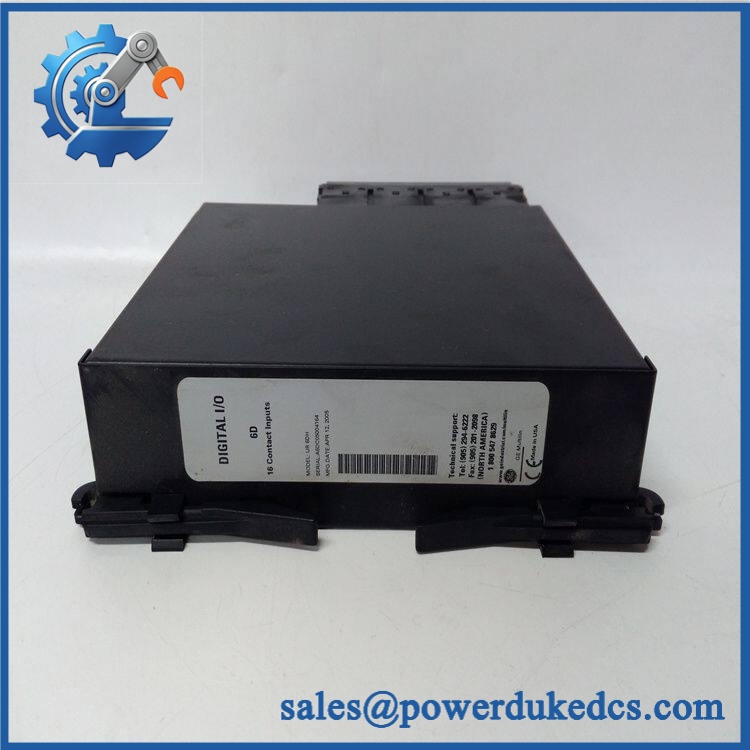
- Full Model Number — UR6EV
- System/Series Family — Multilin Universal Relay UR Family
- Core Function — Digital I/O expansion for protection, control, monitoring, and auxiliary equipment interfaces
- Top 3 Hardcore Specs — 6 isolated digital inputs; 6 digital outputs; Form C (SPDT) output contacts
- Stock Status — New Original Stock
GE describes the Universal Relay family as a common modular platform with expandable I/O, integrated monitoring and metering, high-speed communications, and configurable protection and control functions. Current third-party technical listings identify the UR6EV as a six-input, six-output digital I/O module with isolated inputs and Form C output contacts.
Technical Product Introduction
A failed I/O module can stop otherwise healthy protection logic from receiving breaker, switch, trip, close, or alarm states. The GE Multilin UR6EV adds or restores discrete field I/O within the Universal Relay architecture, giving the host relay a dedicated interface for digital status acquisition and contact-based control. The UR family uses a common modular architecture, so I/O capacity can be expanded according to the relay configuration rather than rebuilding the complete protection platform.
For maintenance teams, the important numbers are the I/O count and electrical interface: six isolated digital inputs and six digital outputs, with the outputs identified as Form C/SPDT contacts in current technical references. Another technical listing gives an input range of 24 VDC to 125 VDC or 120 VAC, output switching ratings extending to 250 VDC/120–250 VAC, and 2,500 VDC isolation; these electrical ratings should be checked against the exact UR6EV hardware revision before energization because published third-party data is not fully consistent.
Application Scenarios & Field Realities
- At a transmission or distribution substation, the UR6EV can be assigned to discrete breaker-status, disconnect-status, interlock, alarm, and control functions. The six-input/six-output arrangement is useful where a protection panel needs additional binary points without adding a separate remote I/O rack. GE identifies utility substation automation and multiple protection/control applications as core UR-family use cases.
- During generator protection panel maintenance, an I/O replacement is often preferable to disturbing the protection CPU and existing application logic. Keeping the same UR6EV part number also reduces the number of wiring and configuration variables introduced during an outage — though the exact terminal assignment must still be checked against the installed relay and wiring drawings.
- For transformer protection and control panels, discrete signals such as breaker auxiliary contacts, lockout status, trip circuit supervision, and alarm indications may be distributed across several I/O modules. GE lists transformer protection and industrial plant automation among the UR family’s application areas.
- Where a legacy UR installation is being maintained rather than redesigned, the practical advantage is parts continuity. The UR platform was built around common modular hardware and expandable I/O, which can reduce the number of unique spare modules that a maintenance department has to carry.
Migration, Compatibility & Installation Traps
Replacement Matrix
| Replacement Case | Status | Engineering Requirement |
|---|---|---|
| replacing the same part number | Drop-in Replacement | Verify hardware revision, terminal wiring, host relay configuration, and firmware before energization |
| replacing a different UR-family I/O module | Software Compatible / Configuration Dependent | Confirm I/O type, point count, terminal mapping, configuration file, and host relay support |
| migrated to a non-UR relay platform | Hardware Modification Required | External interface hardware, wiring changes, and application re-engineering may be necessary |
GE confirms that the Universal Relay family uses a common modular platform with expandable I/O, but that does not mean every UR I/O module is electrically interchangeable with every other module.
Field Traps — Watch Out
Voltage mismatch: Do not treat the presence of a digital input as proof that any available DC control voltage is acceptable. Published references for the give different voltage descriptions, so the exact module revision and the relay’s installation documentation should control the final wiring decision.
Contact configuration: A Form C/SPDT output is not equivalent to a simple sourcing transistor output. Confirm whether the existing circuit expects common, normally open, and normally closed contacts before transferring wires. One misplaced control wire can create an unexpected permissive or trip path.
Configuration and firmware: GE maintains dedicated UR firmware-update and configuration resources, and current UR documentation identifies firmware-dependent feature sets. Preserve the existing setting file before replacing the module, then validate I/O mapping and diagnostics after installation.
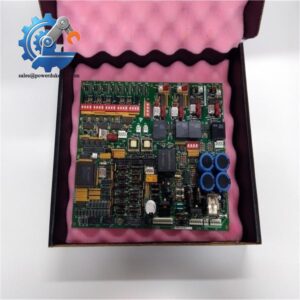
GE UR6EV
Quality Assurance SOP
For supplied inventory, our pre-shipment inspection is handled as a hardware QA procedure rather than a visual-only order check:
- OEM anti-counterfeit visual inspection — verify GE identification labels, part-number format, serial/date markings where present, connector condition, housing finish, terminal integrity, PCB construction, and evidence of modification or rework.
- Mechanical inspection — check mounting surfaces, terminal blocks, connector interfaces, locking hardware, and enclosure condition for impact, corrosion, contamination, or bent contacts.
- Power-on self-test (POST) — energize the module within the applicable test setup and inspect the available diagnostic indication, including ERR/RUN status LEDs where provided by the installed UR hardware. Abnormal indications are recorded before shipment.
- I/O functional verification — exercise the available digital input channels with controlled test signals and verify state changes through the host relay configuration.
- Output contact test — verify each applicable output contact changes state correctly and confirm Form C contact behavior against the test circuit.
- Communication handshake verification — establish communication between the UR host system and the engineering interface, then verify module recognition, I/O status, and diagnostic reporting.
- Configuration check — compare the observed I/O assignment with the approved test configuration and record any hardware-revision differences.
- Final inspection and packaging — photograph the tested unit, confirm the exact part number against the purchase order, apply ESD protection, and package the module for industrial transport.
The UR family supports engineering and diagnostic workflows through EnerVista software, while GE provides dedicated resources covering configuration-file handling, communications, contact I/O testing, and firmware updates.



 Start Chat


