

Description
- Brand: GE Fanuc Embedded Systems
- Full Model Number: VMICPCI-7806-211000
- Item Number: 350-657806-211000L
- System/Series Family: VMICPCI-7806 Universal CompactPCI SBC
- Core Function: 6U single-slot CompactPCI single-board computer for embedded control and industrial computing
- Top 3 Hardcore Specs: Intel Pentium M 1.6 GHz; 512 MB DDR SDRAM; 128 MB CompactFlash
- Expansion: 2 PMC sites; 64-bit/66 MHz PCI-X plus 32-bit/33 MHz PCI
- Networking: 2 × 10/100/1000Base-T Ethernet
- Backplane: 64-bit/66 MHz CompactPCI
- Stock Status: New Surplus — stock confirmation required
The 211000 configuration corresponds to the 1.6 GHz Pentium M, 512 MB DDR SDRAM, and 128 MB CompactFlash options in the published GE ordering scheme.
Technical Product Introduction
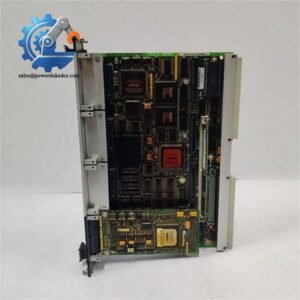
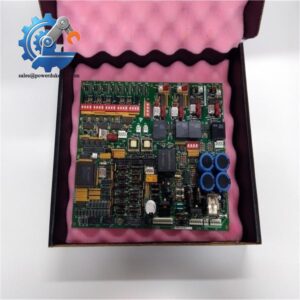
A failed controller in a CompactPCI chassis can stop the host application even when the I/O cards and field wiring remain healthy. GE Fanuc’s VMICPCI-7806 is a 6U single-slot universal CompactPCI single-board computer built to operate as either a system-slot or peripheral-slot controller. The VMICPCI-7806-211000 configuration uses a 1.6 GHz Intel Pentium M processor, 512 MB DDR SDRAM, and 128 MB CompactFlash. Its architecture includes a 64-bit/66 MHz CompactPCI interface, dual 10/100/1000Base-T Ethernet ports, two serial interfaces, two USB 2.0 ports, and two PMC expansion positions.
From a replacement-cost perspective, the important point is not simply CPU frequency. The board consolidates computing, network connectivity, local storage, graphics, and PMC expansion in one CompactPCI slot. The 400 MHz system bus and Intel 855GME/6300ESB chipset establish the platform around a processor generation designed for embedded deployments with lower power demand than contemporary desktop hardware. The VMICPCI-7806 also supports PICMG 2.16 packet switching and PICMG 2.1 hot-swap architecture, while the published environmental specification is 0 to +50 °C operating temperature with 5% to 95% noncondensing humidity. —cabinet airflow still matters because the board uses a passive heat sink that depends on forced rack cooling.
Application Scenarios & Field Realities
- Where the CompactPCI chassis is the control platform, this board can serve as the host SBC while PMC cards handle application-specific I/O or communication. The two PMC positions are useful when a legacy system already depends on a carrier-card architecture rather than a modern PCIe-based controller.
- In power and process-control cabinets, dual Gigabit Ethernet can support separate network paths or front-panel/backplane routing depending on the installed backplane design. PICMG 2.16 support is particularly relevant when Ethernet traffic is carried through the CompactPCI packet-switching backplane rather than only through front RJ45 connections.
- For long-running embedded applications, the programmable watchdog timer and IPMI support provide useful management functions at the platform level. The processor, memory, and CompactFlash configuration are fixed by the order code, so verify the original hardware image before substituting a board with another VMICPCI-7806 option code.
- During high-availability maintenance, PICMG 2.1 hot-swap support is significant. GE documentation states that the processor assembly can be removed and replaced while the system remains operational, with processing capable of transferring to a previously installed backup SBC. That behavior depends on the actual chassis, redundant controller arrangement, and system implementation—not merely on the presence of the hot-swap feature on the board.
Migration, Compatibility & Installation Traps
Replacement Matrix
| Replacement Condition | Classification | Engineering Guidance |
|---|---|---|
Replacing an existing -211000 with the same 211000 configuration |
Drop-in Replacement | Usually the least disruptive path when the CompactPCI chassis, rear-I/O arrangement, storage image, and BIOS settings are unchanged |
Replacing another processor or memory option with this 211000 version |
Software Compatible | Hardware family is related, but verify CPU-dependent software behavior, memory requirements, CompactFlash image, and BIOS configuration before deployment |
| Installing into a chassis using a different mechanical or rear-transition architecture | Hardware Modification Required | Backplane routing, rear transition hardware, PMC cards, and auxiliary I/O may require redesign or reconfiguration |
Field Traps:
Rear-I/O mismatch. The routes IDE, floppy, USB, SATA, video, and keyboard/mouse functions through CompactPCI rear connectors. GE specifies the VMIACC-0584 rear-transition adapter for access to these signals. Without that adapter, certain interfaces must be properly terminated or disabled through CMOS setup. Do not assume a previously used transition board has identical routing.
Cooling and hot-swap assumptions. The passive heat sink requires forced air through the rack at the specified flow rate. A replacement board that powers up on the bench can still behave differently after chassis installation if airflow is restricted by adjacent cards, filters, or fan degradation. Hot-swap capability also requires a compliant CompactPCI infrastructure and correct power sequencing; it should not be treated as permission to remove the board from any energized chassis without checking the installed system design.
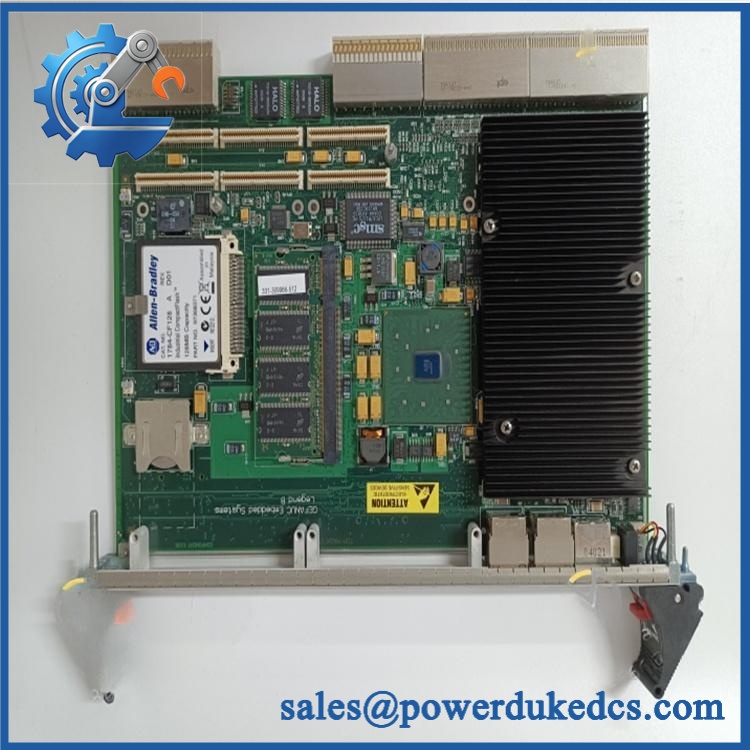
GE VMICPCI-7806-211000
Quality Assurance SOP
For surplus inventory, identification comes before functional testing. Each -211000 is checked against the stated ordering code and item number, with an OEM anti-counterfeit visual inspection covering board markings, PCB layout, connectors, labels, component condition, and evidence of rework. Configuration-critical items are cross-checked against the 211000 option code: 1.6 GHz Pentium M, 512 MB DDR SDRAM, and 128 MB CompactFlash.
The electrical test starts with controlled insertion into a compatible CompactPCI test chassis, followed by power-on self-test (POST) checking for ERR/RUN and board-status indications. Ethernet ports are exercised individually, with link and data activity verified under controlled traffic. Serial interfaces and available USB functions are checked where the test fixture supports them. A communication handshake verification is then performed through the configured network path or application test environment. PMC interfaces are inspected for bus enumeration and card recognition where a known-good PMC test module is available.
Thermal verification follows the functional cycle rather than relying on a single boot result. Because the uses passive heat dissipation, the board is evaluated under forced-air rack conditions, with attention to stability during sustained operation. The CMOS battery holder, CompactFlash connection, PMC connectors, and rear-I/O interface points receive a final physical inspection before packing. Test records should retain the board serial information, observed LED status, POST result, communication result, and configuration details for shipment traceability.



 Start Chat