

Description
- Brand: Triconex / Invensys
- Full Model Number: 3503E / 9563-810
- System/Series Family: Tricon v9–v10
- Core Function: 32-point TMR digital input acquisition for nominal 24 VAC/VDC field signals with commoned inputs
- Top 3 Hardcore Specs: 32 input points; 20–42.5 VDC recommended range; 47–63 Hz AC or DC operation
- Input Configuration: Commoned in groups of 8
- Switching Threshold: 15 VAC/VDC typical Off-to-On; 8 VAC/VDC typical On-to-Off
- Input Impedance: >1.25 kΩ nominal
- Input Delay: <8 ms Off-to-On; <15 ms On-to-Off
- Point Isolation: 1,000 VAC minimum / 1,500 VDC minimum
- Self-Test: TMR input diagnostics with periodic input fault detection
- Logic Power: <10 W
- Compatible Termination Panel: 9563-810, 24 V commoned, 16 points
- Termination Fuse: 1 A slow-blow per input point
- Stock Status: New Surplus or Fully Tested Refurbished; exact hardware revision to be confirmed
Tricon documentation identifies 3503E as a 32-point, 24 VAC/VDC TMR digital-input module with self-test. The corresponding 9563-810 termination panel provides 16 commoned points, so two panels are required for the 32-point module.
Module 3: Technical Product Introduction
A nominal 24 V field circuit becomes a serious diagnostic issue when a digital input has to distinguish a real OFF state from a weak or partially energized signal. The TRICONEX 3503E is a 32-point TMR digital input module for 24 VAC/VDC field signals, with the inputs commoned in groups of eight. Each point is optically isolated, and the module includes self-test diagnostics intended to identify input-channel faults rather than simply report the measured state. Tricon documentation specifies the module for Tricon v9–v10 systems.
The field thresholds are important during commissioning. The recommended input range is 20–42.5 VDC, with a maximum input voltage of 42.5 VAC/VDC. The typical Off-to-On switching point is 15 V, while On-to-Off is 8 V, creating approximately 4 V of typical hysteresis. Input delay is below 8 ms for Off-to-On and below 15 ms for On-to-Off transitions. Input impedance is greater than 1.25 kΩ, and point isolation is rated at a minimum of 1,000 VAC / 1,500 VDC.
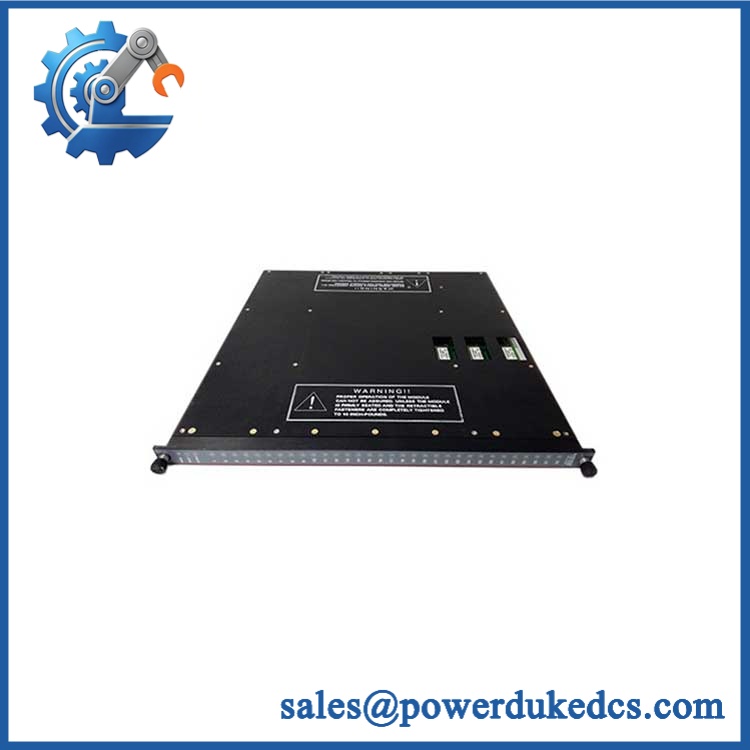
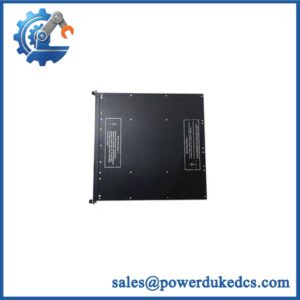
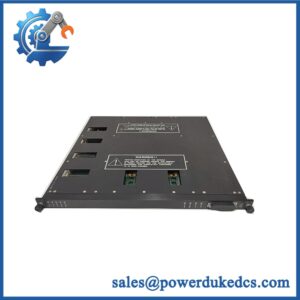
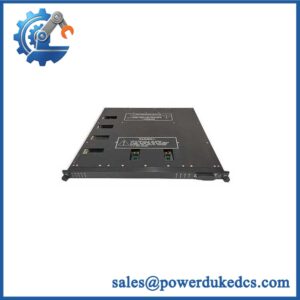
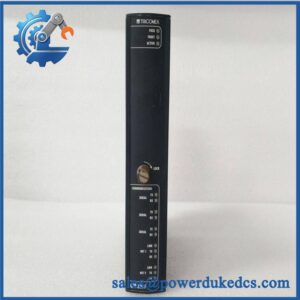
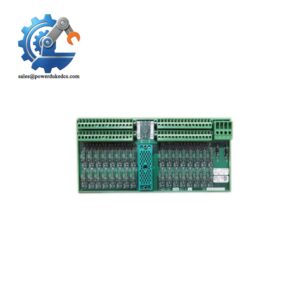
TRICONEX 3503E 9563-810
Module 4: Application Scenarios & Field Realities
- For 24 VDC shutdown permissives and equipment-status contacts, 3503E provides 32 discrete input points with TMR processing and commoned field-power groups. The architecture is suited to status acquisition where the controller must continuously diagnose the input path rather than rely on a single electronic channel.
- On motor-control and valve-status circuits, the actual voltage at the Tricon termination panel deserves measurement. A nominal 24 V signal can fall into the transition region when field contacts, cable resistance, or auxiliary relays degrade. The documented 8–15 V switching thresholds make marginal wiring readily visible during a proper loop test.
- For cabinet installations using 9563-810, each termination panel provides 16 commoned input points, while the 3503E contains 32 points. Two 9563-810 panels are therefore required to terminate a complete 3503E channel set, normally covering points 1–16 and 17–32.
- During maintenance of legacy Tricon systems, the termination panel should be tested with the input module rather than treated as a passive connector board. The 9563-810 incorporates individual input protection, including a 1 A slow-blow fuse per point, so a blown fuse can mimic an input-channel problem even when the 3503E electronics remain healthy.
Module 5: Migration, Compatibility & Installation Traps
Replacement Matrix
Replacement classification: Drop-in Replacement for an existing Tricon 3503E installation when the same module revision, termination architecture, field voltage, and Tricon system configuration are retained.
Software compatibility: Configuration verification required. The 3503E is an I/O module, but channel assignments, diagnostic behavior, input logic, and associated system configuration must match the existing Tricon application.
Cross-model replacement: Hardware and configuration verification required. The Tricon family includes other digital-input modules for different voltage ranges and threshold characteristics. Matching the 32-point count alone is not sufficient.
Field Traps — Watch Out
1. Match 3503E with the correct termination hardware. Tricon’s field-termination guide explicitly lists 9563-810 as compatible with 3503E. Because one 9563-810 provides 16 points, a complete 32-point 3503E installation uses two panels.
2. Respect the commoned-group arrangement. The 3503E inputs are commoned in groups of eight. A field wiring change that assumes all 32 points are independently referenced can alter the intended circuit topology. Review the cabinet schematic before moving any field return or power connection.
3. Check the 20–42.5 V operating range at the termination panel. A 24 V supply that appears normal at the source can sag at the field interface. Signals near the switching thresholds can produce intermittent state changes, especially under relay or solenoid loading.
4. Inspect the 9563-810 fuse before condemning the module. Each input point has a 1 A slow-blow fuse and blown-fuse indication. A field-side open caused by the termination panel can present as a dead input channel while the 3503E itself remains operational.
5. Do not substitute 3505E without an engineering check. Although the 9563-810 panel also supports 3505E, Tricon documentation describes 3505E as a 24 VDC low-threshold digital-input module. Its input behavior is therefore not identical to the 3503E 24 VAC/VDC module.
Module 6: Quality Assurance SOP
Pre-Shipment Inspection Protocol for TRICONEX 3503E / 9563-810
- OEM identity inspection: Verify Triconex/Invensys markings, exact 3503E designation, hardware revision, serial number, and all visible assembly identifiers.
- Termination identification: Verify the associated panel is specifically 9563-810 and record its label, hardware revision, and serial information where available.
- Mechanical inspection: Examine the 3503E housing, module guides, locking features, card-edge/backplane interface, LEDs, and accessible PCB surfaces for corrosion, contamination, deformation, cracked components, or unauthorized modification.
- Panel inspection: Check the 9563-810 enclosure, terminal blocks, fuse holders, label strips, mounting hardware, and field wiring interface for damage or heat discoloration.
- Fuse inspection: Verify the 9563-810 uses the specified 1 A slow-blow fuse arrangement and inspect each fuse position for correct seating, continuity, and signs of overheating.
- Power-on self-test: Install the 3503E in a compatible Tricon test chassis and verify PASS, FAULT, ACTIVE, and individual point indications during startup.
- 32-channel verification: Exercise all 32 digital-input points individually rather than qualifying the module from a single sample channel.
- AC input test: Apply representative 24 VAC signals within the documented operating range and verify stable ON/OFF recognition across all channels.
- DC input test: Apply representative 24 VDC signals and confirm correct state recognition across the specified 20–42.5 VDC range.
- Threshold verification: Test controlled input levels around the documented Off-to-On and On-to-Off switching thresholds and record channel behavior.
- Timing verification: Apply controlled signal transitions and verify response within the documented <8 ms Off-to-On and <15 ms On-to-Off limits.
- Isolation verification: Perform an approved controlled isolation test against the applicable 1,000 VAC / 1,500 VDC minimum point-isolation specification.
- Input self-test verification: Exercise the supported diagnostic test behavior and confirm that representative input faults are detected rather than incorrectly reported as healthy states.
- Termination-panel simulation: Test the 3503E through the 9563-810 interface and verify correct channel mapping for points 1–16 and 17–32.
- Fuse-fault simulation: Where the laboratory procedure permits, simulate a termination-panel fuse-open condition and confirm the expected diagnostic indication.
- TMR verification: Where the test environment permits, validate the three independent input channels and confirm correct data transfer into the Tricon voting architecture.
- Thermal observation: Operate a representative number of channels under continuous field excitation and monitor for abnormal temperature rise, intermittent input transitions, or diagnostic instability.
- Final QC record: Record model, revision, serial number, termination panel identity, test voltage, all 32 channel results, threshold measurements, timing results, isolation results, fuse status, diagnostics, test date, and inspector approval.
- ESD-controlled packaging: Protect the 3503E module and 9563-810 panel interfaces from electrostatic discharge, connector damage, impact, moisture, and contamination during final packing.
Procurement note: The technically supported combination is TRICONEX 3503E + 9563-810, where 3503E is the 32-point 24 VAC/VDC TMR digital-input module and 9563-810 is the matching 16-point commoned termination panel. Two termination panels are required for all 32 input points. The 3503E specification calls for 20–42.5 VDC recommended input, 42.5 VAC/VDC maximum, 15 V typical Off-to-On threshold, 8 V typical On-to-Off threshold, <8 ms / <15 ms response, and 1,000 VAC / 1,500 VDC point isolation.



 Start Chat