

Description
- Model: 505XT 8200-1312
- Brand: Woodward
- Series: 505XT Digital Control System
- Part Type: Digital Steam Turbine Governor / Turbine Control
- Core Function: Controls and protects industrial steam turbines by managing speed, load, process parameters, startup, shutdown, and actuator demand.
- Key Specs: Low-voltage DC architecture, Marine/ATEX compliance variant, four isolated 10/100 Ethernet ports, four isolated CAN ports, two independent speed-sensor circuits, and support for actuator and process-control I/O.
Product Introduction
At the turbine control panel, the WOODWARD 505XT 8200-1312 provides the digital control layer responsible for turbine startup, speed regulation, load management, process control, and protective functions. Woodward’s 505XT platform is intended for single-valve and extraction/admission steam turbines, including turbine-generator and mechanical-drive applications. The 8200-1312 is the LV-ATX & Marine variant, making exact part-number verification important when replacing an installed controller.
For legacy turbine installations, this distinction matters… the 8200-1312 is not simply interchangeable with every 505XT hardware variant. The controller integrates speed inputs, discrete inputs, analog I/O, actuator outputs, relay outputs, Ethernet, and CAN communications within the turbine-control architecture.
Core Technical Specifications
| Parameter | Value |
|---|---|
| Manufacturer | Woodward |
| Model | 505XT 8200-1312 |
| Series | 505XT Digital Control System |
| Product Type | Digital Steam Turbine Governor / Control |
| Application | Industrial steam turbines and turbo-expanders |
| Variant | LV-ATX & Marine |
| Power Supply | Low-voltage DC; verify site wiring against the applicable Woodward documentation before installation |
| Ethernet | 4 isolated 10/100 communication ports |
| CAN | 4 isolated CAN communication ports |
| Speed Inputs | 2 isolated digital speed-sensor circuits |
| Speed Sensor Types | MPU or proximity probe |
| Proximity Sensor Supply | Dedicated isolated +24 V supply on each speed-sensor channel |
| Analog Inputs | 8 configurable analog input channels shown in the 505XT configuration data |
| Analog Outputs | 6 analog output channels |
| Actuator Outputs | 2 actuator output channels |
| Discrete Inputs | 20 local discrete-input channels |
| Discrete Output Relays | 8 relay outputs |
| Environmental Temperature | −30°C to +70°C operating/storage range listed for the 8200-1312 |
| Enclosure Rating | IP20 |
| Overvoltage Category | II |
| Pollution Degree | 2 |
| Real-Time Clock | Battery-backed RTC |
| Manual Reference | Woodward Manual 35018 / 505XT Digital Control System |
The 505XT manual identifies the 8200-1312 among the covered hardware variants and documents two isolated speed-sensor circuits, 4–20 mA interfaces, actuator outputs, discrete I/O, and relay functions. The 8200-1312-specific environmental and communication specifications are reported by current technical listings.
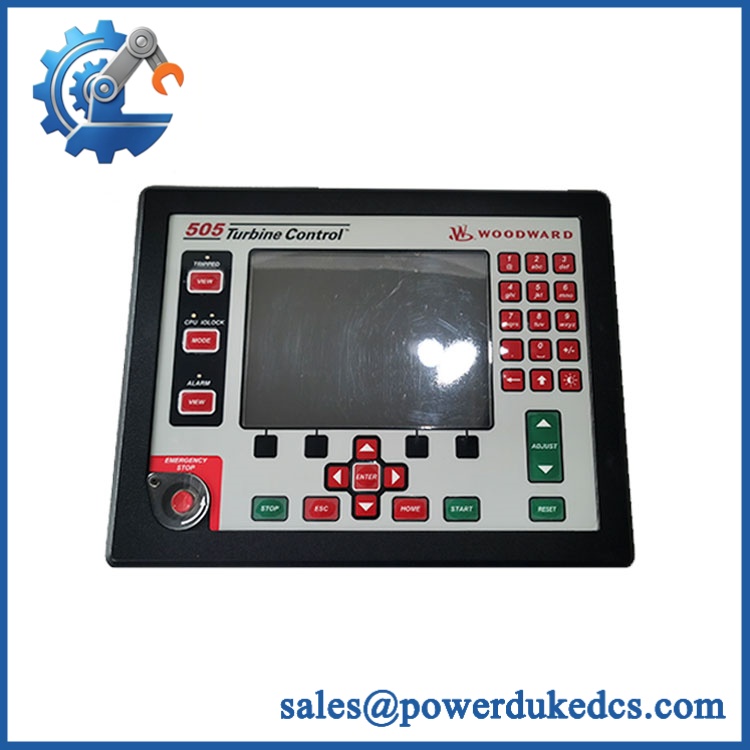
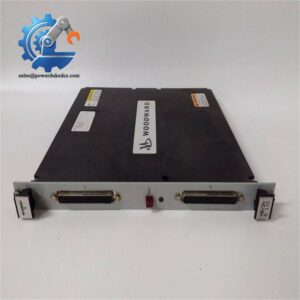
WOODWARD 505XT 8200-1312
Application Scenarios & Pain Points
A turbine trip during normal generation can expose a control-system problem much faster than a routine inspection ever will. With a correctly matched 505XT spare, technicians can focus on proving whether the failure is inside the controller, in the actuator circuit, or in the field instrumentation.
Utility and Industrial Power Generation
The 505XT handles turbine startup, shutdown, speed, load, and process-control duties for generator-drive applications. A controller problem can therefore manifest as unstable frequency, failed sequencing, unexpected trips, or an inability to accept load correctly.
Mechanical-Drive Turbines
For compressors, pumps, or industrial fans driven by steam turbines, actuator and speed-loop performance directly affects process output. Wrong controller hardware can produce incorrect actuator behavior even when the turbine itself is mechanically sound.
Extraction / Admission Turbines
The 505XT platform supports extraction and/or admission turbine configurations. Those applications can involve multiple control objectives, so replacement should be based on the complete hardware and application configuration rather than the 505XT family name alone.
Marine Installations
The 8200-1312 is specifically identified as a Marine/ATEX variant. Environmental and certification requirements therefore form part of the replacement decision, not merely the electrical specifications.
Hot Turbine-Control Rooms
At sustained 50°C+ ambient temperatures, inspect ventilation, terminal condition, dust loading, and controller thermal behavior carefully. The published temperature range extends to +70°C, but cabinet temperature, airflow, and surrounding equipment still need to remain within the installation requirements.
Common Error Codes & Diagnostic Symptoms
Symptom/Code: Speed Input Loss / Zero-Speed Detection
→ Diagnosis: The controller may be seeing an invalid or missing MPU/proximity signal. A defective probe, incorrect gap, wiring fault, or failed speed-input circuit can all create this condition.
→ Action: Verify sensor waveform and wiring first; replace the 8200-1312 when the fault follows the controller.
Symptom/Code: Actuator Output Fault / Loss of Valve Response
→ Diagnosis: Possible actuator wiring failure, incorrect configuration, output-stage failure, or actuator incompatibility. The 505XT provides dedicated actuator output channels that must be matched to the installed actuator arrangement.
→ Action: Check actuator resistance/current and configuration; substitute a tested controller when the output fault remains controller-dependent.
Symptom/Code: Repeated Controller Trip or I/O Diagnostic Alarm
→ Diagnosis: Internal hardware, I/O circuitry, configuration, power quality, or field-device faults may be involved.
→ Action: Capture the diagnostic screen and event log, verify power and field signals, then replace the controller if diagnostics consistently identify the hardware.
Exact numeric fault codes should be taken from the applicable 505XT manual and configured application. A generic “error number” should not be assigned to the 8200-1312 without confirming the installed software/application version.
Cross-Reference & Lifecycle Migration
The most important lifecycle point for 8200-1312 is now documented by Woodward itself.
Original part:
8200-1312 — 505XT (LV-ATX & Marine) Steam Turbine Control
Replacement path:
8200-2312 — 505XT (LV-ATX) Steam Turbine Control
Woodward’s product-change notification states that the 8200-1312 was affected by a relay supplier change and identifies 8200-2312 as its replacement hardware. The notification notes equivalent performance with differences including Marine type approval and random-vibration requirements.
A current lifecycle listing reports that new-unit last-time-buy for 8200-1312 ended September 23, 2024, with the part classified as obsolete.
Compatibility warning: Do not interpret 8200-2312 as an automatic drop-in replacement for every marine installation. Woodward’s notice specifically distinguishes the newer LV-ATX item from the former LV-ATX & Marine version. Marine certification and project approval requirements therefore need verification before migration.
Firmware / application: Firmware flashing should not be treated as a routine replacement step. The 505XT uses application software and configurable control parameters; preserve the installed configuration and verify the replacement hardware/software combination before commissioning. The 505XT documentation includes application management and configuration procedures.
Buffer-stock strategy: Because the 8200-1312 is obsolete and the LTB window has closed, operating facilities should prioritize verified spare units, configuration backups, repair capability, and documented replacement compatibility.
Field Engineer’s Tech Notes
First warning: do not swap the speed sensor wiring blindly. The 505XT has two isolated digital speed-sensor circuits, each configurable for MPU or proximity sensing. Each proximity channel has a dedicated isolated +24 V supply, and Woodward specifically cautions that these outputs are not general-purpose power supplies.
Second warning: preserve the application before replacing hardware. A replacement controller may power up perfectly and still be unsuitable because the turbine application, actuator scaling, speed settings, trip logic, or I/O assignments do not match. Back up the existing application/configuration whenever possible before removing the failed unit (that file can save hours during commissioning).
Strict QA & Testing SOP
1. Inbound inspection
Verify the complete 8200-1312 marking, revision information, serial identification, terminal condition, housing integrity, display/front-panel condition, and certification markings where applicable.
2. Traceability check
Photograph the nameplate and record all hardware identifiers. Confirm that the unit is actually the LV-ATX & Marine variant rather than a similar 505XT part number.
3. Power-input inspection
Check the DC power interface, terminal condition, polarity markings, and internal/external signs of electrical stress before energization.
4. Controller startup test
Power the controller using an appropriate controlled test rig. Verify boot behavior, display operation, diagnostics, and system recognition.
5. Speed-input test
Simulate an appropriate MPU or proximity-probe signal on the available isolated speed inputs. Confirm stable speed acquisition and correct signal behavior.
6. Analog and discrete I/O test
Exercise representative analog inputs, analog outputs, discrete inputs, and relay outputs. Confirm channel response against the expected configuration.
7. Actuator-output test
Use a controlled load/test interface to verify the actuator-output channels. Check current response, scaling, and fault indication without connecting an unverified field actuator.
8. Communication test
Verify Ethernet communication and, where required by the application, CAN communications. The 8200-1312 provides four isolated Ethernet ports and four isolated CAN ports.
9. Extended functional observation
Monitor the controller during a sustained test cycle for unexpected resets, communication loss, abnormal temperature rise, or intermittent I/O behavior.
10. Final QC and packaging
Record test results, serial number, configuration information, technician sign-off, and condition classification. Use ESD protection and shock-resistant packaging for shipment.
11. Evidence package
Provide the QC report and photographs with the shipment. Test videos can also be supplied to document power-up, diagnostics, communication, and representative I/O testing.
Buyer’s FAQ
Q: Is 8200-2312 a direct replacement for my 8200-1312?
A: It is the documented replacement path, but do not treat the change as universally identical. Woodward specifically identifies differences involving Marine type approval and other characteristics. Confirm the project certification and application requirements before migration.
Q: Can I use a standard 505XT instead of the 8200-1312?
A: Not without engineering verification. The 8200-1312 has a specific LV-ATX & Marine designation, and its certification and hardware characteristics may be necessary for the installed system.
Q: What does “New Original” mean for this obsolete controller?
A: Ask for the complete Woodward part number, nameplate photographs, serial traceability, condition statement, and functional-test evidence. Since new-unit availability ended with the September 23, 2024 LTB deadline, claims of unused inventory should be independently documented.
Q: What warranty should I require?
A: Put the warranty period and covered failure modes in writing. For an obsolete turbine controller, the purchase record should also identify whether the unit is new old stock, repaired, refurbished, or used, and should include the actual test report supplied with that serial-numbered unit.



 Start Chat


