

Description
- Brand: Foxboro
- Full Model Number: FBM233 / P0926GX
- System/Series Family: Foxboro I/A Series 200 / Foxboro Evo 200 Series
- Core Function: Redundant Ethernet interface between single- or dual-ported field devices and the Foxboro control system
- Top 3 Hardcore Specs: 10/100 Mbps Ethernet; 24 VDC +5%/-10%; up to 64 external devices
- Ethernet Protocols: TCP/IP or UDP/IP
- Fieldbus: Redundant 2 Mbps module Fieldbus
- Maximum DCI Connections: Up to 2,000
- Power Consumption: 7 W maximum
- Connector: RJ-45
- Operating Temperature: -20°C to +70°C
- Dimensions: 102 × 45 × 104 mm; 114 mm high including mounting lugs
- Weight: Approximately 284 g
- Stock Status: New Surplus or Fully Tested Refurbished; exact hardware revision to be confirmed
Schneider Electric’s current Foxboro specification identifies FBM233 / P0926GX as a Field Device System Integrator (FDSI) module with 10/100 Mbps redundant Ethernet.
Module 3: Technical Product Introduction
When field instruments or packaged equipment communicate over Ethernet but the control system still depends on the Foxboro module fieldbus, the interface between those two domains becomes the critical integration point. The FBM233 is a Field Device System Integrator module that provides an Ethernet path between external field devices and the Foxboro I/A Series or Foxboro Evo system. Each module provides a 10/100 Mbps copper Ethernet interface through an RJ-45 connector, while redundant operation is achieved by pairing two FBM233 modules as Master and Tracker.
Capacity is substantial for a compact 200 Series module. The published specification permits up to 64 devices per FBM233, with up to 2,000 DCI connections, subject to driver and performance limitations. Ethernet communication supports 10 or 100 Mbps using TCP/IP or UDP/IP, while the FBM-side connection to the associated FCM100Et, FCM100E, or FCP270 uses the redundant 2 Mbps module Fieldbus. Power input is specified at 24 VDC +5%/-10%, with maximum consumption of 7 W per module.
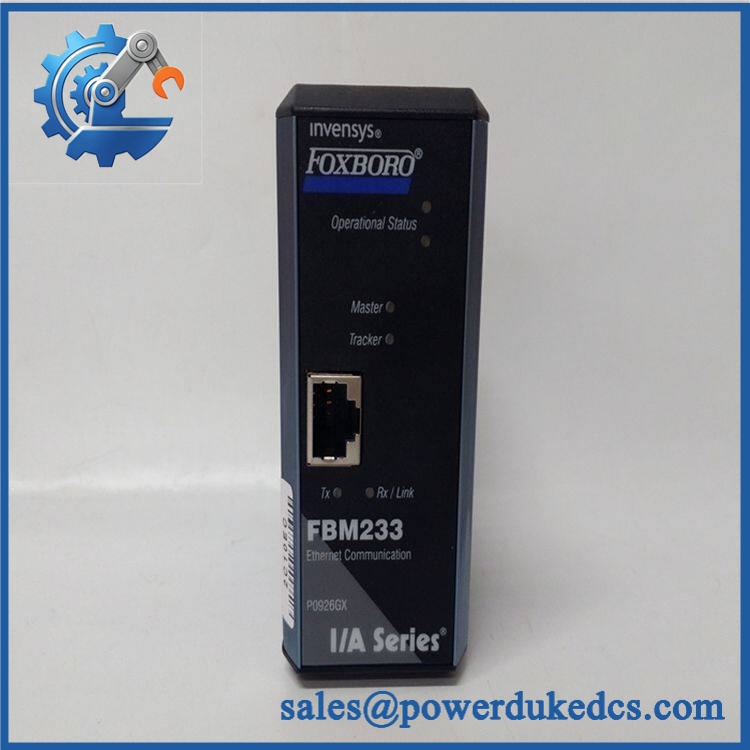
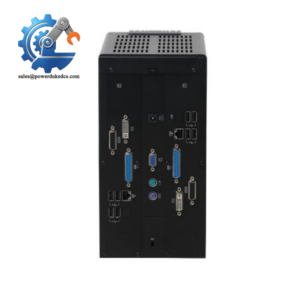
FOXBORO FBM233 P0926GX
Module 4: Application Scenarios & Field Realities
- For packaged skids using Ethernet-enabled instruments, FBM233 provides the bridge from the device network into the Foxboro control architecture. A common deployment uses an industrial Ethernet switch or hub, with external devices connected to the network and the FBM itself linked to the Foxboro fieldbus.
- Where redundant communication is required for a continuous process, two modules can operate as Master and Tracker. Role switching is automatic when the configured I/O driver detects loss of the required heartbeat or other defined communication condition.
- On systems with a large number of Ethernet field devices, the architecture can scale through Ethernet switches. Foxboro documentation describes up to 64 devices per , with the actual number depending on performance and driver limitations.
- During cabinet replacement or expansion, network distance must be checked as part of the installation. Foxboro specifies 1 m to 100 m between the and the associated hub, switch, or device, using an RJ-45 connection. Cable routing, switch configuration, and network segmentation still need to follow the site design.
Module 5: Migration, Compatibility & Installation Traps
Replacement Matrix
Replacement classification: Drop-in Replacement when the existing installation uses P0926GX with the same baseplate, fieldbus architecture, Ethernet topology, and supported driver configuration.
Software compatibility: Configuration verification required. depends on the Foxboro I/O driver for device data types, DCI mapping, device capacity, communication behavior, and control-station integration. Replacing the hardware does not remove the need to verify the existing I/O database and driver configuration.
Cross-model replacement: Not automatically interchangeable. Different Foxboro Ethernet FDSI modules can have different device capacity, network architecture, protocol support, or hardware-generation requirements. Match the complete part number and system documentation before substitution.
Field Traps — Watch Out
1. Do not treat as a generic Ethernet card. The RJ-45 connection is only one side of the architecture. The module also depends on the redundant 2 Mbps module Fieldbus and the associated FCM100Et, FCM100E, or FCP270. A network link test alone does not prove system compatibility.
2. Verify Master/Tracker configuration when redundancy is installed. A redundant pair is not created simply by installing two modules. The associated driver, field-device topology, and network connections must correspond to the intended redundancy architecture. Foxboro documentation describes one module as Master and the other as Tracker, with automatic role switching under defined fault conditions.
3. Check device count and DCI loading. The published maximum is 64 devices and up to 2,000 DCI connections, but the actual supported configuration is performance-dependent and driver-specific. A replacement module should be evaluated against the existing device count rather than only the number of RJ-45 connections.
4. Validate the 24 VDC supply at the module. The specified range is 24 VDC +5%/-10%. A nominal cabinet voltage measurement can hide voltage drop at the module terminals, especially after long distribution runs or through aging terminal hardware.
Module 6: Quality Assurance SOP
Pre-Shipment Inspection Protocol for FOXBORO P0926GX
- OEM identity inspection: Verify Foxboro marking, exact designation, P0926GX part number, hardware revision, serial information, and visible identification labels.
- Variant verification: Confirm that the unit is specifically P0926GX and not another Foxboro Ethernet or FDSI variant with a similar enclosure.
- Mechanical inspection: Examine the housing, mounting interface, RJ-45 connector, fieldbus interface, retention hardware, labels, and PCB-accessible areas for cracks, deformation, corrosion, contamination, or unauthorized modification.
- Connector inspection: Check the RJ-45 port and module-fieldbus interfaces for oxidation, damaged contacts, contamination, broken latches, or mechanical looseness.
- Power-on verification: Install the module in a compatible Foxboro baseplate/test system and apply a controlled 24 VDC supply within the specified tolerance while monitoring startup current and abnormal temperature rise.
- Ethernet link test: Connect a known-good switch or field-device simulator and verify 10 Mbps and 100 Mbps operation where the test environment supports both speeds.
- Protocol verification: Exercise representative TCP/IP or UDP/IP traffic and verify stable packet exchange without unexpected link drops or module resets.
- Redundancy test: Where a second and suitable Foxboro test environment are available, verify Master/Tracker operation and controlled role switching under the applicable test conditions.
- Fieldbus handshake verification: Confirm communication between the and the associated FCM100Et, FCM100E, or FCP270 through the redundant 2 Mbps module Fieldbus.
- Device simulation: Connect representative Ethernet device simulators and verify correct device discovery, data transfer, and DCI mapping through the applicable Foxboro driver.
- Thermal observation: Operate the module under representative network traffic and monitor for abnormal heat generation, communication instability, or intermittent resets.
- Final QC record: Record model, part number, hardware revision, supply voltage, Ethernet link results, protocol test results, redundancy results where applicable, fieldbus status, test date, and inspector approval.
- ESD-controlled packaging: Package the module in an ESD-safe bag with connector protection and mechanical cushioning to prevent PCB flex, RJ-45 damage, contamination, and impact during shipment.
Procurement note: P0926GX is an Ethernet Field Device System Integrator module, not an analog I/O card. Schneider Electric’s published specifications identify 10/100 Mbps Ethernet, TCP/IP or UDP/IP, redundant 2 Mbps module Fieldbus communication, 24 VDC +5%/-10% input, 7 W maximum consumption, and support for up to 64 devices with up to 2,000 DCI connections.



 Start Chat