

Description
- Brand: GE Fanuc / GE
- Full Model Number: IC660BBA106
- System/Series Family: Genius I/O
- One-Sentence Core Function: Six-channel isolated current-source analog input block for 4–20 mA process signals
- Top 3 Hardcore Specs: 6 isolated inputs; 4–20 mA signal range; 1 µA resolution
- Block Type: Current-source Analog Input Block
- Input Channels: 6
- Input Signal: 0–20 mA / 4–20 mA
- Current-Loop Supply: 24 VDC supplied by each input circuit
- Channel Isolation: Individually isolated
- Nominal Block Power: 115 VAC / 125 VDC
- Power Input Range: 93–132 VAC / 105–145 VDC
- Conversion Time: Approximately 16.6 ms to 400 ms, user selectable
- Input Accuracy: Approximately 0.1% of full reading
- Channel-to-Channel Isolation: 1500 VAC RMS
- Terminals: 32
- Status LEDs: Unit OK / I/O Enabled
- Stock Status: New Surplus / Fully Tested Refurbished subject to availability
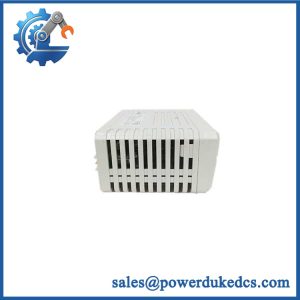
GE Genius I/O documentation identifies IC660BBA106 as a 115 VAC / 125 VDC Current-source Analog Input Block with six isolated 4–20 mA input circuits. Each input provides loop power, while conversion time can be selected to trade response speed against resolution and noise rejection.
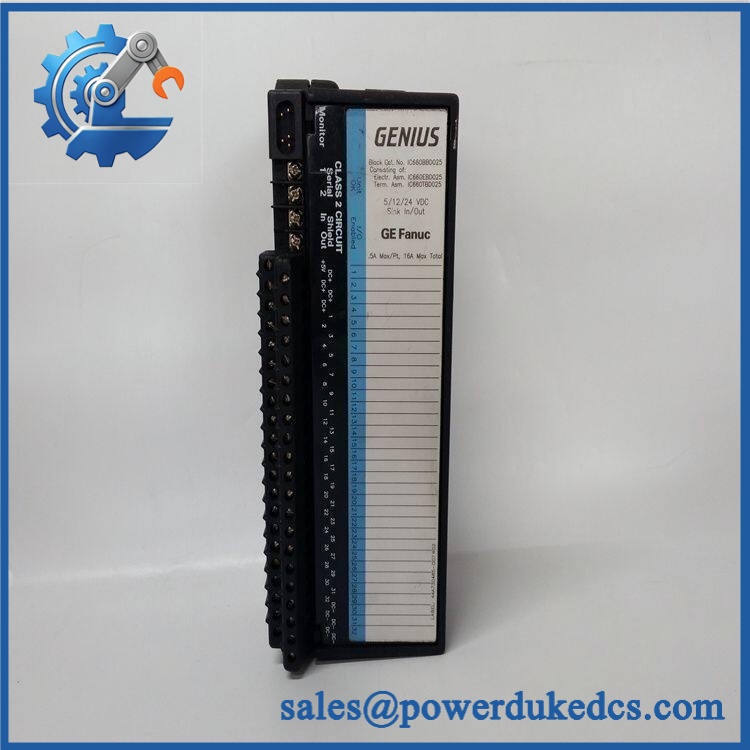
GE IC660BBA106
Module 3: Commercial-Technical Deep Dive
A failed IC660BBA106 can remove six process-current measurement channels from a legacy Genius I/O network while the controller and remaining blocks continue operating. The GE IC660BBA106 is specifically a current-source analog input block, not an analog output module. It provides six individually isolated current inputs for standard 0–20 mA and 4–20 mA instrumentation. Each input circuit supplies the required 24 V current-loop excitation, converts the analog current into digital data, and transfers that information to the controller across the Genius bus. This architecture is well suited to transmitters, signal conditioners, VFD feedback, dampers, panel meters, and similar process devices.
The conversion-time setting is important in real installations. GE documentation describes programmable conversion from roughly 16 ms to 400 ms, allowing the application to select faster updates or greater noise rejection and resolution; at the longer conversion setting, documented resolution reaches 1 µA. The block uses a 115 VAC / 125 VDC nominal supply, with an operating input range of 93–132 VAC or 105–145 VDC. Each of its six current-input circuits is isolated, with published channel-to-channel isolation of 1500 VAC RMS. That means the replacement must be checked against both the field-loop architecture and the legacy Genius power arrangement—not merely the number of terminals.
Module 4: Compatibility & Installation Traps
Migration/Compatibility
- System: GE Genius I/O
- Full Model: IC660BBA106
- Module Type: Current-source analog input block
- Input Channels: 6
- Input Range: 0–20 mA / 4–20 mA
- Input Resolution: Up to 1 µA at the applicable conversion setting
- Input Isolation: Individual channel isolation
- Loop Excitation: 24 VDC supplied by each current-input circuit
- Nominal Block Power: 115 VAC / 125 VDC
- Power Input Range: 93–132 VAC / 105–145 VDC
- Genius Architecture: Genius bus block
- Configuration: Genius block configuration includes conversion timing, alarm limits, diagnostics, and network-related parameters
- Replacement Type: Exact IC660BBA106 revision match preferred
- Logic Rewrite: Normally not required for a like-for-like block replacement, but Genius configuration and controller scaling must be verified
⚠️ Field Traps (Watch Out)
1. Do not mistake for an analog output block.
The BBA106 is a current-source analog input block with six current inputs. GE’s documentation specifically differentiates the BBA106 from current-source analog output hardware.
2. The field loop is powered by the input block.
Each input circuit provides a 24 V current-loop supply. Before connecting a replacement, verify whether the field transmitter is intended to use the block’s loop power or an external supply. Incorrect loop-power wiring can damage instrumentation or produce an invalid current reading.
3. Verify the block’s AC/DC supply before energization.
is the higher-voltage version of this Genius analog-input architecture, using 115 VAC / 125 VDC nominal power. It should not be confused with the 24/48 VDC IC660BBA026, despite the similar current-input function.
4. Record conversion time and alarm configuration.
The module’s conversion time influences response, filtering, and resolution. GE documentation also supports programmable upper and lower alarm limits. Replacing the hardware without preserving those parameters can change field behavior even when the 4–20 mA measurements look correct.
5. Check the Genius bus configuration before condemning the block.
A replacement can pass a local electrical test but remain offline if its Genius bus address, communication configuration, or block parameters do not match the existing controller project.
Module 5: Quality Assurance SOP
Each available GE should undergo a documented Genius I/O inspection and functional test before shipment:
- OEM anti-counterfeit visual inspection: Verify GE/Genius I/O identification, complete catalog number, board/block labeling, terminal markings, connector arrangement, and manufacturing identifiers.
- Revision verification: Record the physical hardware revision, including any K/L/M/N-series suffix where present.
- Module condition inspection: Check the enclosure, terminals, mounting hardware, bus connections, and status indicators for physical damage.
- PCB condition inspection: Inspect accessible electronics for corrosion, contamination, cracked components, thermal discoloration, damaged traces, and previous repair evidence.
- Power-input precheck: Perform controlled resistance and continuity measurements before applying 115 VAC or 125 VDC.
- Power-on self-test (POST): Energize the block using an approved Genius I/O test fixture and verify Unit OK and I/O Enabled status.
- Genius bus handshake verification: Connect the block to a controlled Genius bus and verify controller recognition at the assigned test address.
- Loop-power verification: Measure the current-loop supply provided by representative channels under controlled laboratory conditions.
- Channel-by-channel input test: Test all six analog inputs individually.
- 4–20 mA verification: Apply calibrated 4 mA, 12 mA, and 20 mA signals and verify the corresponding digital values.
- 0–20 mA verification: Where supported by the approved configuration, test representative 0–20 mA operation.
- Resolution test: Verify measurement resolution against the selected conversion-time configuration; documented resolution can reach 1 µA at the applicable setting.
- Conversion-time test: Verify representative fast and slow conversion settings within the documented approximately 16.6 ms to 400 ms range.
- Isolation test: Perform the approved low-voltage isolation verification between representative channels and logic-side circuitry.
- Alarm test: Configure controlled upper and lower limits and verify the module reports the corresponding diagnostic condition.
- Open-wire test: Simulate an applicable open-input condition and verify the expected diagnostic response.
- Data integrity test: Confirm six-channel values are correctly transmitted to the Genius bus master.
- Final QC record: Record catalog number, hardware revision, Genius address, conversion time, channel measurements, alarm settings, isolation results, and technician sign-off.
- ESD-safe packaging: Package the unit in protective material with mechanical support around the terminal and bus interfaces.
For this module, the strongest outgoing test evidence is six-channel calibrated current injection plus Genius-bus verification. A board that only powers on does not demonstrate that the current-loop supplies, analog converters, isolation barriers, or network data path are functioning correctly.
Module 6: CRO-Driven Buyer FAQ
What is GE ?
GE is a Genius I/O current-source analog input block with six isolated analog-input channels. It accepts standard current signals, including 4–20 mA, and communicates the converted values to a Genius I/O controller.
Is a 4–20 mA input or output module?
It is an input module. The six channels accept 0–20 mA or 4–20 mA signals. Each channel also provides current-loop excitation, which is why the module is described as a current-source input block.
What power supply does require?
The nominal block supply is 115 VAC / 125 VDC, with a documented input range of approximately 93–132 VAC or 105–145 VDC. Do not substitute the similar 24/48 VDC IC660BBA026 without verifying the system architecture.
How many analog channels are on ?
There are six individually isolated current-input channels. GE documentation identifies a 24 V loop supply for each input circuit and programmable conversion timing from approximately 16 ms to 400 ms.
Is obsolete?
The module is part of the legacy GE Genius I/O product family, and current industrial automation inventories commonly classify it as discontinued. That makes exact revision identification important; documented variants include IC660BBA106K, L, M, N, and N1.
Can be replaced while the Genius system is powered?
Do not assume live replacement is permitted. The block carries a potentially hazardous 115 VAC / 125 VDC supply and field-loop wiring. Follow the site’s electrical isolation procedure and the applicable Genius I/O maintenance procedure before removing the block.
What should I verify before ordering ?
Confirm the complete identifier and hardware revision, Genius bus address, 115 VAC/125 VDC supply arrangement, six-channel current-input wiring, loop-power arrangement, conversion-time setting, alarm limits, and controller configuration. For a legacy installation, a photograph of the existing block label is useful for revision matching.
What warranty and technical support should I expect?
Warranty duration should be stated for the exact unit condition and test status on the quotation. Technical support should cover part-number and revision verification, Genius bus compatibility, current-loop wiring review, six-channel analog testing, configuration checks, and documented bench-test results. Process-loop commissioning and Genius controller programming should be treated separately unless explicitly included.



 Start Chat