

Description
- Model & Brand: GE Fanuc IC693CPU351DH, Series 90-30 Model 351 CPU. The suffix DH represents a hardware/firmware revision designation used on later CPU351 versions; GE documentation explains that two-letter CPU suffixes identify hardware and firmware revisions.
- Physical Dimensions: Approx. 36 × 130 × 135 mm (W × H × D) based on commonly published dimensional data; verify against the actual unit before designing custom packaging.
- Estimated Shipping Weight: Plan around 0.9–1.0 kg for the module itself. Published figures vary from approximately 0.91 kg to 0.94 kg, while some supplier records list lower net weights; use the actual packed weight for freight documentation.
- Mounting Format: Single-slot Series 90-30 CPU module installed directly into the compatible modular CPU baseplate.
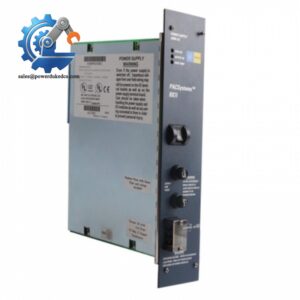
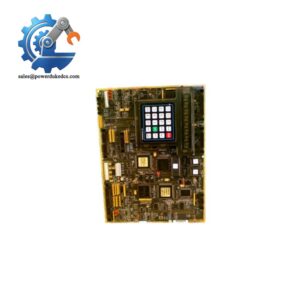
- Visible Hardware: Front status indicators, ON/RUN and OFF/STOP key switch, memory-protection function, and the CPU’s RS-232 Port 1 / RS-485 Port 2 interfaces.
- What’s in the Box: CPU module as quoted. Original terminal blocks are not part of the CPU itself; the module interfaces with the PLC baseplate and associated power-supply architecture. A grounding wire or grounding bracket may be supplied depending on the specific sales package (verify lot contents before shipment).
- Packaging Recommendation: Preserve the original ESD shielding bag and use rigid cushioning around the front connector area and retaining features.
Product Introduction
Within a GE Fanuc Series 90-30 PLC, the IC693CPU351DH occupies a single CPU slot on the modular baseplate and serves as the central processor for the control application. It is built around an 80386EX processor running at 25 MHz, with three serial communication paths and support for up to seven expansion or remote I/O baseplates.
From an asset-management perspective, this is a legacy control component where revision identity matters. The CPU351 family progressed through numerous suffix combinations, including CD, DF, DH, DJ, EK, FN, GP, GR, GT, HT, JT, and KT, so purchasing “IC693CPU351” without confirming the complete suffix can create an avoidable firmware or configuration mismatch.
Core Technical Specifications
| Parameter | Value |
|---|---|
| Manufacturer | GE Fanuc / General Electric |
| Model | IC693CPU351DH |
| PLC Family | Series 90-30 |
| CPU Type | Single-slot modular CPU |
| Processor | 80386EX |
| Processor Clock | 25 MHz |
| Power Requirement | +5 VDC |
| Current Draw | Approx. 890 mA |
| Approx. DC Power at CPU Rail | 4.45 W |
| User Program Memory | Up to 240 KB with firmware Release 9.0+ |
| Earlier User Memory | 80 KB with firmware before Release 9.0 |
| Typical Scan Rate | Approx. 0.22 ms per 1K Boolean logic |
| Discrete Inputs | 2,048 %I |
| Discrete Outputs | 2,048 %Q |
| Analog Input Memory | Up to 32,640 %AI words |
| Analog Output Memory | Up to 32,640 %AQ words, depending on configured memory allocation |
| Internal Coils | 4,096 %M bits |
| Temporary Coils | 256 %T bits |
| Global Memory | 1,280 %G bits |
| System Status | 128 %S bits |
| Register Memory | Up to 32,640 %R words, subject to memory allocation |
| Serial Communications | 3 serial paths |
| Port 1 | RS-232 |
| Port 2 | RS-485 |
| Power-Supply Serial Port | SNP/SNPX slave support |
| Expansion Capacity | Up to 7 additional expansion and/or remote baseplates |
| Memory Storage | RAM and Flash |
| Battery-Backed Clock | Yes |
| Override | Yes |
| Floating-Point Math | Firmware-based support in Release 9.0+ |
| Operating Temperature | 0 to 60°C (32 to 140°F) ambient |
| Approx. Dimensions | 36 × 130 × 135 mm |
| Approx. Module Weight | 0.9–1.0 kg planning range |
GE’s Series 90-30 hardware documentation specifies 890 mA from the +5 VDC supply, a 25 MHz 80386EX processor, a 0.22 ms/1K Boolean-logic scan figure, and the firmware-dependent 80 KB/240 KB memory distinction.
For heat calculations, the CPU’s nominal electrical load is approximately 4.45 W at the 5 V rail based on 5 V × 0.89 A. That figure is useful for cabinet thermal assessment, but it should not be interpreted as a complete cabinet heat-loss calculation because the rack power supply and neighboring modules contribute their own dissipation.
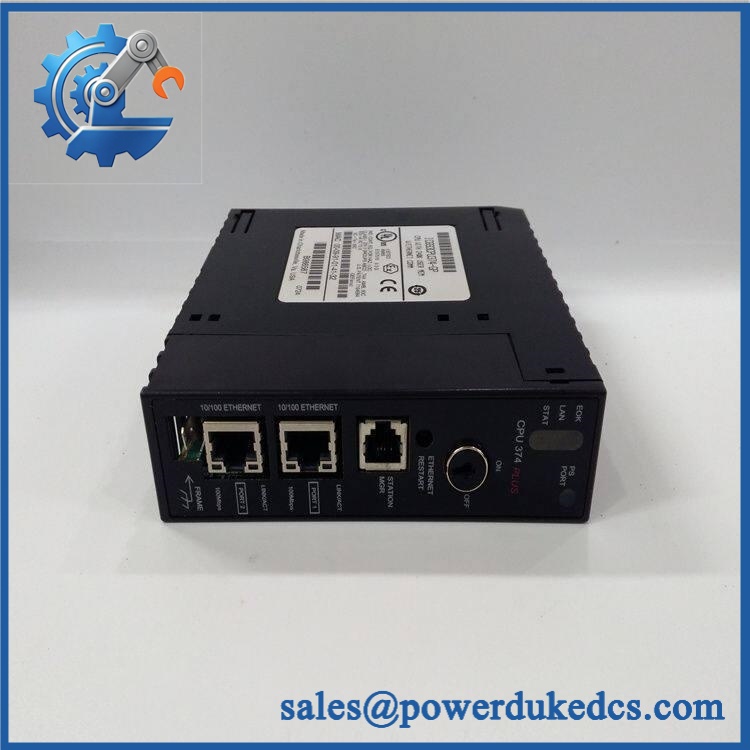
GE IC693CPU351DH
🚨 Global Compliance & Industry Certifications
For the Series 90-30 CPU351 product family, documented revision history shows regulatory additions over the product’s development:
- CE Mark: Revision CD is specifically identified with CE Mark approval in the published CPU351 revision history.
- UL / C-UL Class I, Division 2: The same revision history identifies DD with C-UL and UL Class I, Division 2 approval.
- ATEX / IECEx: These should not be assumed for an IC693CPU351DH merely because another industrial PLC carries such markings. The published documentation reviewed here does not establish ATEX or IECEx approval for this exact DH lot.
- Marine approval: DNV GL or other marine classification should likewise be treated as lot-specific and application-specific, not as a standard attribute of the CPU351DH.
A Class I, Division 2 approval can be significant in facilities handling flammable gases or vapors because the certified equipment is evaluated for use in defined hazardous-location conditions. Do not substitute an uncertified spare where the installed control cabinet relies on the certification basis.
Verify specific lot certifications with OEM.
For audit records, photograph the actual nameplate and certification markings before shipment. The certificate number, revision, and manufacturing traceability should remain attached to the asset record.
🚨 Long-Term Storage & Asset Preservation Guide
Keep the CPU in its original ESD shielding bag whenever possible. The exposed edge connectors and internal electronics should not be left on open warehouse shelving where electrostatic discharge, dust, or condensation can accumulate. This is especially important when the spare may remain untouched for several years.
Control humidity, not just temperature. A clean, dry storage environment at approximately 40–60% RH, non-condensing, is a practical warehouse target. Avoid rapid movement between an air-conditioned store and a hot loading area; condensation on the metal chassis and PCB surfaces can occur before the unit reaches ambient temperature.
Manage the battery-backed-clock risk separately. The Series 90-30 architecture uses battery backup for clock/memory retention, and the manuals contain dedicated battery-replacement procedures. For a long-held spare, inspect the battery condition and date code during periodic asset audits rather than allowing a decades-old battery to remain unchecked.
Check the date code.
Record the firmware revision.
Repeat the visual inspection before every redeployment.
Physical Installation Prerequisites
The CPU351DH is a rack-mounted Series 90-30 module, not a DIN-rail device. Installation requires the correct modular CPU baseplate and a properly seated card edge connection.
GE’s installation documentation specifies baseplate mounting orientation and cooling allowances. For the Series 90-30 modular baseplates, the documented mechanical envelope includes approximately 4 inches / 102 mm of allowance for cooling around the baseplate assembly rather than treating the CPU card as an isolated free-air component.
Maintain these physical controls:
- Mount the CPU in the correct Series 90-30 CPU baseplate slot and engage the retaining hardware fully.
- Keep the cabinet oriented as specified by the GE installation documentation so convection cooling is not obstructed.
- Allow the documented rack clearances; do not place cable ducts, terminal strips, or sheet-metal barriers directly against cooling paths.
- Maintain a low-impedance protective ground. GE’s installation documentation specifically addresses attaching a grounding wire or using a grounding bracket for the CPU351/352 assembly.
- Before inserting the module, inspect the card-edge contacts and the baseplate connector for oxidation, contamination, or bent mechanical components.
- Confirm that the CPU key switch and memory-protection setting match the approved commissioning procedure.
Do not force the retaining clips. A connector that seats with abnormal mechanical resistance should be investigated rather than pressed into place.
Buyer’s FAQ — Logistics & Compliance Focus
Q1. Which HS Tariff Code should I use for IC693CPU351DH?
A commonly published classification for the broader IC693CPU351 family is HS 853710 for electrical control equipment, with some suppliers using more specific national tariff extensions such as 8537101190. However, HS classification varies by jurisdiction and customs interpretation.
For a commercial shipment, have the importer or customs broker confirm the final national tariff code based on the actual product description, import country, and local tariff schedule.
Q2. What should I declare as the Country of Origin?
Do not infer COO solely from the brand name. Supplier records commonly identify the IC693CPU351 as USA origin, but the commercial declaration should be supported by the actual unit label, manufacturer documentation, and applicable supply-chain records.
For audit-sensitive shipments, keep the COO statement consistent across the commercial invoice, packing list, certificate of origin, and customs entry.
Q3. Do I need shipping insurance for one CPU module?
For a single module, cargo insurance is inexpensive relative to the cost of an emergency replacement and the potential downtime associated with impact damage. Use rigid outer packaging, ESD protection, internal cushioning, and a declared shipment value that matches the commercial documentation.
Photograph the package before dispatch. Those records can become useful evidence when a carrier damage claim involves crushed cartons, broken retaining hardware, or connector impact.
Q4. Does the IC693CPU351DH include the latest firmware pre-loaded?
Not necessarily. DH is a specific hardware/firmware revision combination, and the Series 90-30 documentation explains that the two-letter suffix format identifies hardware and firmware revisions.
For this reason, the receiving engineer should verify the exact firmware revision on the physical CPU rather than assuming that every carries the latest possible Series 90-30 firmware. Also note the important memory threshold: firmware Release 9.0 and later supports up to 240 KB of user program memory, while earlier firmware versions have an 80 KB fixed allocation.
Asset-control recommendation: Record the complete catalog number, suffix, serial number, firmware revision, battery condition, certification markings, and incoming inspection result in the warehouse asset register. That five-minute record can prevent a much longer compatibility investigation during a shutdown.



 Start Chat