

Description
- Brand: GE Fanuc / GE Series 90-30
- Full Model Number: IC693CPU374-HX
- Lifecycle Status: Legacy / Obsolescence-risk
- Core Function: Single-slot PLC CPU with embedded Ethernet interface
- Top 3 Technical Specs: 133 MHz Embedded 586 | 240 KB total user memory | Dual 10/100Base-T/TX Ethernet ports
- Stock & Condition: Physical stock confirmation required | New Surplus / Tested Refurbished by lot | Emergency dispatch subject to order cutoff
Module 3: Obsolescence & Supply Chain Deep Dive
A failed CPU on a GE Series 90-30 installation can stop the entire control sequence, particularly when the maintenance team has no verified spare on the shelf. The documented IC693CPU374 is a single-slot CPU with embedded Ethernet, a 133 MHz Embedded 586 processor, 240 KB total user memory, and two 10/100Base-T/TX Ethernet ports supporting SRTP and Ethernet Global Data. The IC693CPU374-HX designation should be checked against the physical nameplate and revision marking before shipment, because the primary technical documentation identifies the base catalog number as IC693CPU374, while published firmware notices distinguish later hardware revisions such as -BG and later.
For an operating 90-30 rack, preserving the installed CPU architecture can have a lower TCO than migrating the whole PLC platform. The CPU374 provides 240 KB memory, hardware floating-point math, integrated Ethernet, and support for up to eight Series 90-30 baseplates, so a verified replacement can avoid application redevelopment, panel changes, field rewiring, and a larger commissioning scope. The power requirement also matters: the CPU374 is specified at approximately 7.4 W from 5 VDC, and the documentation recommends a high-capacity power supply. (For legacy CPUs, surplus inventory can materially reduce sourcing time versus waiting for a special-production or repair route.)
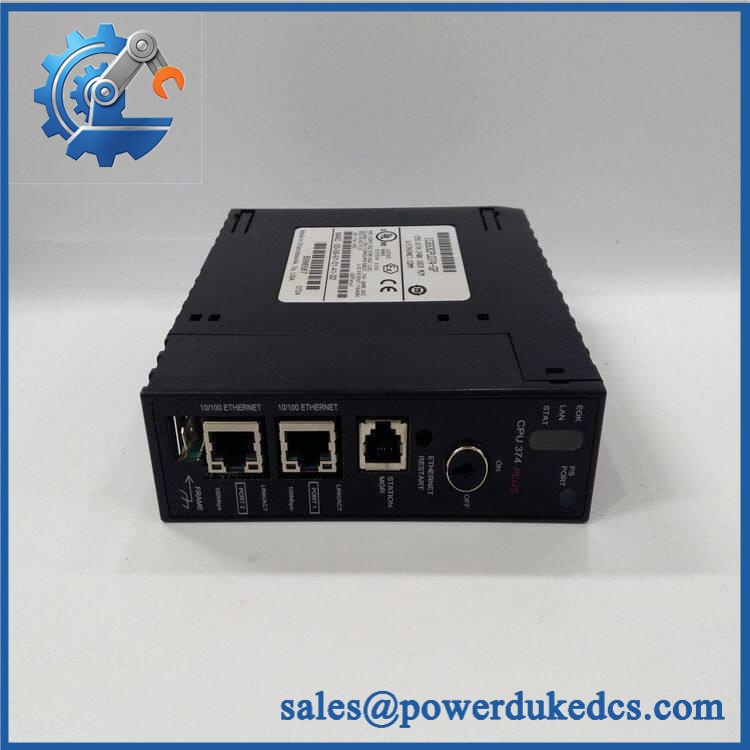
GE IC693CPU374-HX
Module 4: Compatibility & Replacement Matrix
| Purchase Review Item | Engineering Guidance |
|---|---|
| Replacement Classification | Drop-in Replacement — conditional |
| Hardware Modification | Normally none for an exact CPU374 hardware/revision match |
| Software Compatibility | Required verification before installation |
| Firmware Requirement | Match the existing CPU firmware and hardware revision |
| Power Requirement | 5 VDC, approximately 7.4 W; high-capacity Series 90-30 power supply recommended |
| Typical Switch Time | ~2–6 labor hours for controlled replacement and functional verification |
| Typical Engineering Cost | Approximately 300–1,200, excluding outage, travel, and site commissioning |
| Recommended Migration Path | Back up logic/settings → record firmware → photograph hardware identification → verify replacement → install → test Ethernet and PLC operation |
The standard CPU374 documentation specifies 133 MHz, 240 KB total user memory, built-in Ethernet with two 10/100Base-T/TX ports, and a Series 90-30 single-slot architecture. Programming/configuration support includes VersaPro 2.03 or later and CIMPLICITY Machine Edition Logic Developer 2.60 or later; related documentation also specifies Control software 2.50 or later.
Field Traps — Watch Out
- Firmware / hardware revision mismatch: GE’s product-update documentation identifies IC693CPU374-BG and later with CPU firmware 11.10 and states that the new firmware is compatible with previous CPU374 firmware and hardware versions. Do not treat the -HX suffix as interchangeable with every CPU374 revision until the actual nameplate and firmware are verified.
- Power-supply capacity: The requires about 1.48 A at +5 VDC, or 7.4 W, and the documentation recommends high-capacity power supplies. Confirm available 5 VDC capacity after accounting for all installed I/O and communication modules.
Module 5: Quality Assurance & Testing SOP
A strict pre-shipment inspection for an IC693CPU374-HX should include:
- Identity verification: Confirm complete catalog number, suffix, revision marking, serial number, connector layout, and physical label information.
- OEM anti-counterfeit visual inspection: Examine GE/GE Fanuc markings, PCB identification, label construction, connectors, solder condition, component placement, and signs of unauthorized rework.
- Mechanical inspection: Check the housing, backplane connector, mounting hardware, Ethernet ports, serial interface area, and PCB for corrosion, cracks, bent contacts, contamination, or impact damage.
- Power-on self-test (POST): Apply the specified Series 90-30 power arrangement and verify startup diagnostics, CPU status, Ethernet indicators, and absence of persistent fault indications.
- CPU execution test: Load a controlled test program and verify normal logic execution and scan behavior.
- Memory verification: Confirm RAM/Flash operation and verify access to the available CPU memory areas.
- Ethernet test: Test both 10/100 Ethernet ports, link/activity status, IP configuration, and communication using the applicable SRTP or EGD test environment.
- PLC I/O test: Exercise representative discrete and analog data paths through a controlled Series 90-30 test rack.
- Load testing: Run the CPU under sustained operating conditions while monitoring power behavior, temperature, communications stability, and diagnostic status.
- Firmware recording: Document CPU firmware and hardware revision before final release.
- Final QC: Record serial number, inspection results, test data, condition grade, packaging status, and QC authorization.
Module 6: Procurement & Lifecycle FAQ
Is the GE -HX genuinely in stock, and what is the cutoff for emergency shipping?
Physical inventory should be confirmed against the exact nameplate before the PO is released. Emergency dispatch depends on stock location, payment clearance, export documentation, and the carrier pickup schedule. The quotation should state the actual same-day dispatch cutoff.
How do you guarantee the condition and authenticity of an obsolete or surplus ?
Require complete model and serial verification, OEM marking inspection, PCB examination, power-up diagnostics, PLC execution testing, Ethernet communication testing, and documented final QC. For surplus stock, the condition should be explicitly classified as New Surplus or Tested Refurbished.
Are there firmware compatibility issues I should warn my engineers about before issuing the PO?
Yes. documentation identifies multiple firmware and hardware revision stages, including -AC and later and -BG and later revisions. The installed CPU firmware, hardware revision, programming software level, Ethernet configuration, and application backup should be checked before release.
Can the -HX be installed as a direct replacement?
Treat it as a conditional drop-in replacement only after the exact hardware suffix and revision are matched. The underlying architecture is a single-slot Series 90-30 CPU with embedded Ethernet, but revision, firmware, power-supply capacity, and application compatibility still require verification.
What warranty and return terms should procurement require?
The quotation should specify the exact model and suffix, serial traceability, condition grade, pre-shipment test scope, warranty period, DOA coverage, and return authorization process. For a legacy PLC CPU, those records provide a clear basis for evaluating the supplied hardware if an installation issue occurs.



 Start Chat