

Description
- Brand: GE Fanuc / GE Automation
- Full Model Number: IC698RMX016-ED
- System/Series Family: PACSystems RX7i
- One-Sentence Core Function: 16 MB Redundancy Memory Xchange module for deterministic reflective-memory networking and RX7i CPU hot-standby redundancy
- Top 3 Hardcore Specs: 16 MB SDRAM user memory; 2.12 Gbaud optical network speed; 2.1 GB/s transfer rate
- Network Capacity: Up to 256 reflective-memory nodes
- Optical Interface: Fiber-optic transmitter/receiver
- Redundancy Function: Dedicated CPU-to-CPU redundant link
- Configuration: Hardware-configured by the RX7i CPU before normal network operation
- Revision: ED
- Hot Insertion: Supported by the IC698RMX016 family
- Stock Status: New Surplus / Fully Tested Refurbished subject to availability
Module 3: Commercial-Technical Deep Dive
A failed RMX module is not merely a communications fault when it sits inside an RX7i high-availability architecture. The IC698RMX016-ED provides the memory-exchange path used to synchronize critical control information between redundant RX7i CPUs, while the same hardware can operate as a reflective-memory network node when redundancy mode is not selected. GE’s documentation describes the module as a 16 MB Redundancy Memory Xchange device and notes that a redundant RX7i system can use one or two RMX016 modules on each CPU pair. During normal hot-standby operation, control data is transferred between the active and backup CPUs twice per PLC sweep.
For data-intensive reflective-memory applications, the specification is significant: 16 MB of SDRAM is available, the optical network operates at 2.12 Gbaud, and the published transfer rate reaches approximately 2.1 GB/s. A reflective-memory network can contain up to 256 nodes, with data written to one node propagated across the network. That architecture removes repeated polling of remote devices from the application logic and provides deterministic data availability between connected computing nodes. One important limitation: the RMX016 powers up in a non-configured state with its optical transmitter disabled, so a valid RX7i hardware configuration must be delivered before the module participates in network operation.
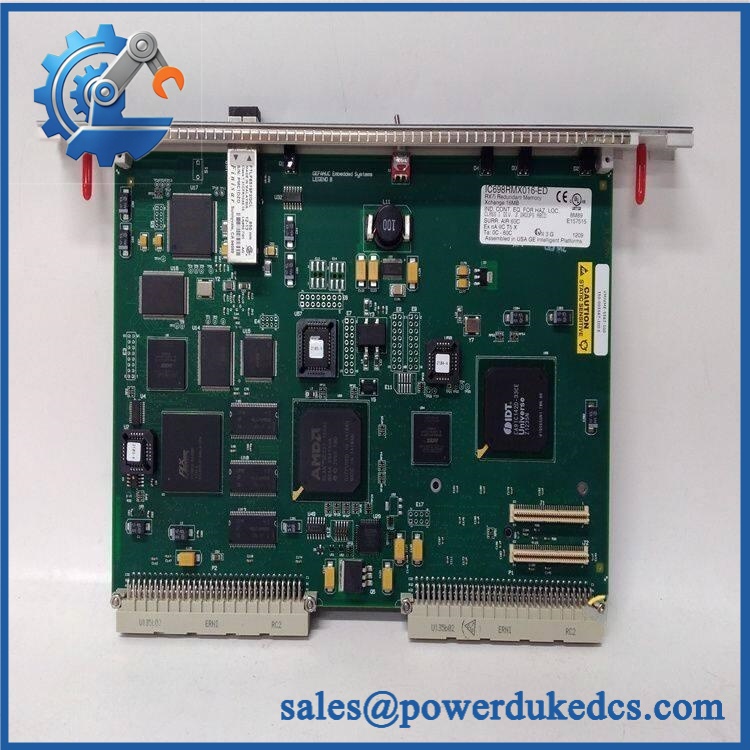
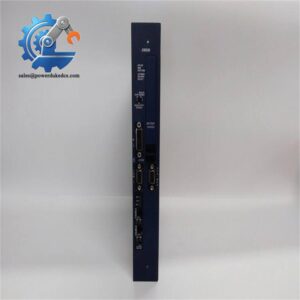
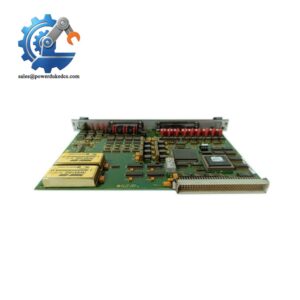
GE IC698RMX016-ED
Module 4: Compatibility & Installation Traps
Migration/Compatibility
- System: Designed for the GE Fanuc PACSystems RX7i platform.
- Primary use: CPU redundancy link for RX7i hot-standby systems or reflective-memory networking when used as a general-purpose memory-exchange node.
- Functional equivalent: When redundancy-link operation is not selected, GE documentation states that the RMX016 is functionally equivalent to the IC698CMX016.
- Configuration requirement: The module must receive hardware configuration from the RX7i CPU before its optical transmitter becomes active. Relevant parameters can include redundancy transfer mode, node ID, network memory offset, rogue-master behavior, and interrupt enable.
- Logic rewrite: Normally not required solely because an RMX016-ED is being replaced with another compatible RMX016 revision; the existing RX7i hardware configuration remains the governing reference.
- Revision check: Verify the suffix before shipment and installation. The documented revision sequence includes AA, BA, CB, DC, and ED; IC698RMX016-ED corresponds to hardware revision E with firmware revision D in the published release history.
⚠️ Field Traps (Watch Out)
1. Do not diagnose a dark optical link as a failed board immediately.
A newly installed RMX016 initially powers up with its optical transmitter disabled until the RX7i CPU supplies the appropriate hardware configuration. Check the project configuration and download status before replacing the module again.
2. Redundancy mode and general reflective-memory operation are not interchangeable configurations.
The RMX module can be configured as a Redundancy Only Link or a communications/reflection-memory link. When the redundancy link function is enabled, several network parameters are controlled by the CPU rather than being independently configurable. A configuration copied from a CMX application therefore requires a deliberate review before use on an RMX module.
3. Fiber topology matters.
Reflective-memory nodes are connected in a daisy-chained optical loop, with each transmitter connected to the receiver of the next node. A reversed TX/RX connection, damaged fiber, or broken loop can present as a communications failure even when the RMX hardware itself passes bench testing.
Module 5: Quality Assurance SOP
Each available IC698RMX016-ED should be processed through a traceable hardware inspection and functional test before shipment:
- OEM anti-counterfeit visual inspection: Verify GE identification markings, catalog number, revision suffix, PCB layout, connector construction, component population, and front-panel labeling against the IC698RMX016 reference documentation.
- Revision verification: Confirm the physical unit is specifically marked , not merely without revision traceability.
- PCB condition inspection: Check for corrosion, cracked components, contaminated surfaces, lifted components, damaged connectors, fiber-interface damage, and signs of previous repair.
- Power-stage inspection: Verify suitability for the RX7i 5 VDC system environment and inspect power-related circuitry before functional testing. Published documentation identifies +5 VDC as the operating supply environment for the module.
- Power-on self-test (POST): Install in an approved RX7i test chassis and verify the expected OK, LINK OK, OWN DATA, and SIGNAL DETECT indications under the corresponding test conditions.
- Configuration download verification: Load a controlled RX7i hardware configuration and confirm that the module leaves its initial non-configured condition correctly.
- Communication handshake verification: Establish a controlled fiber-optic connection and verify transmitter/receiver activity, link recognition, and reflective-memory data exchange.
- Redundancy test where applicable: For RMX hardware intended for hot-standby service, verify the configured redundancy link and confirm expected local/remote READY and ACTIVE indications.
- Data integrity check: Write controlled test data to the reflective-memory test network and verify propagation to the designated receiving node.
- Final QC record: Record catalog number, revision, serial/trace information where available, test fixture, configuration file, test results, and technician sign-off.
- ESD and fiber protection: Package the module in ESD-safe material and protect the optical transceiver from contamination or impact during transit.
The RX7i documentation provides separate LED indicators for general module status, link/configuration status, local and remote redundancy states, own-data reception, signal detection, and optical TX/RX activity. Those indicators make a meaningful pre-shipment functional test possible rather than relying on visual inspection alone.
Module 6: CRO-Driven Buyer FAQ
Is the GE -ED obsolete?
The belongs to the legacy PACSystems RX7i platform and is no longer a current-generation module. Current replacement sourcing therefore depends on exact hardware revision, application architecture, and available compatible inventory. The documented revision family includes AA, BA, CB, DC, and ED.
What is the difference between the and IC698CMX016?
The is specifically intended for RX7i CPU redundancy and can also operate as a reflective-memory node. GE states that when the is not being used as a redundancy link, it is functionally equivalent to the IC698CMX016. For a live redundancy system, however, the RMX designation and the configured redundancy role are critical.
Does the -ED support hot insertion?
The family is documented as supporting hot insertion. That does not eliminate site-level electrical and process controls. Before removing or inserting a module in a production RX7i installation, follow the plant’s approved maintenance procedure and confirm the redundancy architecture is in the expected state.
Why does a replacement power up but fail to communicate?
A common cause is configuration rather than hardware. The module initially powers up without its optical transmitter enabled and requires the RX7i CPU to provide hardware configuration. Verify the project configuration, redundancy-transfer setting, node configuration, memory offset, and fiber TX/RX topology before condemning the replacement module.
What warranty and technical support should I expect when?
Warranty duration should be stated on the quotation for the exact unit condition—new surplus, refurbished, or tested spare—rather than assumed from the GE model number. Technical support should cover part-number verification, revision matching, configuration review, installation guidance, and test documentation. Application-level PLC logic changes or OEM engineering support should be treated separately unless explicitly included in the commercial terms.




 Start Chat