

Description
- Brand: GE / General Electric
- Full Model Number: IS220PDOAH1A
- System/Series Family: GE Mark VIe Distributed I/O
- Core Function: Discrete output I/O pack interfacing one or two I/O Ethernet networks with relay-output terminal boards
- Output Capacity: Up to 12 relay channels per I/O pack
- Network Interfaces: 2 × RJ45 Ethernet ports
- Power Input: 28 VDC via 3-pin connector
- Field Interface: DC-37 connector to compatible terminal board
- Compatible Terminal Boards: TRLYH1B, TRLYH1C, TRLYH1D, TRLYH1E, TRLYH1F; selected SRLY boards
- Control Modes: Simplex, Dual, or TMR depending on terminal-board/application configuration
- Diagnostics: PWR, ATTN, LINK, TxRx status indicators; IR service interface
- Typical I/O Response: Approximately 6 ms from Ethernet command to output
- Stock Status: New Surplus / Fully Tested Refurbished — verify revision, terminal board pairing, and test records
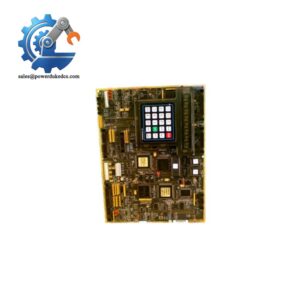
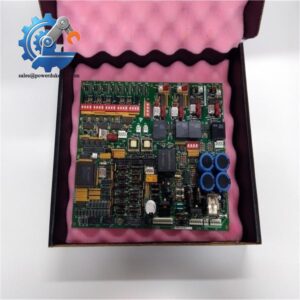
GE’s Mark VIe hardware guide identifies IS220PDOAH1A as the PDOA Discrete Output Pack, capable of controlling up to 12 relays and receiving terminal-board-specific feedback. The pack uses dual RJ45 Ethernet interfaces, a 3-pin 28 VDC power input, and a DC-37 connection to the associated terminal board.
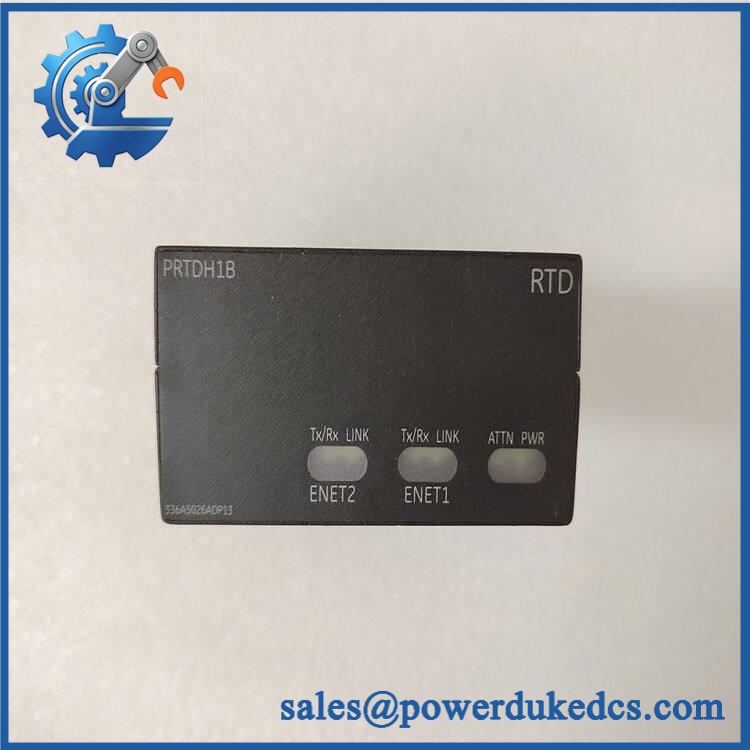
GE IS220PDOAH1A
Module 3: Commercial-Technical Deep Dive
A failed output I/O pack can remove commands to multiple field relays at once, making a turbine control fault appear much larger than a single electronic module failure. The GE IS220PDOAH1A sits between the Mark VIe I/O Ethernet network and the relay-output terminal board. GE specifies support for up to 12 relay channels, with electromagnetic-relay and solid-state-relay configurations determined by the mating terminal board. The pack receives control data through one or two Ethernet connections and passes the output and feedback signals through its DC-37 interface.
The practical ROI comes from replacing the I/O processing layer without disturbing the complete Mark VIe field wiring architecture. GE documents an I/O-pack response of approximately 6 ms from Ethernet command to output, while the terminal-board identification hardware allows the processor to verify the correct board pairing during initialization. Power management is built into the pack’s 28 VDC input, including soft-start and current limiting. —The relay’s actual load rating depends on the attached terminal board, so the PDOA itself should not be assigned a universal contact-current specification.
Module 4: Compatibility & Installation Traps
Migration/Compatibility
For an existing Mark VIe installation specified for IS220PDOAH1A, the preferred replacement strategy is a like-for-like PDOA I/O pack exchange, provided the terminal board, control mode, hardware revision, and system configuration are compatible.
GE documentation confirms that the H1A PDOA is compatible with specific TRLY terminal boards and is used in Simplex, Dual, and TMR arrangements according to the terminal-board configuration. It is not compatible with the DIN-rail DRLY terminal board family.
No PLC-style logic rewrite is normally associated with replacing the I/O pack itself. The Mark VIe application still needs to recognize the correct hardware and terminal-board identity, and any system-specific configuration should be verified before return to service.
⚠️ Field Traps (Watch Out)
- Terminal-board mismatch: IS220PDOAH1A is approved with specific TRLY configurations, including TRLYH1B, H1C, H1D, H1E, and H1F. It should not be paired with a DIN-rail DRLY board simply because the connector appears similar.
- Simplex versus TMR: A Simplex installation uses one PDOA pack, while a TMR arrangement uses three packs with separate network connections. Do not assume the number of installed packs based only on the PDOA part number.
- DC-37 alignment: The PDOA mounts directly to the terminal board through the DC-37 interface. GE specifies mechanical securing through the threaded inserts; avoid applying side force to the connector during installation.
- 28 VDC supply: The three-pin connector supplies 28 VDC to the pack and associated terminal-board circuitry. Verify polarity and the cabinet power-distribution path before energization.
- Terminal-board load rating: The output current and voltage limits belong to the particular relay terminal board. Verify the attached TRLY variant before validating a field load.
Module 5: Quality Assurance SOP
- OEM anti-counterfeit visual inspection — verify GE identification, IS220PDOAH1A marking, revision, connector layout, LEDs, labels, and evidence of unauthorized modification.
- Part-number reconciliation — photograph the complete part number, revision marking, serial information, and all visible secondary identifiers.
- Mechanical inspection — inspect the DC-37 connector, RJ45 ports, 3-pin power connector, mounting studs, housing, and PCB assembly for cracks, contamination, corrosion, or connector damage.
- Terminal-board compatibility verification — confirm the intended mating board is an approved TRLY/SRLY configuration for the H1A pack.
- Power-on self-test (POST) — apply controlled 28 VDC and verify the expected PWR and ATTN status behavior.
- Ethernet link verification — test ENET1 and ENET2 separately where the application uses both, confirming link and transmit/receive indications.
- DC-37 interface verification — confirm correct identification and signal exchange between the PDOA and a representative terminal board.
- Relay-command verification — command representative output channels and verify the expected terminal-board relay response under a controlled test fixture.
- Feedback verification — confirm that terminal-board-specific feedback signals are correctly recognized by the PDOA. GE specifies that the module uses feedback information from the mating board to monitor relay status.
- Control-mode test — where applicable, verify Simplex, Dual, or TMR operation using the approved Mark VIe test architecture.
- Timing and stability test — verify representative command-to-output behavior and monitor for intermittent Ethernet links, resets, or abnormal thermal behavior.
- Diagnostic verification — confirm PWR, ATTN, LINK, and TxRx indicators respond correctly to controlled normal and fault conditions.
- Final QC release — retain identification photographs, terminal-board pairing information, POST results, communication records, output tests, and packaging inspection documentation.
For a Mark VIe output pack, a green power LED is only the first checkpoint. The meaningful acceptance result is successful Ethernet communication, correct terminal-board identification, verified relay output operation, and stable feedback handling.
Module 6: CRO-Driven Buyer FAQ
1. What is GE ?
is a Mark VIe PDOA Discrete Output I/O Pack. GE documents it as the interface between one or two I/O Ethernet networks and a discrete-output terminal board, with capacity for up to 12 relay channels.
2. Which terminal boards are compatible with ?
GE documents compatibility with the TRLYH1B, TRLYH1C, TRLYH1D, TRLYH1E, and TRLYH1F terminal-board types, as well as specified SRLY configurations. The H1A pack is not intended for the DIN-rail DRLY family.
3. Does support TMR?
Yes. GE documents Simplex, Dual, and TMR arrangements. A TMR configuration uses three PDOA packs, with one I/O network connection associated with each pack.
4. What power does require?
The Mark VIe hardware guide specifies a 28 VDC input through the pack’s 3-pin power connector. The pack includes internal power management with soft-start and current limiting.
5. Can be hot-swapped?
Do not assume hot-swap capability. The pack connects directly to active control-network, DC power, and field-output circuitry. Follow the GE Mark VIe maintenance procedure and site electrical isolation requirements before removing the module.
6. What warranty and technical support should I expect?
The quotation should clearly identify whether the unit is new surplus, unused, or tested refurbished and state the warranty duration. Technical support should cover exact part-number verification, terminal-board compatibility, control-mode verification, Ethernet testing, and documented output-test results. Turbine application changes, protection logic changes, and site commissioning should remain separate engineering activities.


 Start Chat