

Description
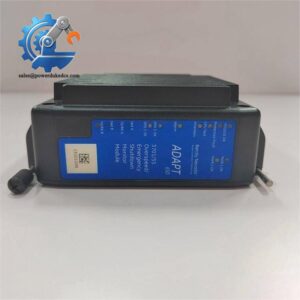
- Model: IS220PVIBH1A 336A4940CSP16
- Brand: GE
- Series: Mark VIe Speedtronic
- Part Type: PVIB Vibration Monitor I/O Pack
- Core Function: Acquires turbine vibration, proximity, seismic, and related speed-reference signals through the TVBA terminal-board architecture.
- Key Capacity: 13 differential input channels
- Network Interface: Two independent 10/100 Ethernet ports
- Signal Rates: 3.125 to 100 Hz, depending on configuration
- Power: 28 VDC nominal
- Environmental Range: Approximately −30°C to +65°C
- Physical Size: Approximately 82.6 × 41.9 × 121.4 mm
- Lifecycle Position: Legacy/obsolete H1A technology, with IS420PVIBH1B identified as the later replacement path.
Product Introduction
Structure B — Technical Direct
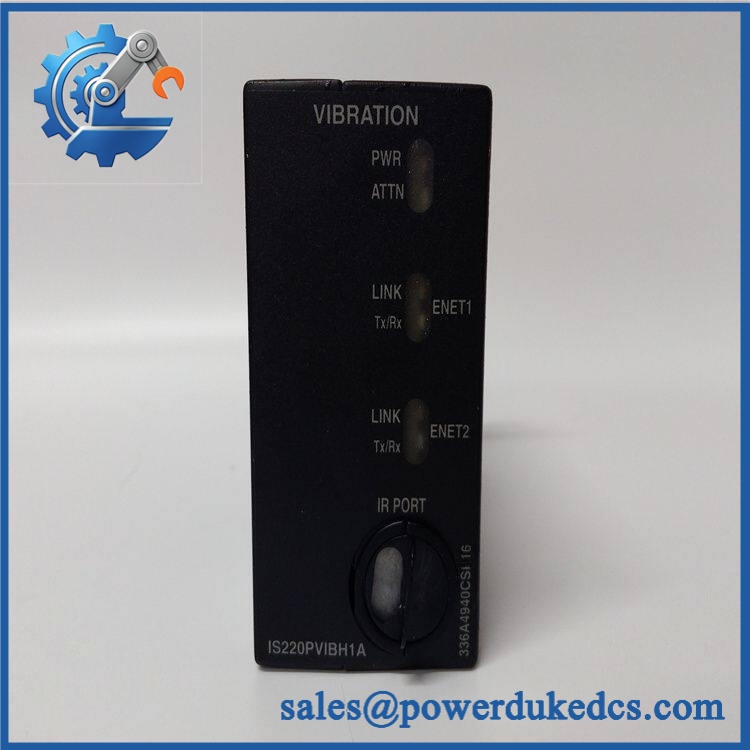
GE IS220PVIBH1A 336A4940CSP16
The pack combines a processor section, acquisition electronics, and the common distributed-I/O architecture used across Mark VIe I/O packs. Depending on channel allocation, it can process proximity probes, Velomitor signals, seismic inputs, supported accelerometers, and a Keyphasor-type input.
The architecture provides 13 differential channels, with channels 1–8 supporting a broader range of vibration sensor types, channels 9–12 dedicated to proximity applications, and channel 13 supporting Keyphasor or proximity service. For an installed legacy system, this distinction is important: the module is not a generic analog-input card that can be substituted solely by matching connector geometry. The intended TVBA board, channel configuration, redundancy arrangement, and ControlST baseline must all be checked. (That is where many maintenance substitutions go wrong.)
For lifecycle planning, treat IS220PVIBH1A / 336A4940CSP16 as legacy Mark VIe inventory. GE lifecycle information identifies the H1A generation as superseded by IS420PVIBH1B, making New Surplus or verified existing-stock H1A units particularly relevant for plants postponing a larger legacy migration.
Core Technical Specifications
| Parameter | Value |
|---|---|
| Manufacturer | GE |
| Model | IS220PVIBH1A |
| Additional Part Number | 336A4940CSP16 |
| Series | Mark VIe Speedtronic |
| Functional Acronym | PVIB |
| Product Type | Vibration Monitor I/O Pack |
| Primary Interface | TVBA Vibration Terminal Board |
| Input Channels | 13 differential channels |
| Channels 1–8 | Proximity, Velomitor, seismic, supported accelerometer applications |
| Channels 9–12 | Proximity inputs |
| Channel 13 | Keyphasor or proximity input |
| Ethernet Interfaces | 2 × independent RJ45 Ethernet ports |
| Ethernet Architecture | 10/100 Mbps Mark VIe IONet |
| Frame Rates | 3.125, 6.25, 12.5, 25, 50, 100 Hz |
| Nominal I/O Pack Power | 28 VDC |
| Probe Power | Approximately −24 VDC, 12 mA per transducer in the documented configuration |
| Status Indicators | Attn, Pwr, Link, Tx/Rx |
| Common-Mode Voltage | Minimum approximately 5 VDC |
| Operating Temperature | Approximately −30°C to +65°C |
| Mounting Interface | Direct connection to compatible terminal board |
| Approx. Height | 82.6 mm / 3.25 in. |
| Approx. Width | 41.9 mm / 1.65 in. |
| Approx. Depth | 121.4 mm / 4.78 in. |
| Approx. Module Weight | About 0.45 kg / 1 lb |
| Redundancy | Simplex and TMR architectures supported |
| Lifecycle | Legacy/obsolete H1A generation |
The documented hardware specification identifies four status LEDs and the six selectable frame-rate values shown above. It also identifies TVBA as the compatible vibration terminal-board family.
Application Scenarios & Pain Points
A turbine vibration channel should not be treated as an ordinary process-I/O replacement. Sensor type, channel assignment, terminal-board hardware, and configuration all affect whether a replacement pack can return the monitoring loop to service.
Gas Turbine Monitoring
On a gas-turbine installation with enclosure temperatures approaching 50°C+, the PVIB pack continuously handles vibration and proximity acquisition through the Mark VIe architecture. A failed pack can interrupt multiple monitored channels at once, creating a maintenance event that is much larger than a single sensor failure.
Steam Turbine Protection and Condition Monitoring
For steam-turbine applications, channels may be divided among shaft-relative proximity measurements, vibration sensors, and speed-reference functions. In field deployments, the channel map should be captured before removal because a replacement with the same catalog number still requires the correct configuration.
TMR Vibration Architecture
Within a TMR Mark VIe arrangement, the PVIB population must be reviewed as a group. Mixing H1A and H1B generations can impose software and operating-mode constraints, so one failed module can become a lifecycle-management issue for the entire redundant set.
Legacy Control-System Preservation
For a plant retaining an older Mark VIe installation, maintaining one or more tested H1A spares can reduce exposure to long procurement cycles. This is especially relevant where the plant cannot immediately schedule a ControlST and I/O technology migration.
🚨 Common Error Codes & Diagnostic Symptoms
Because GE documentation does not provide one universal numeric failure code that uniquely identifies every PVIBH1A hardware fault, field diagnosis should begin with the module’s LEDs, IONet status, channel behavior, and controller diagnostics.
Symptom/Code: ATTn LED remains active with abnormal I/O-pack diagnostics
→ Diagnosis: The pack has detected a hardware, configuration, communication, or internal operating condition requiring attention. Check controller diagnostics, pack status, supply voltage, and terminal-board connections.
→ Action: Isolate configuration versus hardware failure; replace the module when the diagnostic evidence follows the pack.
Symptom/Code: LINK LED lost on one Ethernet path / IONet communication fault
→ Diagnosis: Possible Ethernet cable, network-path, connector, terminal-board, or I/O-pack communication failure. The PVIB architecture supports independent Ethernet paths, so compare both network interfaces before condemning the module.
→ Action: Verify cable and network path first; replace the PVIBH1A when the fault remains localized to the pack.
Symptom/Code: Multiple vibration channels simultaneously become unavailable or invalid
→ Diagnosis: A simultaneous failure across several channels is more consistent with the common I/O acquisition path, terminal-board interface, or module power/processing section than with independent field sensors.
→ Action: Check the 28 VDC supply and TVBA interface, then replace the I/O pack when the fault follows the module.
🚨 Cross-Reference & Lifecycle Migration
Replacement and Revision Path
- IS220PVIBH1A is the legacy H1A-generation PVIB vibration-monitoring pack.
- GE lifecycle documentation identifies IS420PVIBH1B as the later replacement for IS220PVIBH1A.
- The H1B should not be treated as an automatic blind swap in every Mark VIe installation.
- GE system documentation provides replacement procedures for PVIBH1A → PVIBH1A and PVIBH1A → PVIBH1B, with the required procedure dependent on simplex/TMR architecture and the existing firmware/configuration.
- When an H1B is introduced into an older project, ControlST version, I/O-pack firmware, TMR composition, and application configuration must be checked before commissioning.
- When Auto-Reconfiguration is enabled, the controller can download the stored configuration to a replacement pack; without it, the existing configuration must be downloaded through ToolboxST.
Lifecycle Status
Status: Obsolete / Legacy H1A technology
GE’s Mark VIe lifecycle policy defines later lifecycle stages separately from active manufacture and recommends spare acquisition and upgrade planning as components move toward end-of-life support.
For a maintenance warehouse, the implication is straightforward: do not wait for the first critical failure before checking H1A availability. Where the installed fleet still depends on PVIBH1A, retain a tested spare buffer while planning the IS420PVIBH1B migration path.
Field Engineer’s Tech Notes
Warning 1 — Do not confuse an I/O-pack problem with a sensor problem.
When several channels disappear together, start with the 28 VDC supply, TVBA connection, Ethernet paths, and pack diagnostics. Replacing four field sensors before checking the common acquisition hardware wastes outage time.
Warning 2 — Do not mix PVIB generations casually in a TMR set.
A junior engineer may see and IS420PVIBH1B and assume the newer catalog number is an unrestricted drop-in. It is not that simple. GE documentation shows that H1A/H1B replacement behavior changes according to redundancy arrangement, firmware, and operating mode. Record the firmware level of all three packs before touching a TMR group.
Strict QA & Testing SOP
Step 1 — Inbound Identity Check
Record:
- GE catalog number:
- Additional identifier: 336A4940CSP16
- Serial number
- Hardware revision
- Manufacturer markings
- Visible condition of Ethernet and terminal-board connectors
Photograph the complete module label before unpacking it from ESD protection.
Step 2 — Physical Inspection
Check the enclosure, connector housing, mounting studs, LED window, and PCB-related interfaces for impact damage, oxidation, contamination, or bent contacts.
Step 3 — Electrical Verification
Verify the applicable 28 VDC input requirement using a controlled test setup. Check power-up behavior and confirm that no abnormal current condition is present.
Step 4 — Live Rig Test
Install the PVIBH1A onto a compatible test terminal-board arrangement and verify:
- Power LED operation
- Ethernet Link indication
- Tx/Rx activity
- Controller-to-I/O-pack communication
- Channel acquisition behavior
- Vibration/proximity signal handling
- Keyphasor-related channel behavior where supported
- Diagnostic response under controlled fault conditions
Step 5 — Configuration Verification
Record the installed firmware/configuration baseline. For TMR applications, compare the three I/O packs as a set rather than testing one unit in isolation.
Step 6 — Extended Run
Where equipment and test-rig capability permit, conduct an extended powered test and monitor module temperature, communication stability, and channel integrity.
Step 7 — Final QC
Attach a QC record containing:
- Part number
- Serial number
- Test date
- Test-rig identification
- Firmware/configuration information where accessible
- Electrical test results
- Communication test results
- Visual inspection result
- Technician sign-off
Step 8 — Preservation Packaging
Return the tested module to an ESD-safe antistatic bag, use shock protection around the enclosure, and place it inside a moisture-controlled storage package suitable for long-term industrial electronics storage.
Test videos are available as part of the inspection record when video documentation is included with the specific unit.
Buyer’s FAQ
Q: Can I hot-swap the during operation?
A: Do not assume that it is safe simply because Mark VIe supports online maintenance functions. The approved replacement procedure requires the applicable site safety process, power/network handling, and configuration method. Follow the specific Mark VIe maintenance procedure for the installed architecture rather than unplugging the pack as a generic hot-swap action.
Q: How do I verify that a New Original is genuine?
A: Compare the GE nameplate, full identification, serial number, revision markings, connector condition, and supporting traceability documents. Packaging alone is not sufficient proof of authenticity.
Q: What about warranty on a replacement unit?
A: Warranty terms should be tied to the actual sales condition—new original, New Surplus, refurbished, or tested used—and should be stated on the quotation and commercial documents. For safety- or condition-monitoring applications, retain the incoming inspection and test record with the warranty file.
Q: Is IS420PVIBH1B a direct replacement for my H1A?
A: It is the documented newer replacement path, but compatibility must be reviewed before ordering. Check ControlST version, firmware, TVBA configuration, redundancy architecture, and existing application settings. A replacement that fits mechanically can still require software or configuration work before returning the turbine-monitoring system to service.




 Start Chat