

Description
- Model: IS400JPDHG1ABB
- Brand: GE
- Series: Mark VIe / Mark VIeS
- Part Type: High-Density Power Distribution Board (JPDH)
- Core Function: Distributes redundant 28 VDC control power from the upstream power-distribution system to Mark VIe I/O packs and Ethernet switches.
- Input Power: Three independent R/S/T 28 VDC feeds
- I/O Pack Outputs: 24
- Ethernet Switch Outputs: 3
- Branch Protection: PTC-based protection on the individual I/O-pack circuits
- Expansion: J1X daisy-chain connection for additional JPDH boards
- Mounting: DIN rail
- Cooling: Convection
- Environmental Range: -40°C to +70°C is documented for the JPDH family in GE HazLoc material.
Product Introduction
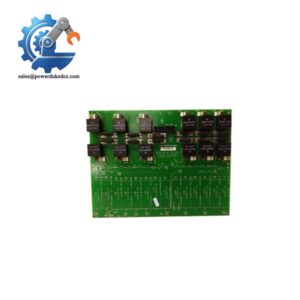
Power distribution is often the first place to look when several Mark VIe I/O packs disappear simultaneously. The GE IS400JPDHG1ABB is a JPDH high-density distribution assembly designed to fan out 28 VDC control power to multiple Mark VIe I/O packs and Ethernet switches. GE documentation identifies the JPDH family as part of the Mark VIe/Mark VIeS power-distribution architecture, with three redundant power feeds and DIN-rail installation.
The board is a passive power-distribution element rather than a controller or communication processor. Its value is in power segmentation: 24 individual I/O-pack branches are divided across the R, S, and T feeds, while dedicated outputs support Ethernet switches. That arrangement helps prevent a single downstream branch fault from removing power from every connected device (the board itself does not execute control logic).
Core Technical Specifications
| Parameter | Specification |
|---|---|
| Manufacturer | GE |
| Part Number | IS400JPDHG1ABB |
| Product Family | Mark VIe / Mark VIeS |
| Product Type | High-Density Power Distribution Board |
| Designation | JPDH |
| Nominal Input | 28 VDC |
| Power Inputs | R / S / T redundant feeds |
| I/O Pack Outputs | 24 |
| Ethernet Switch Outputs | 3 |
| I/O Branch Allocation | 8 branches per R/S/T feed |
| Branch Protection | Positive-temperature-coefficient (PTC) protection |
| Daisy-Chain | J1X unfused expansion connection |
| Input Connector | 6-pin J1 for the three power feeds and returns |
| Maximum Current per Pin | 13 A |
| Mounting | DIN rail |
| Cooling | Convection |
| Safety Classification | Applicable Class I Division 2 / Zone 2 / ATEX configurations exist within the JPDH family; exact certification depends on the complete installed system. |
| Operating Temperature | -40°C to +70°C |
| Storage Temperature | -40°C to +85°C |
| Dimensions | Approximately 16.5 × 15.2 × 11.4 cm for the JPDH module family configuration documented in Mark VIe materials |
| Firmware | None; passive distribution hardware |
GE-associated technical material specifies the JPDH architecture as a 28 VDC distribution device with 24 I/O-pack outputs plus three Ethernet-switch outputs. GE’s HazLoc guide identifies IS400JPDHG1A as part of the JPDH family and gives the family environmental rating of -40°C to +70°C.
One important identification point: GE certification records list the distributor-board configuration as IS410JPDHG1A, while the underlying drawing/BOM references IS400JPDHG1ABB. The relationship is therefore documented, but the exact suffix and revision should still be verified from the installed board label before ordering.
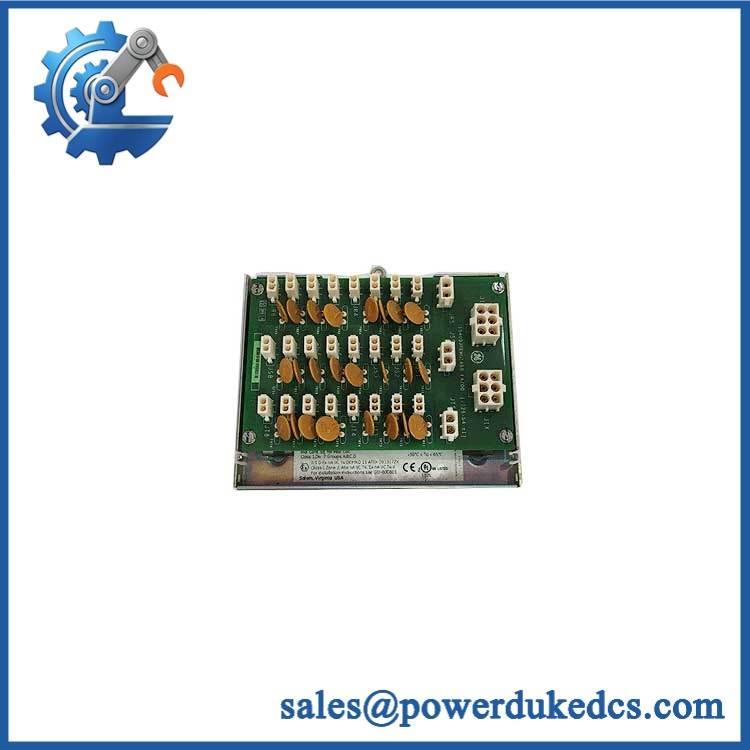
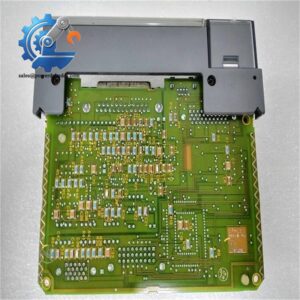
GE IS400JPDHG1ABB
Application Scenarios & Pain Points
Gas and Steam Turbine Control
A large Mark VIe cabinet can require power for many distributed I/O packs at the same time. The JPDH architecture provides 24 dedicated I/O-pack power circuits, making it suitable for dense turbine control installations where distributed power wiring would otherwise become difficult to manage.
Triple-Redundant Control Power
The R/S/T arrangement is intended for high-availability Mark VIe architectures. Each feed supplies a portion of the branch circuits, so technicians should verify all three incoming sources when multiple I/O packs show loss of power.
Turbine Retrofit Projects
Older control cabinets may contain mixed generations of Mark VI and Mark VIe hardware. The JPDH is particularly relevant where an existing power-distribution architecture needs high-density 28 VDC distribution for newer Mark VIe I/O packs rather than a simple terminal-block replacement.
Oil & Gas and Classified Locations
GE HazLoc documentation includes JPDH assemblies within Mark VIe and Mark VIeS classified-location equipment. The applicable wiring method, enclosure, source protection, and certification combination must match the installation; the board’s catalog identity alone does not authorize hazardous-location use.
High Cabinet Temperature
A power-distribution board operating in a cabinet above 50°C deserves closer attention to conductor ampacity, terminal condition, and upstream protection. Do not diagnose a board fault without measuring the actual incoming DC voltage and checking branch loading.
Common Error Symptoms & Diagnostic Checks
Symptom: Multiple I/O packs lose power at the same time
→ Diagnosis: Check the affected R/S/T supply feed, J1 connector engagement, upstream power-distribution board, and the corresponding group of eight branch outputs. The JPDH architecture divides 24 outputs into three groups of eight.
→ Action: Replace module after confirming the upstream supply and wiring are healthy.
Symptom: One I/O pack repeatedly powers down while neighboring packs remain operational
→ Diagnosis: Inspect the individual branch wiring, connector, and PTC-protected output circuit. A downstream short or excessive load can isolate one branch without removing power from the rest of the distribution board.
→ Action: Replace module after confirming the downstream I/O pack and cable are not the source of the overload.
Symptom: Ethernet switch remains offline while I/O packs have power
→ Diagnosis: Verify the dedicated Ethernet-switch output circuit and associated branch wiring. The JPDH provides three separate switch-power outputs in addition to its 24 I/O-pack branches.
→ Action: Replace module after confirming the switch itself and the incoming DC supply.
No specific numerical GE fault-code table has been reliably verified for IS400JPDHG1ABB itself; unsupported numeric codes should not be assigned to this passive board.
Cross-Reference & Lifecycle Migration
GE certification documentation directly connects the IS400JPDHG1ABB drawing/BOM family to the IS410JPDHG1A distributor-board designation. This is useful when tracing older cabinet drawings, but it should not be interpreted as permission to substitute any JPDH-family board without verifying the exact revision and system configuration.
The broader Mark VIe power-distribution documentation also lists IS210JPDHG1A, IS400JPDHG1A, IS410JPDHG1A, and IS411JPDHG1A as related JPDH-family part numbers. Similar nomenclature does not by itself establish connector, certification, or revision-level interchangeability.
The public documentation reviewed does not reliably establish a definitive manufacturer EOL date specifically for . For lifecycle management, treat this as a legacy Mark VIe power-distribution component and maintain traceable spare inventory where the installed cabinet still depends on the JPDH architecture.
Recommended buffer-stock approach: For a critical turbine installation, keep at least one tested spare with the exact part number and revision documented. Include the associated upstream power-distribution type and cabinet drawing reference in the inventory record.
Field Engineer’s Tech Notes
Tech Note 1 — Do not start with the I/O pack.
When several packs fail simultaneously, move upstream. Measure the three incoming power feeds at the JPDH before removing downstream modules. A common-feed problem can look like a large I/O failure even though the I/O hardware is healthy.
Tech Note 2 — Respect the branch-current limitation.
The JPDH uses segmented branch protection rather than treating the entire output bank as one undivided load. GE-related documentation identifies a 13 A pin rating, while the individual branch architecture protects downstream circuits. Verify the actual cabinet design and upstream protection before adding or reassigning loads.
Strict QA & Testing SOP
Step 1 — Inbound Inspection
Verify the complete marking, serial/revision information, connector condition, mounting hardware, board coating condition, and evidence of storage or transport damage.
Step 2 — Mechanical Inspection
Inspect J1 and J1X connectors, all field/output connectors, terminal interfaces, DIN-rail mounting hardware, PCB surface condition, and signs of corrosion or previous rework.
Step 3 — Power Input Verification
Apply a controlled 28 VDC source appropriate to the test configuration. Verify the R/S/T input paths individually and confirm correct polarity and return connections before energizing the distribution board.
Step 4 — I/O-Pack Branch Test
Test each of the 24 output circuits under controlled load. Record output voltage and confirm that a simulated downstream fault on one branch does not produce an abnormal loss of the remaining healthy branches.
Step 5 — Ethernet-Switch Output Test
Verify all three dedicated switch-power outputs under representative load conditions.
Step 6 — Daisy-Chain Test
Where the cabinet design uses multiple JPDH boards, verify the J1X expansion path and confirm that adding the downstream distribution board does not create abnormal voltage drop or unexpected branch behavior.
Step 7 — Thermal / Extended Run Test
For critical spare inventory, operate the board on a test fixture for 24 hours or longer. Monitor input current, output voltage stability, connector temperature, and any intermittent branch behavior.
Step 8 — Final QC and Packaging
Record the part number, revision, serial number, all measured electrical values, and test results. Apply ESD protection, protect the connectors against mechanical impact, and package the board in a traceable carton.
QC Documentation: Retain the test report and available test video with the spare inventory record for emergency deployment and MRO audit traceability.
Buyer’s FAQ
Q1. What is GE ?
It is a Mark VIe JPDH high-density power distribution board used to distribute 28 VDC control power to multiple I/O packs and Ethernet switches. GE documentation places the JPDH within the Mark VIe/Mark VIeS power-distribution architecture.
Q2. How many I/O packs can the JPDH support?
The documented JPDH architecture provides 24 I/O-pack output circuits, arranged as eight circuits on each of the R, S, and T feeds, plus three dedicated Ethernet-switch outputs.
Q3. Does contain firmware or application software?
No. It is a passive power-distribution assembly. It does not execute Mark VIe control logic and does not function as an I/O processor.
Q4. What should be checked before purchasing a replacement?
Confirm the , board revision, connector arrangement, cabinet drawing reference, upstream power-distribution architecture, and required certification environment. GE documentation shows a relationship between the IS400 drawing/BOM and the IS410JPDHG1A designation, so exact physical identification is important.



 Start Chat