

Description
- Model: IS420UCSCH1A
- Brand: GE / GE Vernova
- Series: Mark VIe / Mark VIeS
- Part Type: UCSC Controller Module
- Core Function: Executes Mark VIe control applications and provides the controller-side communications platform for distributed I/O and plant-control networks.
- Processor: AMD GX-412HC
- CPU Frequency: 1.2 GHz
- CPU Cores: 4
- Mark VIe Cores: 2
- Memory: 4 GB DDR3-1333
- Storage: 40 GB pSLC SSD, with 16 GB allocated/used in the published configuration
- Ethernet: 6 × 100 Mbps
- Additional Ports: 2 × USB 2.0
- Nominal Input: 24/28 VDC
- Input Range: 18–30 VDC
- Maximum Power: 31 W
- Operating Temperature: -40°C to +70°C
- Cooling: Convection
- Weight: 1,327 g
- Dimensions: Approximately 55 × 150 × 168 mm, excluding mounting bracket.
Product Introduction
A controller failure on a Mark VIe installation can remove the system’s ability to execute application logic even when the distributed I/O hardware remains powered. The GE IS420UCSCH1A is a UCSC controller for Mark VIe and Mark VIeS systems, using an AMD GX-412HC processor at 1.2 GHz, four CPU cores, 4 GB DDR3 memory, and a 40 GB pSLC solid-state drive. GE’s UCSE data sheet places this controller generation within the Mark VIe control architecture and specifies six 100 Mbps Ethernet ports.
The UCSC is a standalone processing platform rather than a conventional rack CPU. Mark VIe distributes I/O through IONet instead of a traditional backplane, so controller replacement requires attention to the application image, controller revision, network configuration, and redundancy architecture—not simply the physical dimensions of the enclosure. GE describes the controller family as running QNX Neutrino and using application-specific control software.
Core Technical Specifications
| Parameter | Specification |
|---|---|
| Manufacturer | GE / GE Vernova |
| Part Number | IS420UCSCH1A |
| Product Family | Mark VIe / Mark VIeS |
| Product Type | UCSC Controller |
| Processor | AMD GX-412HC |
| CPU Frequency | 1.2 GHz |
| CPU Cores | 4 |
| Mark VIe Cores | 2 |
| L2 Cache | 2 MB |
| Operating System | QNX 6.5 or QNX 7.1, depending on software configuration |
| Memory Type | DDR3-1333 |
| Memory Capacity | 4 GB |
| ECC Memory | Yes |
| Flash / Storage | 40 GB pSLC SSD |
| Allocated SSD Capacity | 16 GB used/allocated in GE’s published configuration |
| Ethernet Ports | 6 |
| Ethernet Speed | 100 Mbps |
| Console | RJ-45 with adapter |
| USB | 2 × USB 2.0 |
| PROFINET | Yes |
| Power Input | Single, bottom connection |
| Minimum Input Voltage | 18 VDC |
| Nominal Input Voltage | 24/28 VDC |
| Maximum Input Voltage | 30 VDC |
| Maximum Power Consumption | 31 W |
| Cooling | Convection |
| Operating Temperature | -40°C to +70°C |
| Storage Temperature | -40°C to +85°C |
| Humidity | 95% non-condensing |
| Altitude | 1000 m nominal |
| Width | 55 mm |
| Depth | 150 mm, excluding mounting bracket |
| Height | 168 mm, excluding mounting bracket |
| Mounting Bracket | 42 mm wide × 204 mm high × 2 mm thick |
| Weight | 1,327 g |
| NVRAM Capability | ControlST V07.05 and later supports 6,139 non-volatile program variables, 338 forces, and 128 totalizers |
| Reverse-Polarity Protection | Provided |
| Surge Protection | Non-replaceable 4 A, 125 VDC rated fuse |
The processor, memory, storage, communications, electrical, and mechanical values above are from GE’s published UCSE specification table. The separate vendor specification also independently identifies IS420UCSCH1A as a four-core 1.2 GHz UCSC controller with 4 GB memory, 40 GB pSLC storage, six Ethernet ports, and 31 W maximum power consumption.
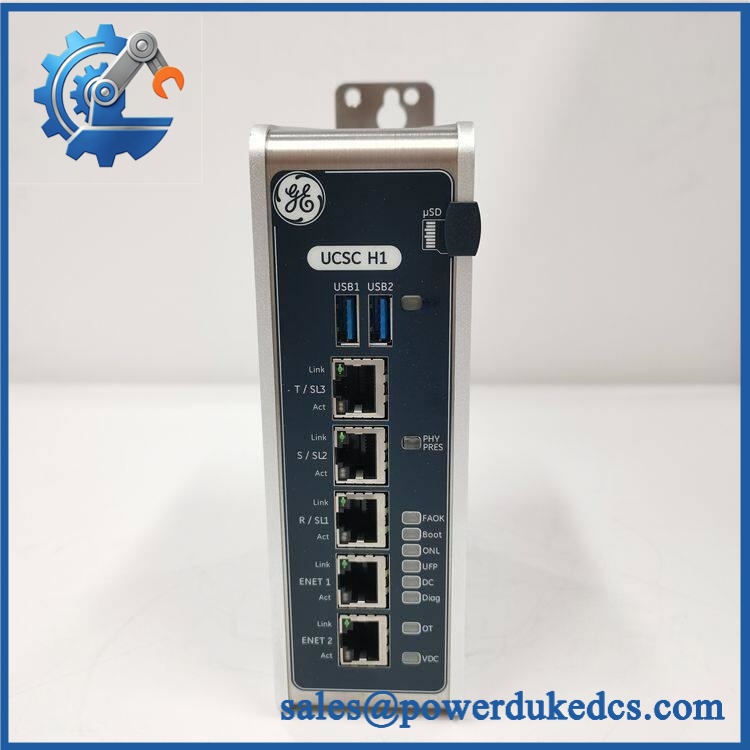
GE IS420UCSCH1A
Application Scenarios & Pain Points
Gas and Steam Turbine Control
The UCSC platform is intended to execute application-specific Mark VIe control logic in turbine and balance-of-plant applications. GE describes the UCSE/UCSC architecture as a standalone controller that exchanges process I/O data through IONet rather than hosting I/O on a conventional backplane.
Mark VIeS Safety Systems
Mark VIeS uses simplex, dual, and TMR controller architectures depending on the required safety arrangement. IS420UCSCH1A is listed by GE within its certified low-voltage I/O and communication-control equipment family, so the complete system configuration and certification conditions matter when this controller is deployed in a safety application.
Distributed I/O Networks
Six Ethernet ports provide the network-side connectivity required by the UCSC architecture. A controller can therefore remain powered while a communication-side fault prevents expected I/O exchange; troubleshooting must separate processor health from IONet, UDH, and cable-related faults.
Legacy-to-Current Mark VIe Maintenance
The IS420UCSCH1A is a newer UCSC generation than the older IS220UCSAH1A. The change is substantial: the uses a four-core AMD processor, 4 GB DDR3, and SSD storage, whereas the older IS220UCSAH1A uses a PowerQUICC II Pro architecture, 256 MB DDR, and CompactFlash. Treat these as different controller generations rather than drop-in equivalents.
High-Temperature Control Cabinets
GE specifies -40°C to +70°C for the , with convection cooling. A cabinet running near 50°C or higher should still be inspected for restricted airflow, dust accumulation, thermal gradients, and abnormal DC supply behavior before a controller is condemned.
Common Error Codes & Diagnostic Symptoms
Symptom: Controller powers up but Mark VIe application does not become operational
→ Diagnosis: Verify the DC supply, controller boot sequence, storage media, application image, and software baseline. Because the controller executes application-specific logic from its installed software environment, hardware replacement without the correct application configuration may not restore control.
→ Action: Replace module after power, storage, and configuration checks.
Symptom: Multiple I/O devices become unavailable while controller power remains normal
→ Diagnosis: Check the six Ethernet interfaces, network cabling, IONet topology, and switch path before replacing the CPU module. Mark VIe architecture transports I/O data over dedicated Ethernet-based IONet connections.
→ Action: Replace module after isolating the fault to the controller.
Symptom: Repeated controller resets or intermittent loss of application execution
→ Diagnosis: Measure input voltage directly at the controller and check thermal conditions. GE specifies an 18–30 VDC operating range and a maximum power consumption of 31 W; supply instability outside the controller’s expected range can produce misleading processor symptoms.
→ Action: Replace module after confirming the external power system.
No unsupported numerical GE fault codes are assigned here because a controller-wide code table specific to was not reliably verified.
Cross-Reference & Lifecycle Migration
The most important cross-reference is the UCSC family itself. GE’s published architecture groups separately from IS420UCSCH2A and older UCSBH/UCSAH generations. For /B, GE specifies an AMD GX-412HC processor at 1.2 GHz, four CPU cores, 4 GB DDR3 memory, and 40 GB pSLC SSD storage.
The should not be treated as interchangeable with the older IS220UCSAH1A merely because both are Mark VIe controllers. The electrical limits, processing platform, storage architecture, memory, network interface arrangement, and software environment differ materially.
GE’s UCSE documentation also states that the relevant controller generation can communicate with previous-generation Mark VIe controllers, while redundancy interoperability depends on defined controller combinations and the applicable GE technical documentation. Compatibility at the communications level therefore does not necessarily mean mechanical or application-image interchangeability.
A definitive manufacturer EOL date specifically for was not established from the public GE material reviewed. GE’s 2026 certification documentation does, however, continue to list among certified low-voltage I/O and communication-control models. That supports continued documented relevance but should not be interpreted as a guarantee of unrestricted new-production availability.
Spare-stock implication: For a critical Mark VIe or Mark VIeS installation, maintain at least one tested spare matching the exact controller part number and revision. Preserve the software baseline and controller configuration with the inventory record.
Field Engineer’s Tech Notes
Tech Note 1 — Record the software baseline before replacement.
The controller is a computing platform, not a passive terminal assembly. Capture the installed QNX/ControlST environment, application image, network parameters, and controller identification before removing a suspect unit. Otherwise, a physically correct spare can still fail to return the plant to service. GE specifically states that the UCSE platform runs application-specific control software and that ToolboxST programs the host application and board-programmable devices.
Tech Note 2 — Do not compare controllers by CPU count alone.
The has four physical CPU cores but GE identifies two Mark VIe cores in its architecture table. That distinction matters when comparing this controller with newer or older UCS generations.
Strict QA & Testing SOP
Step 1 — Inbound Inspection
Verify the complete part number, serial number, hardware revision, GE markings, connector condition, enclosure condition, and mounting hardware.
Step 2 — Mechanical Inspection
Check the six Ethernet ports, two USB 2.0 ports, RJ-45 console interface, power connector, mounting bracket, ventilation path, and enclosure for damage or previous repair.
Step 3 — DC Power Test
Use a regulated supply within the specified 18–30 VDC range, with 24/28 VDC as the normal test reference. Record startup voltage and current and confirm stable operation.
Step 4 — Boot and Storage Verification
Confirm successful controller startup and inspect the SSD configuration. Record the software/OS baseline and storage identification; do not erase or re-image a unit before its original configuration has been documented.
Step 5 — Ethernet Port Test
Verify all six Ethernet ports using a controlled test network. Check link establishment, packet stability, and expected port behavior at 100 Mbps.
Step 6 — Controller Functional Test
Connect the controller to an appropriate Mark VIe test environment. Verify application execution, controller diagnostics, I/O communications, and network synchronization under a representative configuration.
Step 7 — Extended Run Test
For critical spare inventory, operate the controller for 24 hours or longer while monitoring input voltage, current, processor behavior, network links, enclosure temperature, and unexpected resets.
Step 8 — Final QC and Packaging
Record the complete part number, revision, serial number, software baseline, power measurements, Ethernet-port results, and physical photographs. Apply ESD protection, protect connectors from impact, and package the controller in traceable shock-resistant packaging.
QC Documentation: Retain the functional test report and available test video with the inventory record so the controller can be released quickly during an outage.
Buyer’s FAQ
Q1. What is GE ?
It is a GE Mark VIe/Mark VIeS UCSC controller module used to execute control applications and communicate with distributed I/O and other system components. GE specifies an AMD GX-412HC processor, 1.2 GHz clock, 4 CPU cores, 4 GB DDR3 memory, and 40 GB pSLC SSD storage.
Q2. How many Ethernet ports does have?
The controller has six 100 Mbps Ethernet ports. GE’s specification table also identifies PROFINET capability for the /B generation.
Q3. Is a direct replacement for IS220UCSAH1A?
Not automatically. The two controllers use different processor and storage architectures, different memory technologies, and different hardware generations. Verify the system revision, application software, network topology, and approved replacement path before substitution.
Q4. What should be verified before purchasing?
Confirm the , hardware revision, software compatibility, SSD/storage condition, Ethernet configuration, physical condition, and functional test evidence. For Mark VIeS applications, also confirm that the replacement remains within the approved safety-system and hazardous-location configuration. GE’s current certification documentation lists among its certified control models.


 Start Chat